Overview
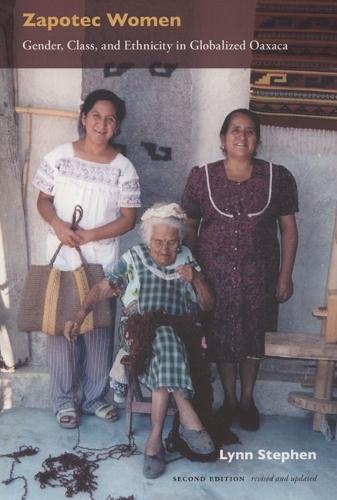
In this extensively revised and updated second edition of her classic ethnography, Lynn Stephen explores the intersection of gender, class, and indigenous ethnicity in southern Mexico. She provides a detailed study of how the lives of women weavers and merchants in the Zapotec-speaking town of TeotitlÁn del Valle, Oaxaca, have changed in response to the international demand for Oaxacan textiles. Based on Stephen’s research in TeotitlÁn during the mid-1980s, in 1990, and between 2001 and 2004, this volume provides a unique view of a Zapotec community balancing a rapidly advancing future in export production with an entrenched past anchored in indigenous culture.Stephen presents new information about the weaving cooperatives women have formed over the last two decades in an attempt to gain political and cultural rights within their community and standing as independent artisans within the global market. She also addresses the place of Zapotec weaving within Mexican folk art and the significance of increased migration out of TeotitlÁn. The women weavers and merchants collaborated with Stephen on the research for this book, and their perspectives are key to her analysis of how gender relations have changed within rituals, weaving production and marketing, local politics, and family life. Drawing on the experiences of women in TeotitlÁn, Stephen considers the prospects for the political, economic, and cultural participation of other indigenous women in Mexico under the policies of economic neoliberalism which have prevailed since the 1990s.
Full Product Details
Author: Lynn Stephen
Publisher: Duke University Press
Imprint: Duke University Press
Edition: 2nd Revised edition
Weight: 0.739kg
ISBN: 9780822336037
ISBN 10: 0822336030
Pages: 408
Publication Date: 17 October 2005
Audience:
Professional and scholarly
,
Professional & Vocational
Format: Hardback
Publisher's Status: Active
Availability: In Print

This item will be ordered in for you from one of our suppliers. Upon receipt, we will promptly dispatch it out to you. For in store availability, please contact us.
Reviews
After it first appeared, Zapotec Women quickly became a must-read in the fields of gender and Latin American studies, and today it can fairly be regarded as a classic. This thoroughly revised edition is a tour-de-force. Not content merely to add a few pages at the beginning or end of chapters, Lynn Stephen has rethought several key conceptual frameworks and reconsidered the changes experienced in Teotitlan del Valle over the past twenty years. -- Matthew C. Gutmann, editor of Changing Men and Masculinities in Latin America This book is a light in the darkness. The author is a brilliant weaver who, with great expertise, intertwines the fine threads of gender, class, ethnicity, nationality, age, and art, rendering a magnificent tapestry. A rigorous anthropology of Zapotec women in a socio-historical context, the work also surprises by contemplating the aesthetic component of the sarapes created by the artisans of Teotitlan del Valle, Oaxaca. --Eli Bartra, editor of Crafting Gender: Women and Folk Art in Latin America and the Caribbean In Zapotec Women, Lynn Stephen presents a complex analysis of stereotypically strong women. She situates women's independence, forged in daily life, in Zapotec tradition that is framed by state sponsored images of 'Mexican Indians' and market transformations that have regional, national, and international dimensions. Stephen's compelling analysis illuminates class, ethnic, and gender relations that are unexpected and contingent. She renders these social processes beautifully, leaving the reader with an appreciation of individual lives in the context of global transformation. --Patricia Zavella, coeditor of Chicana Feminisms: A Critical Reader How wonderful that this second edition of Zapotec Women is available! So well written and blessedly lacking in jargon, it comprehensively explains the evolution of women's cooperatives in Teotitlan, including their interactions with the Mexican state and NGOs, and the effects of transnational forces like NAFTA and increased migration to the United States. --Jean Jackson, coeditor of Indigenous Movements, Self-Representation, and the State in Latin America While the work is listed as a second edition, revised and updated, it has so many significant changes that it could be considered as an entirely new work. The author presents an effective, nuanced analysis that should be refreshing to anyone who enjoys really exploring the reality and identity of women in another culture at the beginning of the twenty-first century. --Peaceful Societies
After it first appeared, Zapotec Women quickly became a must-read in the fields of gender and Latin American studies, and today it can fairly be regarded as a classic. This thoroughly revised edition is a tour-de-force. Not content merely to add a few pages at the beginning or end of chapters, Lynn Stephen has rethought several key conceptual frameworks and reconsidered the changes experienced in Teotitlan del Valle over the past twenty years. -- Matthew C. Gutmann, editor of Changing Men and Masculinities in Latin America This book is a light in the darkness. The author is a brilliant weaver who, with great expertise, intertwines the fine threads of gender, class, ethnicity, nationality, age, and art, rendering a magnificent tapestry. A rigorous anthropology of Zapotec women in a socio-historical context, the work also surprises by contemplating the aesthetic component of the sarapes created by the artisans of Teotitlan del Valle, Oaxaca. --Eli Bartra, editor of Crafting Gender: Women and Folk Art in Latin America and the Caribbean In Zapotec Women, Lynn Stephen presents a complex analysis of stereotypically strong women. She situates women's independence, forged in daily life, in Zapotec tradition that is framed by state sponsored images of 'Mexican Indians' and market transformations that have regional, national, and international dimensions. Stephen's compelling analysis illuminates class, ethnic, and gender relations that are unexpected and contingent. She renders these social processes beautifully, leaving the reader with an appreciation of individual lives in the context of global transformation. --Patricia Zavella, coeditor of Chicana Feminisms: A Critical Reader How wonderful that this second edition of Zapotec Women is available! So well written and blessedly lacking in jargon, it comprehensively explains the evolution of women's cooperatives in Teotitlan, including their interactions with the Mexican state and NGOs, and the effects of transnational forces like NAFTA and increased migration to the United States. --Jean Jackson, coeditor of Indigenous Movements, Self-Representation, and the State in Latin America While the work is listed as a second edition, revised and updated, it has so many significant changes that it could be considered as an entirely new work. The author presents an effective, nuanced analysis that should be refreshing to anyone who enjoys really exploring the reality and identity of women in another culture at the beginning of the twenty-first century. --Peaceful Societies
After it first appeared, Zapotec Women quickly became a must-read in the fields of gender and Latin American studies, and today it can fairly be regarded as a classic. This thoroughly revised edition is a tour de force. Not content merely to add a few pages at the beginning or end of chapters, Lynn Stephen has rethought several key conceptual frameworks and reconsidered the changes experienced in Teotitlan del Valle over the past twenty years. - Matthew C. Gutmann, editor of Changing Men and Masculinities in Latin America How wonderful that this second edition of Zapotec Women is available! So well written and blessedly lacking in jargon, it comprehensively explains the evolution of women's cooperatives in Teotitlan, including their interactions with the Mexican state and NGOs, and the effects of transnational forces like NAFTA and increased migration to the United States. -Jean Jackson, coeditor of Indigenous Movements, Self-Representation, and the State in Latin America In Zapotec Women, Lynn Stephen presents a complex analysis of stereotypically strong women. She situates women's independence, forged in daily life, in Zapotec tradition that is framed by state-sponsored images of 'Mexican Indians' and market transformations that have regional, national, and international dimensions. Stephen's compelling analysis illuminates class, ethnic, and gender relations that are unexpected and contingent. She renders these social processes beautifully, leaving the reader with an appreciation of individual lives in the context of global transformation. -Patricia Zavella, coeditor of Chicana Feminisms: A Critical Reader This book is a light in the darkness. The author is a brilliant weaver who, with great expertise, intertwines the fine threads of gender, class, ethnicity, nationality, age, and art, rendering a magnificent tapestry. A rigorous anthropology of Zapotec women in a socio-historical context, the work also surprises by contemplating the aesthetic component of the sarapes created by the artisans of Teotitlan del Valle, Oaxaca. -Eli Bartra, editor of Crafting Gender: Women and Folk Art in Latin America and the Caribbean [M]ore than seventy pages have been added to the new edition [of Zapotec Women], including new narrative, new analysis, new photographs, new tables, and new reference matter... Ultimately, this new book is richer because it too has a history. In fact, Zaptoec Women, is now positioned as an unfolding story, a serial account of the world created by Zapotec women and North American anthropologists that will change, grow, shrink, and expand as long as people are involved in an exchange of political, economic, and cultural goods and ideas. Given the violent summer of 2006 and the unresolved political conflicts in Oaxaca, there is a renewed urgency to read this volume. -- Patrick McNamara, The Americas
Author Information
Lynn Stephen is Distinguished Professor of Anthropology at the University of Oregon. She is the author of several books, including Zapata Lives! Histories and Cultural Politics in Southern Mexico; Women and Social Movements in Latin America: Power from Below; and Hear My Testimony: MarÍa Teresa Tula, Human Rights Activist of El Salvador.