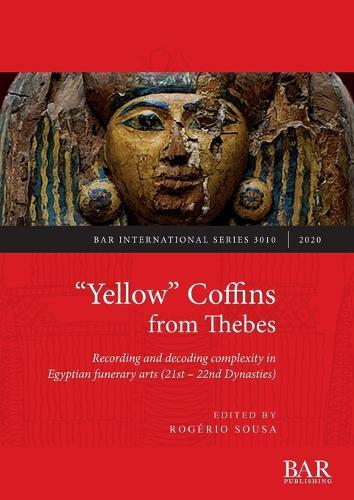
""Yellow"" Coffins from Thebes: Recording and decoding complexity in Egyptian funerary arts (21st - 22nd Dynasties)

Author:   Rogério Sousa
Publisher:   BAR Publishing
ISBN:  

9781407357447


Pages:   248
Publication Date:   26 November 2020
Format:   Paperback
Availability:   Available To Order   Availability explained
We have confirmation that this item is in stock with the supplier. It will be ordered in for you and dispatched immediately.

Our Price $245.92 Quantity:  
Add to Cart

Share |

""Yellow"" Coffins from Thebes: Recording and decoding complexity in Egyptian funerary arts (21st - 22nd Dynasties)


Overview

Full Product Details

Author:   Rogério Sousa
Publisher:   BAR Publishing
Imprint:   BAR Publishing
Weight:   0.989kg
ISBN:  

9781407357447


ISBN 10:   1407357441
Pages:   248
Publication Date:   26 November 2020
Audience:   Professional and scholarly ,  Professional & Vocational
Format:   Paperback
Publisher's Status:   Active
Availability:   Available To Order   Availability explained
We have confirmation that this item is in stock with the supplier. It will be ordered in for you and dispatched immediately.

Table of Contents

"Acknowledgements Foreword 1. Anthropoid coffins before the ""yellow"" type Rogério Sousa 1.1. Typology of anthropoid coffins a. Mummiform coffins b. Feathered (or rishi) coffins c. ""Festive dress"" coffins d. ""Proto-yellow"" coffins 1.2. Decoration a. Rishi coffins b. Mummiform coffins c. ""Festive dress"" type d. Proto-yellow type e. Coffins and visual culture 2. ""Yellow"" coffins: definition and typology Rogério Sousa 2.1. The scheme of decoration of the ""yellow"" type 2.2. Genealogy and evolution 2.3. Typology of the ""yellow"" type Headboard Upper section Central panel Lower section: Central partition Lower section: Lateral partitions Footboard 2.4. Classification of lids and mummy-covers 3. The coffin set of Heritubekhet at the Staatliche Sammlung für Ägyptische Kunst in Munich Rogério Sousa 3.1. Lid Iconography Inscriptions 3.2. Case Iconography Inscriptions 3.3. Mummy-cover Iconography Inscriptions 3.4. Commentary 4. The coffin set of Tabasety at the Antikmuseet of the University of Aarhus Rogério Sousa 4.1. Lid Iconography Inscriptions 4.2. Case Iconography Inscriptions 4.3. Mummy-cover Iconography Inscriptions 4.4. Commentary 5. The mummy-cover from Bab el-Gasus at the Bohusläns Museum in Uddevalla Rogério Sousa Iconography Inscriptions Commentary 6. The mummy-cover of Mutemuia at the University Museum of Aberdeen Rogério Sousa Iconography Inscriptions Commentary 7. The coffin set of Henuttaui at the Staatliche Sammlung für Ägyptische Kunst in Munich Rogério Sousa 7.1. Lid Iconography Inscriptions 7.2. Case Iconography (exterior) Iconography (interior) Inscriptions 7.3. Mummy-cover Iconography Inscriptions 7.4. Commentary 8. The coffin set of Amenniutnakht in Cairo: a case study of a 21st Dynasty burial assemblage Luca Miatello and Mahmoud M. Ibrahim 8.1. Description of decoration and texts on the lid (CG 6174) a. Headboard and upper section b. Central panel (CP) c. Lower section Central partition Lateral partitions Footboard (FB). 8.2. Description of iconography and texts on the exterior of the case (CG 6173) Headboard (HBe) Right column Left column Footboard (FBe) Right side Left side 8.3. Description of the decoration on the interior of the case (CG 6173) Floorboard (FLB). Headboard interior (HBi) Side walls 8.4. Description of decoration and texts on the mummy-cover (CG 6196) Headboard and upper section Central Panel (CP) Lower section Footboard (FB) 8.5. Observations on iconography and texts of the lid (CG 6174) 8.6. Observations on iconography and texts of the exterior of the case (CG 6173) 8.7. Observations on the decoration of the interior of the case (CG 6173) 8.8. Observations on iconography and texts of the mummy-cover (CG 6196) 8.9. Writing style in the coffin of Amenniutnakht 8.10. Additional components in the burial equipment of Amenniutnakht Mummy braces with tabs and pendant (location unknown). 8.11. Observations on the burial assemblage of Amenniutnakht 8.12. Conclusions 9. The Coffin set of Hori from Bab el-Gasus (21st Dynasty): royal attributes and deification scenes Hala Mostafa 9.1. The Owner, Hori 9.2. The coffin set Outer coffin Inner coffin Innermost coffin 9.3. The unique scenes of Hori's coffin set Hori as a king Hori as a deity 9.4. Conclusion 10. Burial ensemble of Ankhef in the collection of the Ivanovo Regional Art Museum (Russia) Vladimir Bolshakov 10.1. Coffin a. General description. b. State of preservation c. Evidence of re-use d. Lid Upper section (A). (Figs 10.10-10.11) Central panel (B) (Fig. 10.14) Lower section Footboard (E). Inscriptions of the lid e. Case Headboard (A). Right wall (B) Left wall (C). 10.2. Mummy-cover a. General description. b. State of preservation. c. Evidence of re-use. d. Scenes and Inscriptions. Headboard (A). Central panel (registers B-C). Lower section (D). 10.3. Additional remarks. Annex. Inscriptions on the coffin and the mummy-cover of Ankhef 11. An unusual Third Intermediate Period Egyptian coffin at the Wayne County Historical Museum (WCHM) Bonnie M. Sampsell 11.1. Lid a. Iconography Headboard Upper section Central panel Lower section Footboard b. Inscriptions 11.2. Case a. Iconography (exterior) Headboard Sides b. Inscriptions c. Iconography (interior) 11.3. Workshop practices a. Pictorial work b. Carpentry work 11.4. Dating the WCHM coffin 11.5. Placement of WCHM coffin in the TIP corpus 12. Chemical analysis of paints reveals history of an Egyptian coffin at the Wayne County Historical Museum Corinne Eloi Deibel, Michael Deibel, Karen Shank-Chapman, Bonnie M. Sampsell 12.1. Chemical analysis of pigments a. Results of chemical tests Unpainted coffin wood The preparation layer Black paint White paint Yellow paint Red paint Blue paint Green paint Brown paint 12.2. Paint and wood filler in restored areas 12.3. Discussion and conclusions 13. """

Reviews

{\rtf1\ansi\ansicpg1252\deff0\deflang2057{\fonttbl{\f0\fswiss\fprq2\fcharset0 Calibri;}{\f1\fnil\fcharset0 Verdana;}} \viewkind4\uc1\pard\sa160\sl252\slmult1\f0\fs22\lquote A brilliant combination of academic rigor and creative thinking characterizes Rog\'e9rio Sousa\rquote s analyses of the \ldblquote yellow coffins\rdblquote of the Third Intermediate Period and illuminates the decipherment of the complementary texts and iconography of these complex funerary documents.\rquote Professor Lorelei H. Corcoran, University of Memphis\par \par \lquote This volume is a real contribution to the broader topic of coffin studies, and an important one for those who focus on the corpus in question.\rquote Professor Aidan Dodson, University of Bristol\par \pard\f1\fs17\par }


{\rtf1\ansi\ansicpg1252\deff0\deflang2057{\fonttbl{\f0\fswiss\fprq2\fcharset0 Calibri;}{\f1\fnil\fcharset0 Verdana;}} \viewkind4\uc1\pard\sa160\sl252\slmult1\f0\fs22\lquote A brilliant combination of academic rigor and creative thinking characterizes Rog\'e9rio Sousa\rquote s analyses of the \ldblquote yellow coffins\rdblquote of the Third Intermediate Period and illuminates the decipherment of the complementary texts and iconography of these complex funerary documents.\rquote Professor Lorelei H. Corcoran, University of Memphis\par \par \lquote This volume is a real contribution to the broader topic of coffin studies, and an important one for those who focus on the corpus in question.\rquote Professor Aidan Dodson, University of Bristol\par \pard\f1\fs17\par }


"'A brilliant combination of academic rigor and creative thinking characterizes Rogério Sousa's analyses of the ""yellow coffins"" of the Third Intermediate Period and illuminates the decipherment of the complementary texts and iconography of these complex funerary documents.' Professor Lorelei H. Corcoran, University of Memphis 'This volume is a real contribution to the broader topic of coffin studies, and an important one for those who focus on the corpus in question.' Professor Aidan Dodson, University of Bristol"


Author Information

Rogério Sousa is Professor of Egyptology and Ancient History at the Faculty of Humanities of the University of Lisbon. He has been studying coffin decoration during the 21st Dynasty from an art historical perspective, focusing into the principles of composition, symbolism and social significance of coffins in Thebes. Currently he coordinates the Gate of the Priests Project which studies the objects found in the Tomb of the Priests of Amun (Bab el-Gasus) in Thebes. Contributors: Vladimir Bolshakov, Corinne Eloi Deibel, Michael Deibel, Mahmoud M. Ibrahim, Luca Miatello, Hala Mostafa, Bonnie M. Sampsell, Karen Shank-Chapman, Rogério Sousa

Tab Content 6

Author Website:  

Countries Available

All regions
Latest Reading Guide

April RG 26_2


Shopping Cart
Your cart is empty
Shopping cart
Mailing List