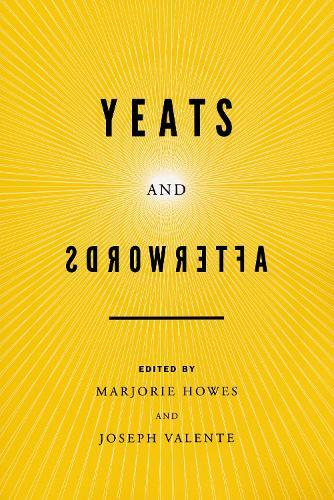
Full Product Details
Author: Marjorie Howes ,
Joseph Valente
Publisher: University of Notre Dame Press
Imprint: University of Notre Dame Press
Dimensions:
Width: 15.20cm
, Height: 2.00cm
, Length: 22.90cm
Weight: 0.526kg
ISBN: 9780268011208
ISBN 10: 0268011206
Pages: 358
Publication Date: 15 September 2014
Audience:
College/higher education
,
Postgraduate, Research & Scholarly
Format: Paperback
Publisher's Status: Active
Availability: To order

Stock availability from the supplier is unknown. We will order it for you and ship this item to you once it is received by us.
Reviews
This ground-breaking collection of essays examines Yeats's sense of historical belatedness as theme, as trope, in formal embodiments such as the afterword, and in his strong critical shaping of literary history. In doing so, it historicizes Yeats's own sense of history with unparalleled depth, while seriously acting on the acceptance that form is itself historical. In showing how Yeats's moulding of the past was also the creation of a future, it offers a range of productive new starting-points for the study of this great poet. --Edward Larrissy, emeritus, Queen's University, Belfast While each of the essays in this volume examine Yeats's belatedness in diverse and unique ways, they share a common, unifying theme that provides the book with a clear sense of purpose and order. One of the most valuable things about this book is its inclusivity, suggesting that it will appeal to a variety of Yeats scholars in addition to those working within the broader field of Irish studies. --James Joyce Literary Supplement In Yeats and Afterwords, editors Marjorie Howes and Joseph Valente have collected a compelling selection of essays by twelve of the leading scholars in Irish studies around the concept of 'belatedness' in the work of W.B. Yeats. Although 'afterwords' and 'belatedness' may seem like conveniently vague rubrics to connect dissimilar essays, Yeats' 'intricate nexus of temporal vectors' is consistently and impressively central to each peace. --James Joyce Quarterly The book offers a dialectical Yeats, and indeed that word recurs throughout, as critical assumptions are trumped by the unresolved dialogue carried in his oeuvre. A stellar cast of latter-day Yeatsians strengthens the case for the resurgence of close reading in Yeats studies. --Times Literary Supplement Marjorie Howes and Joseph Valente's critically important introduction not only suggests that a 'powerful, multilayered sense of cultural belatedness' is key to Yeats' complex literary method, but also teases out the larger significance of this volume, which indeed makes many revealing interventions not only in Yeats studies but also in studies of the Irish Revival, Irish modernism, and contemporary Irish poetry. . . Taking the theme of 'belatedness'. . . what this important volume achieves is to reveal new ways of seeing 'belatedness', revision, temporality and legacy as being central, underpinning factors in Yeats's poetic structures throughout his career. --Irish Studies Review This impressive collection of essays is organized around the theme of 'Yeats's sense of cultural belatedness, ' his tendency to place himself 'at the end' of Romanticism, of the Protestant ascendancy, of a particular cycle of civilization. . . . Several essays offer provocative and competing readings of Yeats's late play Purgatory, and these alone make the volume worth reading. --Choice Yeats and Afterwords. . . brings together twelve of the most prominent Yeats scholars working today to engage this question of Yeatsian temporality. . . . These essays reveal the incredible complexity of Yeats's approaches to time and do so across his long career and through a variety of methodological approaches. Singing by turns of what is 'past, passing, or to come, ' Yeats and Afterwords reveals temporality as the goading challenge and essential mechanism of Yeatsian poetics. --breac: A Digital Journal of Irish Studies This is a superb collection of essays, only one of which, Ronald Schuchard's on Yeats's influence in contemporary Irish poetry, is previously published. The editors' helpful introduction defines the perspective that frames the volume, Yeats's deliberate belatedness. --Irish Literary Supplement Although Yeats and Afterwords focuses broadly on questions of inheritance and legacy, it marks a new departure because it re-conceptualizes belatedness in a more complex and more theoretically useful manner than prior studies. What impressed me most about the collection is that the theoretical paradigms introduced at the outset are at once defining and fluid. The editors conceptualize belatedness in such a way that this insight gives structure to the volume, even as it allows for a multiplicity of readings. This volume will have a major impact on Yeats studies and will be useful for scholars working more broadly in Irish and modernist studies. --Rob Doggett, SUNY Geneseo Overall, Yeats and Afterwords is a focused look at the most prevalent aspect of Yeats' work and offers new connections--and sometimes surprising conclusions--with respect to the way the poet may have understood his own project. The editors thoroughly account for every facet of Yeats' belatedness and the structure of the work crystalizes the interplay across the element of time. --Symploke
This ground-breaking collection of essays examines Yeats's sense of historical belatedness as theme, as trope, in formal embodiments such as the afterword, and in his strong critical shaping of literary history. In doing so, it historicizes Yeats's own sense of history with unparalleled depth, while seriously acting on the acceptance that form is itself historical. In showing how Yeats's moulding of the past was also the creation of a future, it offers a range of productive new starting-points for the study of this great poet. --Edward Larrissy, emeritus, Queen's University, Belfast Although Yeats and Afterwords focuses broadly on questions of inheritance and legacy, it marks a new departure because it re-conceptualizes belatedness in a more complex and more theoretically useful manner than prior studies. What impressed me most about the collection is that the theoretical paradigms introduced at the outset are at once defining and fluid. The editors conceptualize belatedness in such a way that this insight gives structure to the volume, even as it allows for a multiplicity of readings. This volume will have a major impact on Yeats studies and will be useful for scholars working more broadly in Irish and modernist studies. --Rob Doggett, SUNY Geneseo
Overall, Yeats and Afterwords is a focused look at the most prevalent aspect of Yeats' work and offers new connections--and sometimes surprising conclusions--with respect to the way the poet may have understood his own project. The editors thoroughly account for every facet of Yeats' belatedness and the structure of the work crystalizes the interplay across the element of time. --Symploke, Vol. 23, No. 1-2 (2015) In Yeats and Afterwords, editors Marjorie Howes and Joseph Valente have collected a compelling selection of essays by twelve of the leading scholars in Irish studies around the concept of 'belatedness' in the work of W.B. Yeats. Although 'afterwords' and 'belatedness' may seem like conveniently vague rubrics to connect dissimilar essays, Yeats' 'intricate nexus of temporal vectors' is consistently and impressively central to each peace. --James Joyce Quarterly, vol. 53, no. 1, 2014
Overall, Yeats and Afterwords is a focused look at the most prevalent aspect of Yeats' work and offers new connections--and sometimes surprising conclusions--with respect to the way the poet may have understood his own project. The editors thoroughly account for every facet of Yeats' belatedness and the structure of the work crystalizes the interplay across the element of time. --Symploke <p/> In Yeats and Afterwords, editors Marjorie Howes and Joseph Valente have collected a compelling selection of essays by twelve of the leading scholars in Irish studies around the concept of 'belatedness' in the work of W.B. Yeats. Although 'afterwords' and 'belatedness' may seem like conveniently vague rubrics to connect dissimilar essays, Yeats' 'intricate nexus of temporal vectors' is consistently and impressively central to each peace. --James Joyce Quarterly
Author Information
Marjorie Howes is associate professor of English at Boston College. Joseph Valente is UB Distinguished Professor of English at SUNY Buffalo.