Overview
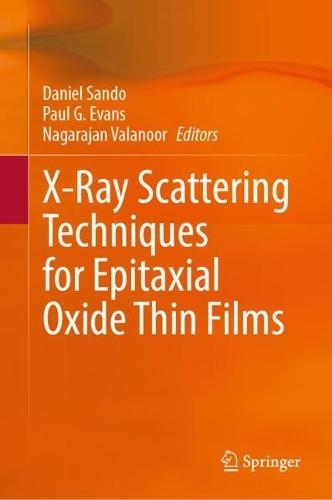
This book acts as a handbook on the topic of x-ray scattering as applied to epitaxial complex oxide films, providing detailed information to collect the data, how to analyze the data and the practical sides of the experiments. The first chapter considers laboratory-based X-ray diffraction (XRD) methods: the indispensable X-ray characterization methods used for phase analysis, epitaxial relationship determination, advanced analytical and data fitting techniques, and grazing incidence diffraction. The subsequent chapters focus on advanced techniques that are typically performed at large-scale facilities such as synchrotrons: diffuse scattering and strain mapping, coherent X-ray methods, magnetic X-ray scattering and dichroism effects, and pump-probe techniques. In addition, detailed characterization methods for complex structures such as oxide superlattices, the measurement of oxygen octahedra rotations, and probing of domain arrangements are covered. The overarching aim of the book is to provide a tutorial-style approach to assist experimentalists actually carrying out their experiments and data analysis. (For instance, the nitty gritty techniques of alignment and experimental setup, along with common mistakes and pitfalls, are often not discussed in textbooks or instruction manuals.). The book is an invaluable tool for the wide range of researchers working globally on ‘oxide electronics,’ serves as a reference text for the many and varied techniques applied to such materials systems, and showcases new advanced methods in x-ray scattering.
Full Product Details
Author: Daniel Sando ,
Paul G. Evans ,
Nagarajan Valanoor
Publisher: Springer Nature Switzerland AG
Imprint: Springer Nature Switzerland AG
ISBN: 9789819659449
ISBN 10: 9819659442
Pages: 186
Publication Date: 12 August 2025
Audience:
Professional and scholarly
,
Professional & Vocational
Format: Hardback
Publisher's Status: Active
Availability: Manufactured on demand

We will order this item for you from a manufactured on demand supplier.
Author Information
Daniel Sando earned his Ph.D. in physics from the Queensland University of Technology (Brisbane, Australia) on experimental laser physics in 2010. Following his Ph.D., he held postdoctoral positions at Unité Mixte de Physique CNRS/Thales (France) and the Center for Correlated Electron Systems (Seoul, South Korea) until 2015. He then joined UNSW Sydney as a research fellow. Since 2022, he has been a senior lecturer at the University of Canterbury. Daniel's research is based on using perovskite oxide thin films in the development of new materials systems for future low-energy computation. Using pulsed laser deposition, his team fabricates thin films (of complex oxide materials including multiferroics, ferroelectrics, optically active materials, and magnetic and topological systems. Paul Evans is a professor of Materials Science and Engineering at the University of Wisconsin-Madison. His research focuses on electronic materials and includes an emphasis on developing and applying x-ray scattering methods making use of the specific properties of synchrotron-radiation and free-electron-laser light sources. Prof. Evans received his Ph.D. in 2000 in Applied Physics from Harvard University and was a postdoctoral researcher at Bell Labs from 2000 to 2002 before moving to UW-Madison. In addition to his research, he teaches at the undergraduate and graduate levels and serves on advisory and proposal review committees for multiple X-ray light sources. Nagarajan Valanoor received his B. Engg in Metallurgy from the University of Pune (1997) and Ph.D. from the University of Maryland (2001) under the supervision of Prof. Ramesh in Materials Science and Engineering, respectively. Following his Ph.D. he continued as a research associate at Maryland until 2003. He followed this with an Alexander von Humboldt Fellowship with Prof. Rainer Waser at Forschungszentrum Juliech. In 2005 he was offered a lectureship at the School of Materials Science and Engineering, where he is currently a professor and postgraduate coordinator. His research focuses on electronic materials, particularly ferroelectric and multiferroic oxides. He is interested in their synthesis, nanoscale characterization, and eventually performance as laboratory-scale functional devices.