Overview
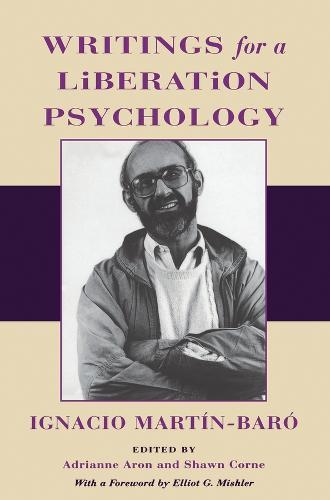
""In your country,"" Ignacio Martín-Baró remarked to a North American colleague, ""it's publish or perish. In ours, it's publish and perish."" In November 1989 a Salvadoran death squad extinguished his eloquent voice, raised so often and so passionately against oppression in his adopted country. A Spanish-born Jesuit priest trained in psychology at the University of Chicago, Martín-Baró devoted much of his career to making psychology speak to the community as well as to the individual. This collection of his writings, the first in English translation, clarifies Martín-Baró's importance in Latin American psychology and reveals a major force in the field of social theory. Gathering essays from an array of professional journals, this volume introduces readers to the questions and concerns that shaped Martín-Baró's thinking over several decades: the psychological dimensions of political repression, the impact of violence and trauma on child development and mental health, the use of psychology for political ends, religion as a tool of ideology, and defining the ""real"" and the ""normal"" under conditions of state-sponsored violence and oppression, among others. Though grounded in the harsh realities of civil conflict in Central America, these essays have broad relevance in a world where political and social turmoil determines the conditions of daily life for so many. In them we encounter Martín-Baró's humane, impassioned voice, reaffirming the essential connections among mental health, human rights, and the struggle against injustice. His analysis of contemporary social problems, and of the failure of the social sciences to address those problems, permits us to understand not only the substance of his contribution to social thought but also his lifelong commitment to the campesinos of El Salvador.
Full Product Details
Author: Ignacio Martín-Baró ,
Adrianne Aron ,
Shawn Corne ,
Elliot G. Mishler
Publisher: Harvard University Press
Imprint: Harvard University Press
Edition: New edition
Dimensions:
Width: 15.60cm
, Height: 1.50cm
, Length: 23.50cm
Weight: 0.336kg
ISBN: 9780674962477
ISBN 10: 0674962478
Pages: 256
Publication Date: 01 September 1996
Audience:
College/higher education
,
Professional and scholarly
,
Undergraduate
,
Postgraduate, Research & Scholarly
Format: Paperback
Publisher's Status: Active
Availability: Out of stock

The supplier is temporarily out of stock of this item. It will be ordered for you on backorder and shipped when it becomes available.
Reviews
Adrianne Aron and Shawn Corne's excellent introduction contextualizes the volume, both within the Salvadoran peasant communities with whom much of Martin-Baro's work was developed and within the academic/intellectual communities to whom it is addressed. The chapters are organized around three major themes, which are, arguably, the major dimensions along which Martin-Baro's work developed: political psychology, war and trauma, and de-ideologizing reality. The selections demonstrate his contributions to social psychology as well as his intense involvement in the social reality of his adoptive country, El Salvador...[This is an] excellent volume. It is required reading for psychologists seeking a more critical psychology--one that takes responsibility for its social position and privilege, and challenges the status quo. It is an equally important resource for those who seek ideas and examples for developing indigenous psychology from the base of marginalized people's lives, in coalition with them. -- M. Brinton Lykes World Psychology
These essays touch on religion as a tool of ideology, the meaning of work and the way in which reality becomes fragmented in a politically repressed society...Those who worked to bring forth these essays have added a measure of justice to his life. -- Richard Higgins Boston Globe Martin-Baro's essays are...characterized by a concreteness and a passion for justice, and they offer tremendous insights into Salvadoran society as well as the struggle for liberation. -- Terry Coonan Human Rights Quarterly Adrianne Aron and Shawn Corne's excellent introduction contextualizes the volume, both within the Salvadoran peasant communities with whom much of Martin-Baro's work was developed and within the academic/intellectual communities to whom it is addressed. The chapters are organized around three major themes, which are, arguably, the major dimensions along which Martin-Baro's work developed: political psychology, war and trauma, and de-ideologizing reality. The selections demonstrate his contributions to social psychology as well as his intense involvement in the social reality of his adoptive country, El Salvador...[This is an] excellent volume. It is required reading for psychologists seeking a more critical psychology--one that takes responsibility for its social position and privilege, and challenges the status quo. It is an equally important resource for those who seek ideas and examples for developing indigenous psychology from the base of marginalized people's lives, in coalition with them. -- M. Brinton Lykes World Psychology
Adrianne Aron and Shawn Corne's excellent introduction contextualizes the volume, both within the Salvadoran peasant communities with whom much of Martin-Baro's work was developed and within the academic/intellectual communities to whom it is addressed. The chapters are organized around three major themes, which are, arguably, the major dimensions along which Martin-Baro's work developed: political psychology, war and trauma, and de-ideologizing reality. The selections demonstrate his contributions to social psychology as well as his intense involvement in the social reality of his adoptive country, El Salvador...[This is an] excellent volume. It is required reading for psychologists seeking a more critical psychology--one that takes responsibility for its social position and privilege, and challenges the status quo. It is an equally important resource for those who seek ideas and examples for developing indigenous psychology from the base of marginalized people's lives, in coaliti
Author Information
Adrianne Aron is a member of the Committee for Health Rights in Central America. Shawn Corne is a member of the Committee for Health Rights in Central America. Elliot G. Mishler is Professor of Social Psychology in the Department of Psychiatry at Harvard Medical School.