Overview
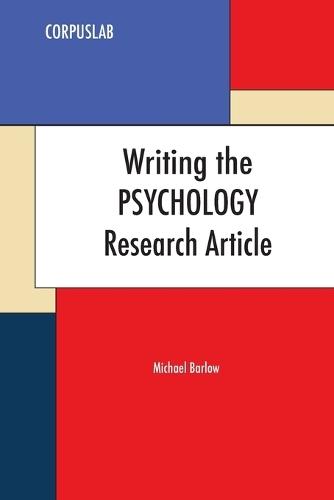
What do published psychology writers actually do? Not what textbooks say they should do-what they actually do, sentence by sentence, section by section, across hundreds of peer-reviewed articles? Using a text corpus, Writing the Psychology Research Article answers that question with data. Drawing on a purpose-built corpus of 231 psychology research articles comprising over 1.6 million words, this book reveals the hidden architecture of successful academic writing in psychology: the recurring rhetorical moves, preferred constructions, and frequency patterns that published writers implicitly rely on. The findings are striking. When psychology writers transition from reviewing literature to announcing their own study, they overwhelmingly reach for the phrase ""In the present study""-a construction so dominant it appears at a rate unmatched by any competing alternative. When they report statistical findings, they follow a consistent three-part template. When they hedge in the Discussion, they draw on a small, predictable set of constructions. These aren't rules pulled out of the air; they're patterns that emerge when you let the data speak. The book is organized into eleven units across four parts. Part 1 maps the rhetorical moves writers make within each major section-Introduction, Method, Results, Discussion, Conclusion, and Abstract-identifying which moves are near-universal and which are optional. The title also covers the macrostructure of Psychology articles. Although Method is rearely used as a heading, the moves described in the book cover what is accomplished under headings such as Experiment 1. Part 2 examines how writers open and close each section, revealing the sentence-level strategies that signal transitions and frame arguments. Part 3 tracks features that shift across the entire paper: tense usage, citation density, and the balance between hedging and boosting. A capstone unit synthesizes everything, showing how the entire article serves a single macro-argument: there is a gap in knowledge, and we fill it. Every frequency, every pattern, and every example sentence comes directly from the corpus. The book is an evidence-based guide that shows writers the full range of options available to them, along with how common each option is. The approach replaces intuition with frequency, making visible the patterns that experienced writers know. Designed for graduate students, early-career researchers, writing instructors, and anyone writing for publication in psychology, this book offers a practical three-step method: conceptualize, consult, compose. The book is particularly valuable for non-native English speakers navigating the conventions of a discipline where rhetorical expectations are strong but rarely made explicit.
Full Product Details
Author: Michael Barlow
Publisher: Athelstan Publications
Imprint: Athelstan Publications
Dimensions:
Width: 15.20cm
, Height: 0.90cm
, Length: 22.90cm
Weight: 0.245kg
ISBN: 9780940753426
ISBN 10: 0940753421
Pages: 130
Publication Date: 09 March 2026
Audience:
General/trade
,
General
Format: Paperback
Publisher's Status: Active
Availability: In Print

This item will be ordered in for you from one of our suppliers. Upon receipt, we will promptly dispatch it out to you. For in store availability, please contact us.