Overview
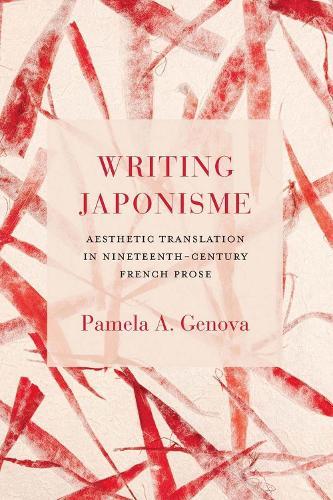
Beginning in the late nineteenth century, French visual artists began incorporating Japanese forms into their work. The style, known as japonisme, spanned the arts. Identifying a general critical move from a literal to a more metaphoric understandingand presentation of japonisme, Pamela A. Genova applies a theory of “aesthetic translation” to a broad response to Japanese aesthetics within French culture. She crosses the borders of genre, field, and form to explore the relationship of Japanese visual art to French prose writing of the mid- to late 1800s. Writing Japonisme focuses on the work of Edmond de Goncourt, Joris-Karl Huysmans, Émile Zola, and Stéphane Mallarmé as they witnessed, incorporated, and participated in an unprecedented cultural exchange between France and Japan, as both creators and critics. Genova’s original research opens new perspectives on a fertile and influential period of intercultural dynamics.
Full Product Details
Author: Pamela A Genova
Publisher: Northwestern University Press
Imprint: Northwestern University Press
Dimensions:
Width: 15.20cm
, Height: 2.50cm
, Length: 22.60cm
Weight: 0.465kg
ISBN: 9780810132191
ISBN 10: 0810132192
Pages: 376
Publication Date: 30 March 2016
Audience:
College/higher education
,
Undergraduate
,
Postgraduate, Research & Scholarly
Format: Paperback
Publisher's Status: Active
Availability: Temporarily unavailable

The supplier advises that this item is temporarily unavailable. It will be ordered for you and placed on backorder. Once it does come back in stock, we will ship it out to you.
Reviews
"""Writing Japonisme is an ambitious book, and one that deserves to be read again and again. Genova's clear prose makes it a pleasure to read, and her grasp of the multiple fields of study that comprise Japonisme is impressive. This book has opened a door to further exploration of the subject in other fields as well; the recurring theme of Japoniste influence on interior design might be one of them... there is much room for continuing the excellent work that Genova has initiated here."" --Journal of Japonisme ""In Writing Japonisme Pamela Genova provides stunning new insights about the nineteenth-century French reception of Japanese culture. A model of interart poetics, the book engages with Japonisme not just as a visual trope, but as a creative and critical model that bridges the visual and the discursive through the concept of 'aesthetic translation.' This erudite and engaging book belongs on the shelf of all those interested in Japonisme, nineteenth-century French studies, and transmedial experimentation.""--Elizabeth Emery, Montclair State University ""Genova has written a superb book that is at once thoroughly scholarly and eminently readable. With its thorough documentation, rich detail, and nuanced analyses... this study deserves the widest possible readership."" --CHOICE ""Genova's study is a thorough and erudite account of Franco-Japanese intercultural and intermedial interactions during the heyday of Japonisme, and shows convincingly how Japonisme continues to shape those same interactions today; it should be read by all those interested in Franco-Japanese relations, nineteenth-century French literature, and the beguiling products of intermedial experimentation."" --Japanese Studies"
In Writing Japonisme Pamela Genova provides stunning new insights about the nineteenth-century French reception of Japanese culture. A model of interart poetics, the book engages with Japonisme not just as a visual trope, but as a creative and critical model that bridges the visual and the discursive through the concept of 'aesthetic translation.' This erudite and engaging book belongs on the shelf of all those interested in Japonisme, nineteenth-century French studies, and transmedial experimentation. Elizabeth Emery, Montclair State University Genova's study is a thorough and erudite account of Franco-Japanese intercultural and intermedial interactions during the heyday of Japonisme, and shows convincingly how Japonisme continues to shape those same interactions today; it should be read by all those interested in Franco-Japanese relations, nineteenth-century French literature, and the beguiling products of intermedial experimentation. --Japanese Studies In Writing Japonisme Pamela Genova provides stunning new insights about the nineteenth-century French reception of Japanese culture. A model of interart poetics, the book engages with Japonisme not just as a visual trope, but as a creative and critical model that bridges the visual and the discursive through the concept of 'aesthetic translation.' This erudite and engaging book belongs on the shelf of all those interested in Japonisme, nineteenth-century French studies, and transmedial experimentation. --Elizabeth Emery, Montclair State University
In Writing Japonisme Pamela Genova provides stunning new insights about the nineteenth-century French reception of Japanese culture. A model of interart poetics, the book engages with Japonisme not just as a visual trope, but as a creative and critical model that bridges the visual and the discursive through the concept of 'aesthetic translation.' This erudite and engaging book belongs on the shelf of all those interested in Japonisme, nineteenth-century French studies, and transmedial experimentation. Elizabeth Emery, Montclair State University
In Writing Japonisme Pamela Genova provides stunning new insights about the nineteenth-century French reception of Japanese culture. A model of interart poetics, the book engages with Japonisme not just as a visual trope, but as a creative and critical model that bridges the visual and the discursive through the concept of 'aesthetic translation.' This erudite and engaging book belongs on the shelf of all those interested in Japonisme, nineteenth-century French studies, and transmedial experimentation. --Elizabeth Emery, Montclair State University
Author Information
Pamela A. Genova is David Ross Boyd Professor of French at the University of Oklahoma, USA.