Overview
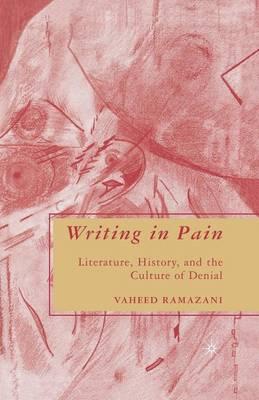
This book argues that while pain is an irreducible neuro-physiological phenomenon, how pain is experienced is powerfully inflected by language and culture. Using Second Empire France after Napoleon III's seizure of power as a particularly revealing time of re-acculturation, it elaborates on the ""culture of denial.""
Full Product Details
Author: V. Ramazani
Publisher: Palgrave Macmillan
Imprint: Palgrave Macmillan
Edition: 1st ed. 2007
Dimensions:
Width: 14.00cm
, Height: 1.10cm
, Length: 21.60cm
Weight: 0.454kg
ISBN: 9781349370245
ISBN 10: 134937024
Pages: 189
Publication Date: 11 October 2015
Audience:
Professional and scholarly
,
Professional & Vocational
Format: Paperback
Publisher's Status: Active
Availability: Manufactured on demand

We will order this item for you from a manufactured on demand supplier.
Reviews
One anticipates future publications by Vaheed Ramazani hopefully and with pleasure. - SubStance The cogency and scope of this challenging but compelling argument about pain and the rhetoric of pain is as breathtaking as its exposition is patient and precise - Ross Chambers, University of Michigan (Emeritus) Ramazani s study measures the cultural resonances of the transformations of 19th century France by looking at an elemental register of human experience, pain. His thesis is arresting: that the cultural processing of pain mirrored and deepened the forms of material stratification and segregation increasingly imposed upon people and increasingly brought to consciousness by the developments that Louis-Napoleon s regime was organizing for France.Ramazani s analysis is theoretically sophisticated; his scholarship is extensive and pertinent. His close readings are ingenious and revealing. This is an important book on a fundamental topic. - Richard Terdiman, Professor of Literature and the History of Consciousness, University of California, Santa Cruz
One anticipates future publications by Vaheed Ramazani hopefully and with pleasure. - SubStance The cogency and scope of this challenging but compelling argument about pain and the rhetoric of pain is as breathtaking as its exposition is patient and precise - Ross Chambers, University of Michigan (Emeritus) Ramazani s study measures the cultural resonances of the transformations of 19th century France by looking at an elemental register of human experience, pain. His thesis is arresting: that the cultural processing of pain mirrored and deepened the forms of material stratification and segregation increasingly imposed upon people and increasingly brought to consciousness by the developments that Louis-Napoleon s regime was organizing for France.Ramazani s analysis is theoretically sophisticated; his scholarship is extensive and pertinent. His close readings are ingenious and revealing. This is an important book on a fundamental topic. - Richard Terdiman, Professor of Literature and the History of Consciousness, University of California, Santa Cruz
One anticipates future publications by Vaheed Ramazani hopefully and with pleasure. - SubStance The cogency and scope of this challenging but compelling argument about pain and the rhetoric of pain is as breathtaking as its exposition is patient and precise - Ross Chambers, University of Michigan (Emeritus) Ramazani s study measures the cultural resonances of the transformations of 19th century France by looking at an elemental register of human experience, pain. His thesis is arresting: that the cultural processing of pain mirrored and deepened the forms of material stratification and segregation increasingly imposed upon people and increasingly brought to consciousness by the developments that Louis-Napoleon s regime was organizing for France.Ramazani s analysis is theoretically sophisticated; his scholarship is extensive and pertinent. His close readings are ingenious and revealing. This is an important book on a fundamental topic. - Richard Terdiman, Professor of Literature and the History of Consciousness, University of California, Santa Cruz
Author Information
VAHEED RAMAZANI is Associate Professor of French, Tulane University.