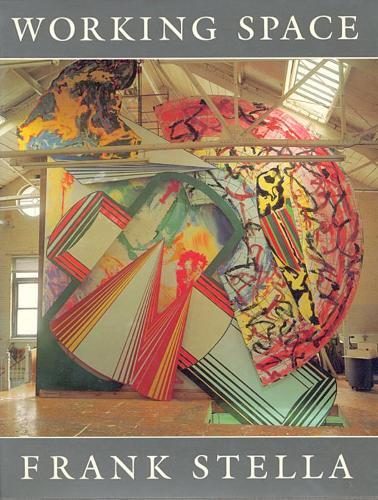
Overview
Working Space affords a rare opportunity to view painting from the inside out, through the eyes of one of the world's most prominent abstract painters. Frank Stella describes his perception of other artists' work, as well as his own, in this handsomely illustrated volume. Stella uses the crisis of representational art in sixteenth-century Italy to illuminate the crisis of abstraction in our time. The artists who followed Leonardo, Michelangelo, Raphael, and Titian searched for new directions to advance their work from beneath the shadow of these great painters. Caravaggio pointed the way. So today, Stella believes, the successors to Picasso, Kandinsky, and Pollock must seek a pictorial space as potent as the one Caravaggio developed at the beginning of the seventeenth century. Stella sees Caravaggio as the pivot on whom painting turns, his consummate illusionism prompting the advance of a more flexible, more ""real"" space that allows painting to move and breathe, to suggest extension and unrestricted motion. Following Caravaggio, Rubens' broad vision of fullness and active volume gave painting a momentum that helped propel it into the nineteenth century, where it came to rest in the genius of Géricault and Manet, themselves the precursors of modern painting. Unfortunately, both contemporary abstract art and figurative painting have become trapped by ambiguous pictorial space and by a misguided emphasis on materiality (pigment for pigment's sake). Pictorial qualities have given way to illustrational techniques. Abstract art has become verbal, defensive, and critical, caught up in theology masquerading as theory. Stella asserts that painting must understand its past, make use of the lucid realism of seventeenth-century Italy, and absorb a Mediterranean physicality to reinforce the lean spirituality of northern abstraction pioneered by Mondrian and Malevich. Working Space will provoke discussion and argument, not least because Stella offers nontraditional evaluations of the works of giants such as Raphael, Titian, Michelangelo, Picasso, and Pollock, as well as lesser-known figures including Annibale Carracci, Paulus Potter, and Morris Louis. The artist's powers of discernment and the profusion of his ideas and opinions will dazzle and engage professionals, amateurs, and students of art.
Full Product Details
Author: Frank Stella
Publisher: Harvard University Press
Imprint: Harvard University Press
Dimensions:
Width: 22.90cm
, Height: 2.00cm
, Length: 27.90cm
Weight: 0.680kg
ISBN: 9780674959613
ISBN 10: 0674959612
Pages: 192
Publication Date: 10 October 1986
Audience:
College/higher education
,
Professional and scholarly
,
Undergraduate
,
Professional & Vocational
Format: Paperback
Publisher's Status: Active
Availability: Out of stock

The supplier is temporarily out of stock of this item. It will be ordered for you on backorder and shipped when it becomes available.
Reviews
Mr. Stella's way of dealing with single paintings, 36 of which are reproduced in color, makes for one tour-de-force after another...Paintings familiar and unfamiliar, from the 'Mona Lisa' to Wassily Kandinsky's 'Composition IX,' gain a just washed sparkle. -- Peter Schjeldahl New York Times Book Review
Mr. Stella's way of dealing with single paintings, 36 of which are reproduced in color, makes for one tour-de-force after another...Paintings familiar and unfamiliar, from the 'Mona Lisa' to Wassily Kandinsky's 'Composition IX,' gain a just washed sparkle. -- Peter Schjeldahl New York Times Book Review Working Space comes as something of a bombshell. For this is a book that explodes a great many received ideas about abstraction...[It] is certainly one of the most remarkable books ever written on the subject. What makes it so remarkable, of course, is that Stella is unquestionably the most celebrated abstract painter of his generation. -- Hilton Kramer The Atlantic It is seldom that a major artist is prepared to commit himself publicly to a considered, large-scale survey of the art of his time, and to relate it moreover to substantial cross-sections of the art of the past. Frank Stella has done this in his Charles Eliot Norton Lectures at Harvard, with considerable erudition, great verve and genuine originality. -- John Golding Times Literary Supplement Working Space develops its thesis with such gusto, elegance, and conviction...The text is rich with insight, integrity, and unexpected rethinkings of erstwhile familiar images. -- David Anfam Art International This is a marvelously insightful and thought-provoking book...Stella's perception of the problem is correct--abstraction has reached a watershed. His analysis of that problem is erudite and plausible, and at times even passionate. If he does not solve it within these pages, he at least has made us consider its ramifications, and he has enabled us to look at art from a valuable and rarely available perspective. -- Edward J. Sozanski Philadelphia Inquirer This is art history and art criticism of a high order, detailed and refreshingly idiosyncratic. Both scholarly and hip, Stella has written a book that reveals the painter's mind and studio, allowing us to see the play of history and vision that goes on within. Highly recommended. -- Calvin Reid Library Journal
In a search for pictorial energy, abstractionist Stella applies his eye to works by Caravaggio, Raphael, Titian, Michelangelo, Picasso, Pollock, Kandinsky, Mondrian, Annabale Carracci, Paulus Potter, and Morris Louis, studying how they handle working space - the space or depth of field in a canvas. The history of painting is seen clearly in how painters have handled space. Caravaggio was the first great rebel, not only seemingly abandoning ideal beauty for the imitation of nature with partly lighted figures in highly charged chiaroscuro, but also in severely limiting the depth of his backgrounds and keeping the picture's plane of focus almost smack into the viewer's face. The effect is as if some great event is taking place about six feet in front of you and nothing beyond this immediate area is important or included. Stella finds working space the place of energy and renewal, the area in which illusionism and representation can be ignored. His own art of abstractionism, coming on the giant heels of the abstract expressionists, avoided this struggle with European modernism and completely severed its roots from any kind of representation. Even Cubism had pretended to some kind of physicality and depth. . . .I made paintings that successfully canceled out their origins. . . I saw a system in front of me that would guarantee the exclusion of painterly gestures which in seemingly abstract paintings always brought the ghost of figuration with them. . . Prolix here and there, but enlightening even for the non-presold. (Kirkus Reviews)
This is art history and art criticism of a high order, detailed and refreshingly idiosyncratic. Both scholarly and hip, Stella has written a book that reveals the painter's mind and studio, allowing us to see the play of history and vision that goes on within. Highly recommended.--Calvin Reid Library Journal
Author Information
Frank Stella was born in 1936 in Malden, Massachusetts, and was educated at Andover and Princeton. An amazingly productive and energetic artist, he has created a large and varied body of work.