Awards
- Nominated for Ed A. Hewett Book Prize 2006
- Nominated for W. Bruce Lincoln Book Prize 2006
- Nominated for Wayne S. Vucinich Book Prize 2006
Overview
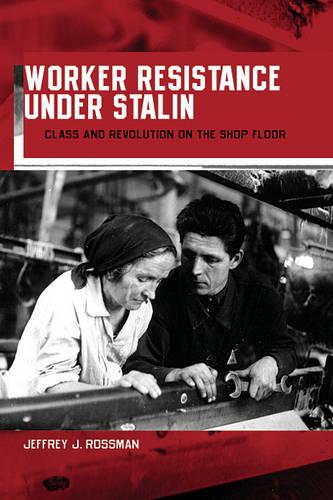
Challenging the claim that workers supported Stalin's revolution ""from above"" as well as the assumption that working-class opposition to a workers' state was impossible, Jeffrey Rossman shows how a crucial segment of the Soviet population opposed the authorities during the critical industrializing period of the First Five-Year Plan. Marshaling an impressive range of archival evidence, Rossman recounts in vivid detail myriad individual and collective acts of protest, including mass demonstrations, food riots, strikes, slowdowns, violent attacks against officials, and subversive letters to the authorities. Male and female workers in one of Russia's oldest, largest, and ""reddest"" manufacturing centers--the textile plants of the Ivanovo Industrial Region--actively resisted Stalinist policies that consigned them to poverty, illness, and hunger. In April 1932, 20,000 mill workers across the region participated in a wave of strikes. Seeing the event as a rebuke to his leadership, Stalin dispatched Lazar Kaganovich to quash the rebellion, resulting in bloodshed and repression. Moscow was forced to respond to the crisis on the nation's shop floors with a series of important reforms. Rossman uncovers a new dimension to the relationship between the Soviet leadership and working class and makes an important contribution to the debate about the nature of resistance to the Stalinist regime.
Full Product Details
Author: Jeffrey J. Rossman
Publisher: Harvard University Press
Imprint: Harvard University Press
Volume: No. 96
Dimensions:
Width: 15.60cm
, Height: 0.30cm
, Length: 23.50cm
Weight: 0.595kg
ISBN: 9780674019263
ISBN 10: 0674019261
Pages: 326
Publication Date: 01 November 2005
Audience:
Professional and scholarly
,
Professional & Vocational
Format: Hardback
Publisher's Status: Out of Stock Indefinitely
Availability: Awaiting stock

Reviews
Jeffrey Rossman's well researched and passionately written book on the resistance of the textile workers to Stalin's industrialization contributes to a number of issues that are the subject of heated debate in the historiography of Stalinism: the mechanisms of a genesis of social resistance to the regime, its extent, effects, dimensions and limits, and the process and sources of the construction of identities. The book explores, among other major issues, the evolution of forms of worker protest; the emergence of patterns of resistance; the impact of workers's struggle on central power policies; the reasons for the failure of shopfloor resistance; the divisions between the workers caused by resistance; the role of a worker leader; and the degree of the (un)development of a political consciousness among workers, to name just a few...Rossman's thorough research in the regional and central archives of Russia has produced a wonderful result--a vivid, intense, colourful and complex story of the worker struggle not just for bread but also for the preservation of the shopfloor democracy and self preservation of the working class as a political group. -- Elena A. Osokina International Review of Social History
Author Information
Jeffrey J. Rossman is Associate Professor of History at the University of Virginia.