Overview
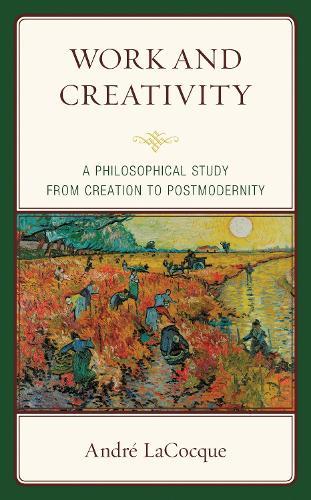
The Bible highly praises human creativity. In fact, work belongs to Adam’s very creation, homo faber in the image of deus faber (Gen. 2:15). Human production is nevertheless seen in the Bible as imbued with an ambiguous value. In Work and Creativity, André LaCocque reflects on the biblical understanding of labor, juxtaposing texts from the book of Genesis with the conceptions of work of psychoanalysts and philosophers such as Sigmund Freud and Karl Marx, and proposing a dialectical approach to human work and creativity.
Full Product Details
Author: André LaCocque
Publisher: Bloomsbury Publishing Plc
Imprint: Lexington Books/Fortress Academic
Dimensions:
Width: 16.20cm
, Height: 1.80cm
, Length: 22.80cm
Weight: 0.390kg
ISBN: 9781978708976
ISBN 10: 1978708971
Pages: 146
Publication Date: 31 December 2019
Audience:
Professional and scholarly
,
Professional & Vocational
Format: Hardback
Publisher's Status: Active
Availability: Manufactured on demand

We will order this item for you from a manufactured on demand supplier.
Reviews
This work is remarkable in several respects. It is one of the very few studies on the theme of work in the Bible, although that theme is front and central in the creation story in Genesis. It is deeply engaged with European philosophy from Hegel to Ricoeur, to a greater degree than any biblical study I can recall. Finally, it articulates a model for a dialectical biblical theology, that rejects any univocal systematizing and insists on ambiguity and paradox. This is the crowning work of a very distinguished career by an urbane and learned scholar. -- John J. Collins, Holmes Professor of Old Testament, Yale University André LaCocque has written an exceedingly subtle book on interpretation. This work has required him to bring into play his astonishing erudition as he mobilizes the great critical tradition of Western philosophy. His text is the tale of origins in Genesis 2-3. His theme is “work” as he ponders, in Genesis 2-3, first human generative work that co-creates with God the creator, and then work as drudgery that lacks any generativity. His method is dialectical, through which he shows that the narrative text will not allow closure or certitude, but only on-going interpretation. LaCocque’s accent on “share faber-ness” of deus faber and homo faber is the pivot of this welcome study. He here brings together a life-time of learning to show how biblical interpretation at its best engages both the resources and challenges of modern thinking. -- Walter Brueggemann, Columbia Theological Seminary
This work is remarkable in several respects. It is one of the very few studies on the theme of work in the Bible, although that theme is front and central in the creation story in Genesis. It is deeply engaged with European philosophy from Hegel to Ricoeur, to a greater degree than any biblical study I can recall. Finally, it articulates a model for a dialectical biblical theology, that rejects any univocal systematizing and insists on ambiguity and paradox. This is the crowning work of a very distinguished career by an urbane and learned scholar. -- John J. Collins, Holmes Professor of Old Testament, Yale University Andre LaCocque has written an exceedingly subtle book on interpretation. This work has required him to bring into play his astonishing erudition as he mobilizes the great critical tradition of Western philosophy. His text is the tale of origins in Genesis 2-3. His theme is work as he ponders, in Genesis 2-3, first human generative work that co-creates with God the creator, and then work as drudgery that lacks any generativity. His method is dialectical, through which he shows that the narrative text will not allow closure or certitude, but only on-going interpretation. LaCocque's accent on share faber-ness of deus faber and homo faber is the pivot of this welcome study. He here brings together a life-time of learning to show how biblical interpretation at its best engages both the resources and challenges of modern thinking. -- Walter Brueggemann, Columbia Theological Seminary
This is interdisciplinary work at its best and is bound to provoke in the reader fruitful reflection, application, and perhaps even labor. * Concordia Journal * This work is remarkable in several respects. It is one of the very few studies on the theme of work in the Bible, although that theme is front and center in the creation story in Genesis. It is deeply engaged with European philosophy from Hegel to Ricoeur, to a greater degree than any biblical study I can recall. Finally, it articulates a model for a dialectical biblical theology, that rejects any univocal systematizing and insists on ambiguity and paradox. This is the crowning work of a very distinguished career by an urbane and learned scholar. -- John J. Collins, Holmes Professor of Old Testament, Yale University André LaCocque has written an exceedingly subtle book on interpretation. This work has required him to bring into play his astonishing erudition as he mobilizes the great critical tradition of Western philosophy. His text is the tale of origins in Genesis 2-3. His theme is “work” as he ponders, in Genesis 2-3, first human generative work that co-creates with God the creator, and then work as drudgery that lacks any generativity. His method is dialectical, through which he shows that the narrative text will not allow closure or certitude, but only on-going interpretation. LaCocque’s accent on “share faber-ness” of deus faber and homo faber is the pivot of this welcome study. He here brings together a lifetime of learning to show how biblical interpretation at its best engages both the resources and challenges of modern thinking. -- Walter Brueggemann, Columbia Theological Seminary LaCocque concludes his new book, Work & Creativity by quoting Paul Ricoeur. “Every tradition lives by grace of interpretation, and it is at this price that it continues, that is, remains living.” There is no more fitting conclusion, as LaCocque also dedicates his latest book to his friend and colleague, Paul Ricoeur with whom he produced Thinking Biblically in 1998. LaCocque models the depth and breadth of a person whose teaching has always been anchored by his own studies and reflection. I do not know another biblical scholar who embraces contemporary ‘intertextuality’ while carefully noting issues in the original biblical Hebrew, classic Greek, Aramaic, and Latin translations. Then insightfully engaging, Karl Marx, the post-Marxist “Frankfurt School of Sociology” (founded in 1923), Emmanuel Levinas, and Sigmund Freud and his disciples. LaCocque has created a rare intellectual feast by dynamically weaving his career-defining biblical insights with a literal library of classic thinkers. -- Rabbi Dr. Joseph A. Edelheit, author of What Am I Missing? Questions About Being Human This breakthrough book proves that biblical studies have much to offer other disciplines, such as psychology and philosophy, and vice versa, and will appeal to scholars in all these disciplines. The topic of labor offers an excellent example of the rich vein of interdisciplinary studies as the way of the academic future. -- Doreen McFarlane, St. Paul’s Evangelical Lutheran Church, Niagara Falls, Ontario In a time in which satisfying work is more and more scarce, in which working people for the majority hate their work, and in which pyramid schemes multiply promises of early retirement to those for whom work has become a chore and a humiliation, LaCocque’s book on work is a fulgurant revelation of humanity’s lost and forgotten identity outlined in Genesis 2 as a homo faber whose task is to nurture and protect the seeds of redemption planted in our world by the Creator, and as such, fully realize His creative project. Drawing on the work of twentieth-century philosophers, psychoanalysts, and sociologists, LaCocque offers a profound re-reading of the creation story and gives us back our sacred vocation and responsibility as co-creators of the world rather than passive victims in an economic context where, increasingly, work has become distorted into modes of oppression rather than of redemption. -- Abi Doukhan, Queens College (City University of New York) LaCocque's dialogue between Genesis and modern thought, between the fruit of the tree in the garden and the fruits of human labor, yields a rare work of deep learning and originality. The dialectical criticism of this book offers striking juxtapositions and poetic reflections that honor, challenge, and connect biblical and philosophical traditions. -- Brian Britt, Virginia Tech
Author Information
André LaCocque is professor emeritus of Hebrew Bible at Chicago Theological Seminary.