Overview
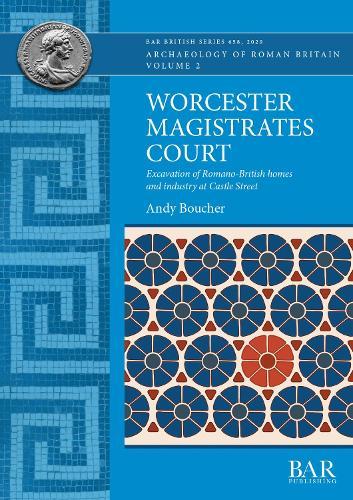
In the summer of 2000 archaeological excavations on the periphery of the Roman 'small town' at Worcester revealed extensive evidence for timber-framed buildings, probably representing the lower status homes of some of the settlement's inhabitants. Major changes during the later Roman period led to much of the site being levelled and a series of gravel and cobbled surfaces being laid out. Several new structures were then built in this area, including a substantial post-built rectangular building, together defining a courtyard associated with a number of hearths, thought to be part of a smithy complex. It may even have formed one element of a wider 'light industrial' zone of the settlement, with evidence for pottery production and other metalworking in the vicinity. This volume presents the results of this work, setting it in the context of increasing archaeological investigation of Roman Worcester, which together is transforming our understanding of the settlement.
Full Product Details
Author: Andy Boucher
Publisher: BAR Publishing
Imprint: BAR Publishing
Weight: 0.957kg
ISBN: 9781407357041
ISBN 10: 1407357042
Pages: 240
Publication Date: 29 October 2020
Audience:
Professional and scholarly
,
Professional & Vocational
Format: Paperback
Publisher's Status: Active
Availability: Available To Order 
We have confirmation that this item is in stock with the supplier. It will be ordered in for you and dispatched immediately.
Table of Contents
List of illustrations List of tables Abstract 1. Introduction Andy Boucher 1.1. Background to the work 1.2. Geology, topography and drainage 1.3. The nature of the archaeological record 2. Roman Worcester and its regional setting Andy Boucher and Alex Smith 2.1. Regional overview The development of nucleated centres in the region Rural occupation in the region Roman industry 2.2. Roman Worcester 3. Results of the excavations Andy Boucher 3.1. Natural deposits and features 3.2. Phase 1 - early deposits and features (c AD 100-175) Phase 1a - enclosure Boundary/enclosure and associated features (G1, G3, G125, G148) Oven and associated features (G7, G8) Phase 1b - changes to the enclosure boundary Circular structure (G31) Burnt or industrial features (G85, G89, G109, G151, G156, G157) Ovens with stake-holes (G63, G64) Features to the north of the boundary ditch (G52) 3.3. Phase 2 - establishment of rectilinear structures within the site (c AD 125-225) Early east-west aligned structure in the south-west part of the site (G149) Rectangular structures (G10, G53, G54, G145) (early-mid-2nd century) Rebuilt structure (G11, G98) (late 2nd century) Structure and associated industry in the south-west part of the site (G88, G111, G112) (late 2nd century) Associated industrial activity (G17, G30, G44, G59, G60, G80, G128) (mid-2nd century) Well (G120) Cremation burial (G126) Pits and other cut features (G65, G114, G127) 3.4. Phase 3 - terracing of the site (c AD 250-320) Soil layers in the south-west corner of the site Main surface and patching (G19) Possible gravel base for a small rectangular structure Impressions in the gravel for rectilinear structures (G16, G200, G18) 3.5. Phase 4 - industry and occupation (c AD 250-320) Cess pit (G141) Workshop in the south-west part of the site (G5, G15, G24, G25, G41, G43, G45, G129, G134, G137) Other industrial activity (G26, G123, G124, G142) Sandstone footing (G131) Associated industrial features (G138, G139, G140) Wheel ruts on the main surface (G143, G161) Other pits (G95, G121, G147) 3.6. Post-Roman archaeology 4. The pottery Jeremy Evans and Margaret Ward with contributions by Phil Mills and Brenda Dickinson 4.1. Introduction and methods 4.2. Taphonomy 4.3. Chronology Phase 1 Phase 2 Phase 3 Phase 4 4.4. Fabrics Class A, amphorae Class B, black burnished wares Class C, shell-tempered ware Class F, colour-coated wares Class G, gritted wares Class M, mortaria Class O, oxidised wares Class Q, white-slipped oxidised wares Class R, reduced wares Class S, samian wares Forms, products and condition South Gaulish wares Central Gaulish ware East Gaulish ware Graffiti Wear and repair Re-working and re-use Further discussion of samian ware Class W, whitewares 4.5. Functional and fineware analysis 4.6. Repaired vessels 4.7. Burnt and sooted vessels 4.8. Discussion of pottery Supply Status 5. The finds Lynne Bevan, Andy Boucher, Kath Crooks, Peter Guest, Martin Henig, Julie Lochrie, Paul Olver, Peter Thomso 5.1. Introduction and Summary 5.2. Coins 5.3. Copper alloy Jewellery and personal items Toilet instruments Other items 5.4. Iron Iron objects Hobnails and nails 5.5. Ceramic 5.6. Vessel and window glass Blue-green glass bottles Other blue-green vessels Pale green vessels Colourless vessel Window glass 5.7. Stone Querns Upper stones Lower stones Whetstone Furniture fragment 5.8. Ceramic building materials Brick and tile Fired clay 5.9. Ironworking residues Slag Magnetic micro-residues Discussion of ironworking residues 6. Environmental evidence Callista Vink, Andy Hammond, Elizabeth Pearson, David Jordan and Andy Boucher 6.1. Faunal remains Methodology Preservation Residuality and contamination Fragmentation Results of analysis Cattle Sheep/goat Pig Horse Dog Deer Birds Other Discussion of the animal bone 6.2. Charred plant remains Methods Results Discussion of the plant remains 6.3. Sediments Natural sands Buried soil beneath cobbles in eastern area 'Dark earth' layer exposed in the southern section Discussion of the sediments 7. The human bone Jacqueline I McKinley, Dr P Nystrom, O Craig and S Isaksson 7.1. Cremated bone and aspects of the mortuary rite Disturbance and condition The dead Cremation Bone weight Fragmentation Skeletal elements Pyre goods and debris Burial formation process Conclusion 7.2. Analysis of residues in the cremation vessel 7.3. Other human bone 8. Archaeomagnetic dating Paul Linford 9. Interpretation of the archaeology within the site Andy Boucher 9.1. Date of occupation and activity 9.2. Nature of occupation Phase 1 Phase 2 Phase 3 Phase 4 10. The site, Roman Worcester and smithing Andy Boucher and Alex Smith Bibliography Appendix 1 - Pottery fabric descriptions Jeremy Evans and Phil Mills Appendix 2 - Fabric occurrence by phase Jeremy Evans and Phil Mills Appendix 3 - Catalogue of potter
Reviews
{\rtf1\ansi\ansicpg1252\deff0\deflang2057{\fonttbl{\f0\fswiss\fprq2\fcharset0 Calibri;}{\f1\fnil\fcharset0 Verdana;}} \viewkind4\uc1\pard\sa160\sl252\slmult1\f0\fs22\lquote The report represents an important new \ldblquote piece\rdblquote in the jigsaw of Roman Worcester, adding to a number of recent publications on excavations in the \ldblquote northern suburbs\rdblquote of the settlement\rquote . Jane Evans, Worcestershire Archive and Archaeology Service \par \pard\f1\fs17\par }
{\rtf1\fbidis\ansi\ansicpg1252\deff0\deflang2057{\fonttbl{\f0\fswiss\fprq2\fcharset0 Calibri;}{\f1\fnil\fcharset0 Verdana;}} \viewkind4\uc1\pard\ltrpar\lang1033\f0\fs22\lquote Andy Boucher, Headland Archaeology UK Ltd and the post excavation team should be congratulated, therefore, for ensuring that this important contribution to the understanding of Roman Worcester has now been published.\rquote Victoria Bryant, Worcestershire Recorder, Vol 103 (2021)\lang2057\par \pard\ltrpar\sa160\sl252\slmult1\par \lquote The report represents an important new \ldblquote piece\rdblquote in the jigsaw of Roman Worcester, adding to a number of recent publications on excavations in the \ldblquote northern suburbs\rdblquote of the settlement\rquote . Jane Evans, Worcestershire Archive and Archaeology Service \par \pard\ltrpar\f1\fs17\par }
Author Information
Andy Boucher is the Director of Commercial Operations at Headland Archaeology and has been working in commercial archaeology since 1986. He has overseen the excavation of a number of prehistoric sites, provided advice on historic buildings, developed projects to record large-scale industrial landscapes and undertaken excavations on deeply stratified sites of Roman, Saxon and medieval date.
Tab Content 6
Author Website:
Countries Available
All regions
|