Overview
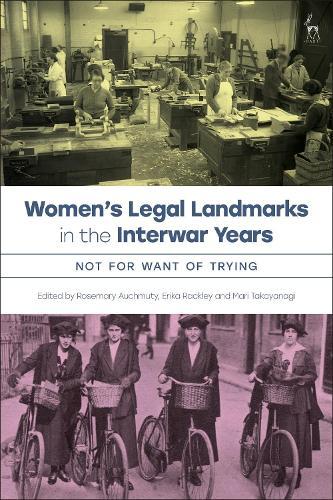
Women’s Legal Landmarks in the Interwar Years shines new light on 33 legal landmarks, many forgotten today, that affected women in England and Wales between 1918 and 1939. It considers the work of feminist activists to bring about legal change which benefited – or aimed to benefit – women. Areas explored include property, inheritance, adoption, marriage, access to health care, criminal law, employment opportunities, pay, pensions and political representation. It also examines campaigns by key women’s organisations, and assesses the impact of early women lawyers and politicians. While some of the landmarks effected change during this period, others provided the foundation for measures in later decades. Together the landmarks demonstrate that far from being a relatively quiet period of British feminism, the interwar period played a key role in ongoing fights for recognition, representation and justice.
Full Product Details
Author: Professor Rosemary Auchmuty (University of Reading, UK) , Erika Rackley (University of Birmingham, UK) , Mari Takayanagi (The Parliamentary Archives, UK)
Publisher: Bloomsbury Publishing PLC
Imprint: Hart Publishing
Dimensions:
Width: 15.60cm
, Height: 2.50cm
, Length: 23.40cm
Weight: 0.454kg
ISBN: 9781509969760
ISBN 10: 1509969764
Pages: 312
Publication Date: 12 February 2026
Audience:
Professional and scholarly
,
College/higher education
,
Professional & Vocational
,
Tertiary & Higher Education
Format: Paperback
Publisher's Status: Forthcoming
Availability: Manufactured on demand 
Table of Contents
1. Women’s Legal Landmarks in the Interwar Years Rosemary Auchmuty (University of Reading, UK), Erika Rackley (University of Kent, UK), Mari Takayanagi (Parliamentary Archives, UK) The Landmarks 2. Parliament (Qualification of Women) Act 1918 Mari Takayanagi (Parliamentary Archives, UK) 3. Constance Georgine Markiewicz, First Woman Elected to Parliament, 1918 Aoife O’Donoghe (Queen’s University Belfast, UK) 4. Nancy Astor, First Woman to Take Her Seat in the UK Parliament, 1919 Jacqui Turner (University of Reading, UK) 5. Report of the War Cabinet Committee on Women in Industry, 1919 Anne Morris (University of Liverpool, UK) 6. Industrial Courts Act 1919 Erika Rackley (University of Kent, UK) 7. First Women Jurors, 1920 Kay Crosby (Newcastle University, UK) 8. Formation of the Six Point Group, 1921 Sharon Thompson (Cardiff University, UK) 9. Ivy Williams, First Woman to Qualify as a Barrister, 1922 Caroline Morris (Queen Mary, University of London, UK) 10. Lady Rhondda’s Petition for Women to Sit in House of Lords, 1922 Mari Takayanagi (Parliamentary Archives, UK) 11. Monica Geikie Cobb, First Woman Barrister to Appear in Court, 1922 Caroline Derry (The Open University, UK) 12. Criminal Law Amendment Act 1922 Caroline Derry (The Open University, UK) 13. Intoxicating Liquor (Sale to Persons under Eighteen) Act 1923 Mari Takayanagi (Parliamentary Archives, UK) 14. Women’s Lavatory Accommodation at the Law Society, 1923 Eduardo Reyes (Law Society Gazette, UK) 15. Agnes Twiston Hughes, First Welsh Woman to Practise as a Solicitor, 1923 Carol Howells (The Open University, UK) 16. First Published Law Textbooks on ‘Women and Law’ Written by Women Lawyers in Great Britain, 1924?34 Anne Logan (University of Kent, UK) 17. Guardianship of Infants Act 1925 Brenda Hale (University College London, UK) 18. Widows', Orphans' and Old Age Contributory Pension Act 1925 Teresa Sutton (University of Sussex, UK) 19. Administration of Estates Act 1925 Rosemary Auchmuty (University of Reading, UK) 20. Short v Poole Corporation (1926) Harriet Samuels (University of Westminster, UK) 21. Adoption of Children Act 1926 Frances Burton (Buckingham University, UK) and Rosemary Auchmuty (University of Reading, UK) 22. Representation of the People (Equal Franchise) Act 1928 Mari Takayanagi (Parliamentary Archives, UK) 23. Age of Marriage Act 1929 Laura Lammasniemi (University of Warwick, UK) and Kanika Sharma (SOAS, University of London, UK) 24. A Room of One’s Own, Virginia Woolf, 1929 Madeleine Davies (University of Reading, UK) 25. Margaret Bondfield, First Woman Cabinet Minister, 1929 Jacqui Turner (University of Reading, UK) 26. Ministry of Health Memorandum 153/MCW, 1930 Joanne Beswick (Staffordshire University, UK) 27. Stella Thomas, First Black Woman to be Called to the Bar of England and Wales, 1933 Judith Bourne (Roehampton University, UK) 28. Law Reform (Married Women and Tortfeasors) Act 1935 Joanne Conaghan (University of Bristol, UK) 29. Matrimonial Causes Act 1937 Penelope Russell (University of Sheffield, UK) 30. R v Bourne (1938) Lesley Hall (University College London, UK) 31. Inheritance (Family Provision) Act 1938 Richard Hedlund (University of Lincoln, UK) 32. Formation of the Married Women's Association, 1938 Sharon Thompson (Cardiff University, UK) 33. Infanticide Act 1938 Kelly-Ann Couzens (University of Warwick, UK) 34. Bradford Third Equitable Benefit Building Society v Borders (1939) Rosemary Auchmuty (University of Reading, UK)
Reviews
Author Information
Rosemary Auchmuty is Professor of Law at the University of Reading, UK. Erika Rackley is Professor of Law at the University of Kent, UK. Mari Takayanagi is Senior Archivist at the Parliamentary Archives, UK.
Tab Content 6
Author Website:
Countries Available
All regions
|