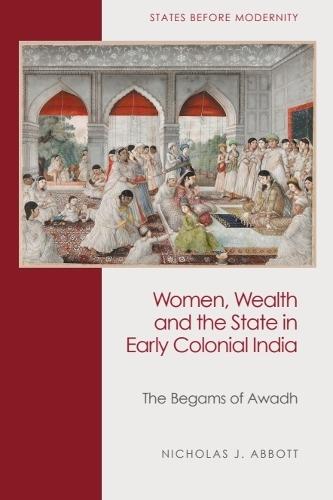
Overview
Few polities were more instrumental to the rise of the East India Company and the advent of British colonial rule in South Asia than the Mughal successor state of Awadh (c. 17221856). And few individuals influenced the making of the Awadh regime and its pivotal relationship with the Company more than the chief consorts (begamcentres the begams of Awadh within a revised history of state-formation and conceptual change in pre- and early colonial India. In so doing, it posits the begams as essential, if contested, builders of both the Awadh regime and the Company state, and as ambivalent partners in forging evolving political economies and emerging conceptual languages of statehood and sovereignty in early colonial India.
Full Product Details
Author: Nicholas J Abbott (Assistant Professor in the Department of History, Old Dominion University, Virginia)
Publisher: Edinburgh University Press
Imprint: Edinburgh University Press
ISBN: 9781399526470
ISBN 10: 1399526472
Pages: 312
Publication Date: 30 April 2026
Audience:
Professional and scholarly
,
Professional & Vocational
Format: Paperback
Publisher's Status: Active
Availability: Not yet available

This item is yet to be released. You can pre-order this item and we will dispatch it to you upon its release.
Reviews
An erudite, thorough and thoughtful break with androcentric colonial-postcolonial historiography of 'the native state’. Abbott’s book also pioneers as the first monograph on women in propertied households as pivots of early modern South Asian finance and political culture. It considerably deepens modern feminist debates on Indian women’s political and property rights -- Indrani Chatterjee, University of Virginia Nicholas Abbott is breaking new ground in writing about South Asia’s eighteenth century from predominantly Persian source materials. This monograph offers a fresh approach to early colonial history as well as an exhaustive and imaginative treatment of source material. Abbott is particularly innovative in using philological and semiotic tools to think about the evolving concept of “sarkar” and in his capacious and thoughtful treatment of gender; by foregrounding the role of Awadh’s matriarchs, he presents a gender-sensitive reading of state and colonialism at a time of profound transition. -- Samira Sheikh, Vanderbilt University Women, Wealth and the State in Early Colonial India: The Begams of Awadh addresses the role elite Muslim women played in state-building in early colonial India by paying close attention to Persianate political concepts and their changing nature under the rule of the East India Company. The book extensively uses the Persian archive of the Company, including its treatises, proclamations, correspondence, and intelligence. -- Asiya Alam, Louisiana State University * American Historical Review *
An erudite, thorough and thoughtful break with androcentric colonial-postcolonial historiography of 'the native state’. Abbott’s book also pioneers as the first monograph on women in propertied households as pivots of early modern South Asian finance and political culture. It considerably deepens modern feminist debates on Indian women’s political and property rights -- Indrani Chatterjee, University of Virginia Nicholas Abbott is breaking new ground in writing about South Asia’s eighteenth century from predominantly Persian source materials. This monograph offers a fresh approach to early colonial history as well as an exhaustive and imaginative treatment of source material. Abbott is particularly innovative in using philological and semiotic tools to think about the evolving concept of “sarkar” and in his capacious and thoughtful treatment of gender; by foregrounding the role of Awadh’s matriarchs, he presents a gender-sensitive reading of state and colonialism at a time of profound transition. -- Samira Sheikh, Vanderbilt University
Author Information
Nicholas Abbott is Assistant Professor in the Department of History at Old Dominion University in Norfolk, Virginia. His research focuses on gender, politics, and state formation in Mughal and colonial India and has been published in the Journal of the Economic and Social History of the Orient, Itinerario and Modern Asian Studies.