Overview
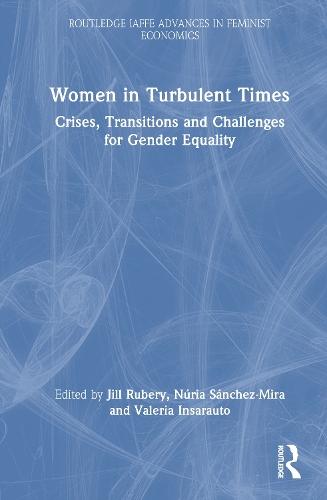
The last two decades have been marked by economic and social turmoil — from the global financial crash and the austerity turn to the Covid-19 pandemic, followed by cost-of-living crises, geopolitical conflicts and heightened political divisions. This succession of crises has destabilised economic and political systems and risks undermining the hard-won, albeit slow, progress towards gender equality in contemporary societies. At the same time, the way we live and work is being challenged by rapidly developing AI and digital technologies, the imperative to accelerate the transition to net zero emissions, and unresolved pressures to transform care systems to support women’s sustained participation in waged work. Against this backdrop, this volume offers a long-term perspective on turbulence, grounded on comparative and country evidence from Europe, the USA, Australia, and the Global South. The chapters trace how acute shocks, chronic crises and systemic transformations reverberate through labour markets, households and state policies, reshaping gender inequalities and vulnerabilities and their intersections. The concluding discussion argues that turmoil is evolving into a polycrisis —an entanglement of economic, social, and ecological disruptions— while exposing a critical but neglected dimension of turbulence: the crisis of social reproduction and women’s pivotal role in managing the tensions between production and the social reproduction spheres. By introducing a gender perspective into the polycrisis debate, this volume speaks to scholars in socioeconomics and gender studies; policy experts and advisors on gender equality; and activists, educators and the general public seeking to understand and address the challenges to gender equality in turbulent times.
Full Product Details
Author: Jill Rubery , Núria Sánchez-Mira , Valeria Insarauto
Publisher: Taylor & Francis Ltd
Imprint: Routledge
Weight: 0.453kg
ISBN: 9781032865850
ISBN 10: 1032865857
Pages: 376
Publication Date: 05 May 2026
Audience:
College/higher education
,
Tertiary & Higher Education
Format: Hardback
Publisher's Status: Forthcoming
Availability: Not yet available 
This item is yet to be released. You can pre-order this item and we will dispatch it to you upon its release.
Table of Contents
Introduction 1. Gender Equality in Turbulent Times: From the Financial Crash to Polycrisis Jill Rubery, Valeria Insarauto, Núria Sánchez-Mira Part 1 – Labour Markets in Crises and Intersecting Inequalities 2. Intersecting Inequalities. The Role of Gender and Migration Background in Women’s Labour Market Vulnerability During Crises Stephanie Steinmetz, Mattia Guarnerio 3. The Gendered Impact of the COVID-19 Pandemic on Labor Market Outcomes: A Comparative European Perspective Marija Bashevska, Giulia Dotti Sani 4. Working Lives and Livelihoods in Turbulent Times: Intersecting Inequalities of Gender and Class in the UK Luis Torres, Tracey Warren 5. Gender Pay Inequality and Wage Setting Institutions through Crises and Recoveries: A Southern European success story? Hugo Figueiredo, Martí López-Andreu Part 2 – The Crisis of Social Reproduction: Households and the State 6. Crises as Drivers of Change in Couples’ Paid Work Arrangements in Europe Luana Marx, Fei Bian, Núria Sánchez-Mira 7. COVID19 and Gender Gaps in Paid and Unpaid Work Janeen Baxter, Alice Campbell, Rennie Lee, Madison Lloyd 8. The Crisis of Social Reproduction Provisioning: Gender, Class and Migration in Poland and Ukraine Ania Plomien, Gregory Schwartz 9. Enhancing Dignity and Equity: Homecare Workforce Challenges amidst the Cost of Living Crisis, with a Focus on California Enrique Lopezlira, Savannah Hunter 10. The ‘Care Transition’ in Turbulent Times Maria Karamessini 11. Unemployment and Care Risks in Times of Crisis: Gender (In)equalities at the Intersection of Unemployment Benefits, Childcare and Leave Policies Trine P. Larsen, Janine Leschke, Sonja Bekker Part 3 – Gendering the Digital and Net Zero Transitions 12. Digitalisation and Remote Work: Gendered Outcomes in Job Quality and the Role of Persistent Gender Inequalities in Paid and Unpaid Work Agnieska Piasna 13. Unmasking Gender Disparities in the Digital Economy: Beyond Access and Numbers Uma Rani, Nora Gobel, Sueda Uludag 14. Unpacking the Green Economy: Worker Justice Without Gender Justice? Jack Daly, Vera Trappmann, Ioulia Bessa, Jennifer Tomlinson Conclusions 15. The Future of Gender Equality in Turbulent Times: Why We Need a Gender Lens on Polycrisis Núria Sánchez-Mira, Jill Rubery, Valeria Insarauto
Reviews
“Women in Turbulent Times is an incisive contribution to our understanding of the contemporary polycrisis, offering a much-needed feminist analysis of the interlocking economic, social, and environmental disruptions shaping women’s lives and society more broadly. The opening and concluding chapters frame the volume with a unique, historically grounded and gender-attuned lens and the book’s three empirical sections delve deeply into the tensions in labour markets and social reproduction, and the challenges brought about by digitalisation and the green transition. Across these chapters, the authors reveal the uneven and often contradictory consequences for women, shaped by class, race, and geography. These accounts, from a variety of countries, expose the persistent tensions between production and the essential work of care and social reproduction, and underscore the need for state action to protect secure work and the foundational care economy. This volume is essential reading for anyone seeking to understand and respond to the gendered contours of our turbulent era.” — Marian Baird, Professor of Gender and Employment Relations and Co-Director of the Sydney Employment Relations Research Group in the University of Sydney Business School. “How are employment relations and gender equality faring amid multiple “crises,” including the care crisis, the transition to a net-zero economy, and the profound transformations driven by digitalization and artificial intelligence? If you are seeking answers, this is the book you have been waiting for. It offers far more than a valuable collection of essays addressing these pressing questions. By mobilizing the framework of social reproduction and adopting an intersectionally-sensitive lens, the opening and concluding chapters weave together evidence from diverse national contexts into a thought-provoking conceptual tapestry. In doing so, they issue a timely warning against complacency regarding progress toward gender equality. I highly recommend this volume to students and scholars alike, as well as to policymakers committed to advancing gender and labour equality.” — Francesca Bettio, Retired Professor of Economics at the University of Siena, Italy. “From a study of how the successive and interlocked shocks of the financial crisis, austerity and Covid-19 have impacted gender equality, the editors progress to embed these ‘poly crises’ in the underlying problems of climate change and the care deficit and the current challenges from the Russia-Ukraine war, the migration crisis, the unpredictable effects of AI, and the political turn to the right around the globe. The resulting accessible but thoughtful study looks beyond the market economy to women’s roles in both production and social reproduction and deepens understanding of the threats to wellbeing and prospects for stability in our increasingly turbulent world.” — Jane Humphries, Professor of economic history (emeritus) Oxford and Centennial Professor (emeritus) LSE. “This book compellingly reconnects production and social reproduction through a gender lens, offering readers a key framework for making sense of today’s interlocking crises and the profound transformations reshaping work. Situating the financial and Covid-19 crises alongside ongoing digital and green transitions, it exposes the intersecting inequalities of gender, class, race, ethnicity, and migration that structure contemporary economic developments. In doing so, it provides a comprehensive and much needed understanding of current socioeconomic dynamics, while also envisioning the political, economic, and social transformations required to reorganize societies in ways that support the flourishing of human and non-human life.” — Emanuela Lombardo, Professor of Political Science Scuola Normale Superiore, Florence, Italy. “This is not just another book about gender and crisis; it is a powerful rethinking of how crises themselves become engines of gendered transformation. Moving from the financial crash to the pandemic and today’s overlapping emergencies, the authors brilliantly show how gender relations are not temporarily disrupted but fundamentally reworked through austerity, precarity, care reconfigurations, climate and technological change and moralized discourses of responsibility. With analytical precision, methodological rigor and political urgency, this book exposes how gender equality is redefined in turbulent times. A major contribution and an insightful and necessary intervention.” — Valeria Pulignano, Professor of Sociology at KU Leuven, Belgium and author of ‘The Politics of Unpaid Labour’, Oxford.
Author Information
Jill Rubery is Professor of Comparative Employment Systems and Executive Director of the Work and Equalities Institute at Alliance Manchester Business School, University of Manchester, UK. She is an international expert on gender and employment and has worked extensively as consultant for the ILO and the EU. Her research focuses on wages, working time, precarious work and the gendered impact of crises and she has edited books on Women and Recession and Women and Austerity (published by Routledge). She is a Fellow of the British Academy. Núria Sánchez-Mira is Professor of Sociology at University of Neuchâtel (Switzerland). Her research focuses on gender inequalities at the work–family interface and across the life course, using quantitative, qualitative, and mixed-methods approaches. She has worked on the gendered impacts of crises on labour markets and household divisions of labour, precarious work in female-dominated sectors, and the digital transformation of work. She currently serves as Co-Editor-in-Chief of the Swiss Journal of Sociology. Valeria Insarauto is Lecturer in Work and Employment, Centre for Decent Work, Sheffield University Management School, UK, and Affiliated Researcher, Institute of Labour Economics and Industrial Sociology (LEST), Aix-Marseille University, France. Her research focuses on gender inequalities in the labour market from an international comparative and quantitative perspective, particularly around socio-economic vulnerability among marginal workers, discrimination and sexual harassment, and the work-family interface. She serves on the editorial boards of Work, Employment and Society and of Papers. Revista de Sociologia.
Tab Content 6
Author Website:
Countries Available
All regions
|