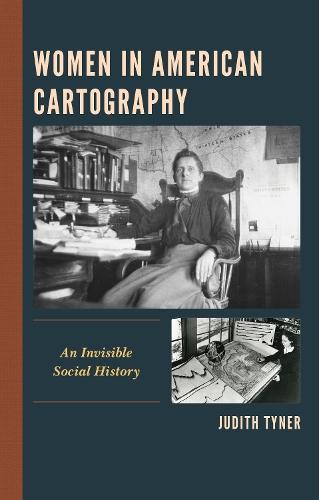
Full Product Details
Author: Judith Tyner
Publisher: Bloomsbury Publishing Plc
Imprint: Lexington Books
Dimensions:
Width: 15.40cm
, Height: 0.90cm
, Length: 21.80cm
Weight: 0.249kg
ISBN: 9781498548311
ISBN 10: 1498548318
Pages: 150
Publication Date: 26 May 2021
Audience:
Professional and scholarly
,
Professional & Vocational
Format: Paperback
Publisher's Status: Active
Availability: Manufactured on demand

We will order this item for you from a manufactured on demand supplier.
Reviews
Judith Tyner's most recent book Women in American Cartography begins with a refreshing moment of context when she shares that she can read a map despite her gender. Tyner seeks to uncover how women have made and interacted with maps from the eighteenth century onward. This book can be viewed as something of a call to action, a roadmap gifted by Tyner to a new generation of women and male academics and cartographers. * The Portolan * Women in American Cartography pulls together a lifetime's of research on the place of women in cartography in the United States. Its author, Judith Tyner has a longstanding interest in the history of cartography and in particular, on the role of women therein. In summary, the volume breaks new ground by bringing together the stories of women cartographers to make sense of their contributions to the field and to show how social attitudes and circumstances shaped their opportunities to make maps. * The Globe: Journal of the Australian and New Zealand Map Society * Map histories have until recently largely ignored female cartographers, partly because maps were not always signed by their creators. However, as women gained greater access to education in the 19th century, geography and mapmaking became important school subjects for them. Tyner (California State Univ., Long Beach), who has written previously on embroidered maps and globes, discusses the roles of Emma Willard and the Westtown School in Pennsylvania in teaching cartography to these women. A surge of American women cartographers came during WW II, when there was an urgent need for new maps of all parts of the world. With men serving in the military, opportunities for training and employment in the field were finally made available to women, and many continued to serve in the map departments of federal and state governments, libraries, and commercial firms once the war ended. Through her investigation Tyner presents brief biographies of a number of notable women, including Marie Tharp, who mapped the ocean floor and discovered the Atlantic Rift Valley, and Gertrude Bracht, the creator of state highway maps for Oklahoma and a map of Route 66, the Main Street of America. Summing Up: Recommended. All readership levels. * CHOICE * Women have long played significant roles in American cartography in educational, commercial, and governmental arenas. In Women in American Cartography: An Invisible Social History, Judith Tyner offers an engaging historical and contemporary account of their individual and collective challenges, trajectories, and contributions. -- Janice J. Monk, University of Arizona The nation's foremost expert on women's contributions to maps, mapmaking, and map use, Tyner, draws on her own research and that of others to produce a comprehensive, well-organized, richly illustrated, and engaging history. The culmination of decades of research, this book fosters a growing interest among map historians in the important roles women took on before gender-neutral geospatial technology canceled gender differences in cartography. -- Mark Monomier, Syracuse University Women in American Cartography kills the old scientific chauvinistic assumption that only men were cartographers. Tyner weaves together years of historical research with her own experiences as a woman cartographer, illuminating the often overlooked, obscured, or downplayed roles women have played in American map production. From early eighteenth-century schoolgirls to women working today in mapping/Geographic Information System companies, Tyner expands our understanding of women's contributions to the American geographical imagination. This is an important addition to American map history. -- Christina Dando, University of Nebraska Omaha
"Judith Tyner's most recent book ""Women in American Cartography"" begins with a refreshing moment of context when she shares that she can read a map despite her gender. Tyner seeks to uncover how women have made and interacted with maps from the eighteenth century onward. This book can be viewed as something of a call to action, a roadmap gifted by Tyner to a new generation of women and male academics and cartographers. * The Portolan * ""Women in American Cartography"" pulls together a lifetime's of research on the place of women in cartography in the United States. Its author, Judith Tyner has a longstanding interest in the history of cartography and in particular, on the role of women therein. In summary, the volume breaks new ground by bringing together the stories of women cartographers to make sense of their contributions to the field and to show how social attitudes and circumstances shaped their opportunities to make maps. * The Globe: Journal of the Australian and New Zealand Map Society * Map histories have until recently largely ignored female cartographers, partly because maps were not always signed by their creators. However, as women gained greater access to education in the 19th century, geography and mapmaking became important school subjects for them. Tyner (California State Univ., Long Beach), who has written previously on embroidered maps and globes, discusses the roles of Emma Willard and the Westtown School in Pennsylvania in teaching cartography to these women. A surge of American women cartographers came during WW II, when there was an urgent need for new maps of all parts of the world. With men serving in the military, opportunities for training and employment in the field were finally made available to women, and many continued to serve in the map departments of federal and state governments, libraries, and commercial firms once the war ended. Through her investigation Tyner presents brief biographies of a number of notable women, including Marie Tharp, who mapped the ocean floor and discovered the Atlantic Rift Valley, and Gertrude Bracht, the creator of state highway maps for Oklahoma and a map of Route 66, “the Main Street of America.” Summing Up: Recommended. All readership levels. * CHOICE * Women have long played significant roles in American cartography in educational, commercial, and governmental arenas. In Women in American Cartography: An Invisible Social History, Judith Tyner offers an engaging historical and contemporary account of their individual and collective challenges, trajectories, and contributions. -- Janice J. Monk, University of Arizona The nation’s foremost expert on women’s contributions to maps, mapmaking, and map use, Tyner, draws on her own research and that of others to produce a comprehensive, well-organized, richly illustrated, and engaging history. The culmination of decades of research, this book fosters a growing interest among map historians in the important roles women took on before gender-neutral geospatial technology canceled gender differences in cartography. -- Mark Monomier, Syracuse University Women in American Cartography kills the old scientific chauvinistic assumption that only men were cartographers. Tyner weaves together years of historical research with her own experiences as a woman cartographer, illuminating the often overlooked, obscured, or downplayed roles women have played in American map production. From early eighteenth-century schoolgirls to women working today in mapping/Geographic Information System companies, Tyner expands our understanding of women’s contributions to the American geographical imagination. This is an important addition to American map history. -- Christina Dando, University of Nebraska Omaha"
Author Information
Judith Tyner is professor emerita at California State University, Long Beach.