Overview
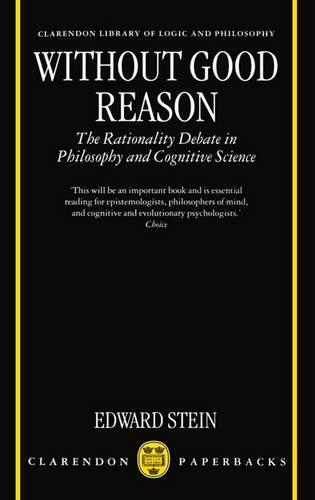
Are humans rational? Various experiments performed over the last several decades have been interpreted as showing that humans are irrational we make significant and consistent errors in logical reasoning, probabilistic reasoning, similarity judgements, and risk-assessment, to name a few areas. But can these experiments establish human irrationality, or is it a conceptual truth that humans must be rational, as various philosophers have argued? In this book, Edward Stein offers a clear critical account of this debate about rationality in philosophy and cognitive science. He discusses concepts of rationality - the pictures of rationality that the debate centres on - and assesses the empirical evidence used to argue that humans are irrational. He concludes that the question of human rationality must be answered not conceptually but empirically, using the full resources of an advanced cognitive science. Furthermore, he extends this conclusion to argue that empirical considerations are also relevant to the theory of knowedge - in other words, that epistemology should be naturalized. from the reviews: 'Stein has done a great service in bringing together all of the important arguments in the human rationality debate and providing a measured critical assessment of them. . . . This will be an important book and is essential reading for epistemologists, philosophers of mind, and cognitive and evolutionary psychologists.' Choice 'very considerable value . . . for professionals' Times Higher Education Supplement
Full Product Details
Author: Edward Stein (Assistant Professor of Philosophy, Assistant Professor of Philosophy, Yale University)
Publisher: Oxford University Press
Imprint: Oxford University Press
Edition: New edition
Dimensions:
Width: 13.90cm
, Height: 1.90cm
, Length: 21.50cm
Weight: 0.419kg
ISBN: 9780198237730
ISBN 10: 0198237731
Pages: 312
Publication Date: 18 December 1997
Audience:
Professional and scholarly
,
Professional & Vocational
Format: Paperback
Publisher's Status: Active
Availability: To order

Stock availability from the supplier is unknown. We will order it for you and ship this item to you once it is received by us.
Reviews
The book contains a particularly clear apraisal - the best in the literature, I thought - of arguments for the rationality thesis from the principle of Charity . (C. 4), as well as a careful, thorough and sophisticated examination of the arguments which portray the rationality thesis as the ... outcome of evolution by natural selection ... The whole book is written in a clear, lively and enjoyable style. It is carefully-argued throughout ... I strongly recommend it to lecturers and students of the philosophy of mind and cognition as the best comprehensive survey of the literature on rationality. * John Preston, Mind * The whole book is written in a clear, lively and enjoyable style. It is carefully-argued throughout ... it is an excellent attempt at a synoptic cognitivist account of the philosophical implications of the experimental investigation of human rationality. I strongly recommend it to lecturers and students of the philosophy of mind and cognition as the best comprehensive survey of the literature on rationality. * John Preston, University of Reading *
Stein's analysis is both clear and cogent. Students of human rationality will find much of interest here. --International Studies in Philosophy<br> Stein has done a great service in bringing together all of the important arguments in the human rationality debate and providing a measured critical assessment of them....This will be an important book and is essential reading for epistemologists, philosophers of mind, and cognitive and evolutionary psychologists. --Choice<br>
<br> Stein's analysis is both clear and cogent. Students of human rationality will find much of interest here. --International Studies in Philosophy<br> Stein has done a great service in bringing together all of the important arguments in the human rationality debate and providing a measured critical assessment of them....This will be an important book and is essential reading for epistemologists, philosophers of mind, and cognitive and evolutionary psychologists. --Choice<br>