Overview
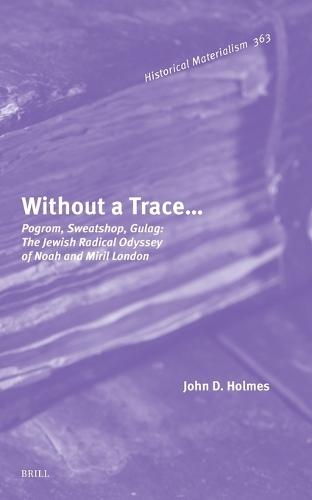
This biography gives an inside story of US and Soviet Communism, their similarities and parallels, and the Soviet bureaucracy in the Stalin era. Unprecedented research in Yiddish-language Jewish archives and underresearched Soviet archives enable genuine revelations. This book tells you how revolution in Russia, twentieth-century Jewish history, US and Russian labor history and the evolution of Stalinism are intertwined threads. They link historical moments on both sides of the Atlantic Ocean and around the world. The London story has much to say about the present day world and prospects for the future. The tragic odyssey of the Londons gives insight into the nature and origins of Stalinism and the causes of the ""Great Terror,"" the most mysterious episode of Soviet history. And Noah London's career as a leader of the Stalinist industrial revolution in the Donbass who became a secret dissident due to the Ukrainian famine sheds vital light on today's war-torn Donbass.
Full Product Details
Author: John Dewey Holmes
Publisher: Brill
Imprint: Brill
Volume: 363
Dimensions:
Width: 15.50cm
, Height: 2.30cm
, Length: 23.50cm
Weight: 1.032kg
ISBN: 9789004730625
ISBN 10: 9004730621
Pages: 492
Publication Date: 27 November 2025
Audience:
College/higher education
,
Postgraduate, Research & Scholarly
Format: Hardback
Publisher's Status: Active
Availability: Manufactured on demand

We will order this item for you from a manufactured on demand supplier.
Reviews
""John Holmes has devoted himself to uncovering the meaning of London’s life which meant careful examination of the different factions within Bund socialism, exploring the ins and outs of labor politics in New York in early decades of the 20th. Century, then studying, with the help of new archival materials, the politics of water in the Ukraine under a system of economic planning and party autocracy, and then following (again with the help of the archives) the tortuous political swings of the Stalinist regime in the 1930s, leading up to the purges. So what does Holmes come up with—apart from a magnificent narrative? I was struck by his explanation of the purges. His detailed analysis suggests the convergence of two processes. On the one hand there was the now familiar politics of upward mobility within the Stalinist party state, but, on the other hand, there was the break neck speed of economic development that inevitably led to planning failures. These might look as though they are the result of deliberate wrecking, but in fact they were the response of enterprise managers bent on an impossible mission. There is no need to look for any conspiracy to explain the purges. More generally, through the biography of Noah London, Holmes has produced a biography of socialism in the twentieth century, from its pre-Soviet beginnings, to the Russian Revolution, to the export of communism, and then to the way the revolution turned in on itself from which it never really recovered."" —Michael B. Burawoy “John Holmes' book is a feat of historical recovery, restoring Noah London to his place in the history of the American left and, notably, Stalinist Russia.” —David Brody “A long-awaited text from the era of the Yiddish Left, this valuable book will be read with interest and pleasure by scholars of the Russian Revolution, the immigrant Left in the US at large, and the Yiddish contingent in US culture and politics."" —Paul Buhle
""John Holmes has devoted himself to uncovering the meaning of London’s life which meant careful examination of the different factions within Bund socialism, exploring the ins and outs of labor politics in New York in early decades of the 20th. Century, then studying, with the help of new archival materials, the politics of water in the Ukraine under a system of economic planning and party autocracy, and then following (again with the help of the archives) the tortuous political swings of the Stalinist regime in the 1930s, leading up to the purges. So what does Holmes come up with—apart from a magnificent narrative? I was struck by his explanation of the purges. His detailed analysis suggests the convergence of two processes. On the one hand there was the now familiar politics of upward mobility within the Stalinist party state, but, on the other hand, there was the break neck speed of economic development that inevitably led to planning failures. These might look as though they are the result of deliberate wrecking, but in fact they were the response of enterprise managers bent on an impossible mission. There is no need to look for any conspiracy to explain the purges. More generally, through the biography of Noah London, Holmes has produced a biography of socialism in the twentieth century, from its pre-Soviet beginnings, to the Russian Revolution, to the export of communism, and then to the way the revolution turned in on itself from which it never really recovered."" —Michael B. Burawoy
Author Information
John D. Holmes, Ph.D. (2008), University of California Berkeley. He is currently a history instructor at Merritt College in Oakland, California. He has about a third of a century of experience in the labor movement, first in the printing industry and then in academic unionism. He has held a number of lower level union posts, and has published a number of articles on Jewish, labor and Soviet history.