Overview
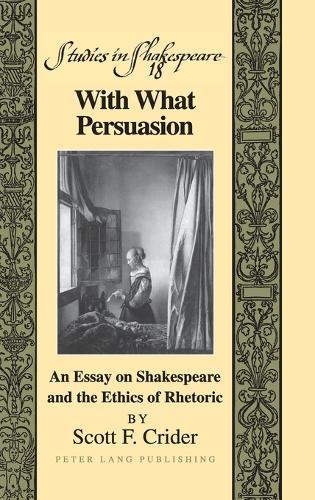
Although there are a number of book-length studies of rhetoric in Shakespeare’s plays, With What Persuasion discerns a distinctly Shakespearean ethics of the art of rhetoric in them. In this interdisciplinary book, Scott F. Crider draws upon the Aristotelian traditions of poetics, rhetoric, and ethics to show how Shakespeare addresses fundamental ethical questions that arise during the public and private rhetorical situations Shakespeare represents in his plays. Informed by the Greek, Roman, and English poetic and rhetorical traditions, With What Persuasion offers close readings of a selection of plays – Hamlet, Julius Caesar, Henry the 5th, All’s Well That Ends Well, Othello, Measure for Measure, and The Winter’s Tale – to answer universal questions about human speech and association, answers that refute a number of contemporary literary and rhetorical theory’s assumptions about language and power. Crider argues that this Shakespearean ethics could assist us in our own historical moment as we in the liberal, multicultural West try to refound, without coercion, ethical principles to bind us to one another.
Full Product Details
Author: Scott F. Crider ,
Scott F. Crider
Publisher: Peter Lang Publishing Inc
Imprint: Peter Lang Publishing Inc
Edition: New edition
Volume: 18
Weight: 0.430kg
ISBN: 9781433103124
ISBN 10: 1433103125
Pages: 212
Publication Date: 30 July 2009
Audience:
Professional and scholarly
,
Professional & Vocational
Format: Hardback
Publisher's Status: Active
Availability: Awaiting stock

The supplier is currently out of stock of this item. It will be ordered for you and placed on backorder. Once it does come back in stock, we will ship it out for you.
Reviews
«Many critics have acknowledged the importance of the classical tradition of rhetoric to Shakespeare, but few have taken it as seriously as Scott F. Crider does. In a series of subtle readings of some of Shakespeare's most intellectually challenging plays -- among them, 'Hamlet', 'All's Well That Ends Well', and 'Measure for Measure' -- Crider initiates a stimulating dialogue between Aristotle's understanding of rhetoric and Shakespeare's. In an especially provocative study of Iago's sophistry in 'Othello', Crider highlights the ethical dimension of rhetoric as a central issue in Shakespeare's achievement as a playwright. -- Paul A. Cantor
«Many critics have acknowledged the importance of the classical tradition of rhetoric to Shakespeare, but few have taken it as seriously as Scott F. Crider does. In a series of subtle readings of some of Shakespeare’s most intellectually challenging plays – among them, ‘Hamlet’, ‘All’s Well That Ends Well’, and ‘Measure for Measure’ – Crider initiates a stimulating dialogue between Aristotle’s understanding of rhetoric and Shakespeare’s. In an especially provocative study of Iago’s sophistry in ‘Othello’, Crider highlights the ethical dimension of rhetoric as a central issue in Shakespeare’s achievement as a playwright.» (Paul A. Cantor, Clifton Waller Barrett Professor of English, University of Virginia)
Many critics have acknowledged the importance of the classical tradition of rhetoric to Shakespeare, but few have taken it as seriously as Scott F. Crider does. In a series of subtle readings of some of Shakespeare's most intellectually challenging plays - among them, `Hamlet', `All's Well That Ends Well', and `Measure for Measure' - Crider initiates a stimulating dialogue between Aristotle's understanding of rhetoric and Shakespeare's. In an especially provocative study of Iago's sophistry in `Othello', Crider highlights the ethical dimension of rhetoric as a central issue in Shakespeare's achievement as a playwright. (Paul A. Cantor, Clifton Waller Barrett Professor of English, University of Virginia)
Many critics have acknowledged the importance of the classical tradition of rhetoric to Shakespeare, but few have taken it as seriously as Scott F. Crider does. In a series of subtle readings of some of Shakespeare's most intellectually challenging plays - among them, 'Hamlet', 'All's Well That Ends Well', and 'Measure for Measure' - Crider initiates a stimulating dialogue between Aristotle's understanding of rhetoric and Shakespeare's. In an especially provocative study of Iago's sophistry in 'Othello', Crider highlights the ethical dimension of rhetoric as a central issue in Shakespeare's achievement as a playwright. (Paul A. Cantor, Clifton Waller Barrett Professor of English, University of Virginia)
Author Information
The Author: An award-winning teacher, Scott F. Crider received his Ph.D. from the University of California at Riverside and is Associate Professor of English at the University of Dallas, where he teaches literature and composition and is Director of the Writing Program. He is a longtime member of the Shakespeare Association of America, and he regularly reviews books for The Ben Jonson Journal. He is also the author of The Office of Assertion: An Art of Rhetoric for the Academic Essay (2005).