Overview
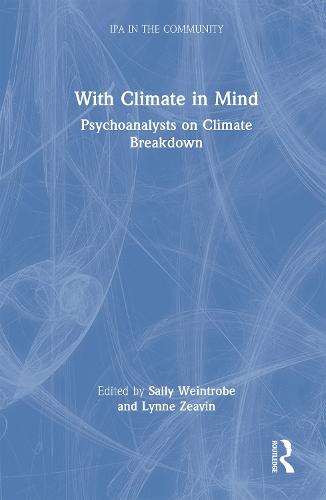
This groundbreaking book enriches and expands psychoanalytic theory and method as it applies to the climate. It embeds psychoanalysis within environmental and cultural awareness; restores the importance Freud placed on external reality and its mental representations; introduces an integrative concept of climate; and, with its attention to clinical detail, offers stepping stones for practitioners seeking to understand clinical material in which phantasies involving nature, culture, and family are intertwined. Presented in four parts – Clinical, Theory, Nature, and Research – its authors are psychoanalysts from across the world. With Climate in Mind is essential reading for practising and training psychoanalysts, for those in the psychotherapy profession, and for other professionals engaged with what climate breakdown in a culture of carelessness means today.
Full Product Details
Author: Sally Weintrobe ,
Lynne Zeavin
Publisher: Taylor & Francis Ltd
Imprint: Routledge
Weight: 0.590kg
ISBN: 9781041063391
ISBN 10: 1041063393
Pages: 218
Publication Date: 08 December 2025
Audience:
Professional and scholarly
,
College/higher education
,
Professional & Vocational
,
Postgraduate, Research & Scholarly
Format: Hardback
Publisher's Status: Active
Availability: Not yet available

This item is yet to be released. You can pre-order this item and we will dispatch it to you upon its release.
Reviews
“An eminently important book that illustrates the expanded scope of psychoanalytic thought and action when nature is recognised as a primary psychic object alongside the primary parental objects of humans. With an integrative concept of climate in mind, we psychoanalysts can no longer keep separated the intimate familial climate from the physical climate and the wider social climate. This has fundamental consequences for the form and content of psychoanalytic interpretations: the examination of the unconscious and conscious meaning of all climatic themes requires our attention, including the concern for the preservation of nature and its representation in the individual psyche. This stirring, lucid, and evocative book emphasises the social responsibility of psychoanalysis, and that deserves many readers because it convincingly conveys the urgency of psychoanalytically contributing to the transformation of the currently widespread culture of uncare into a more lively culture of care.” - Dr. med. Heribert Blass, President International Psychoanalytical Association “At last, as this volume reveals, psychoanalysts across the globe are waking up to the promptings of nature and climate. Not just an ethical imperative, its contributors also demonstrate how this shifting orientation enriches psychoanalytic theory and practice, not least by deepening our understanding of key aspects of the human condition such as omnipotence, splitting, suffering, love and reparation.” - Professor Emeritus Paul Hoggett, Co-Founder Climate Psychology Alliance “As a scientist and ecologist watching what is happening to our natural environments, I have always wondered why so many humans show such little respect for Nature. I am now beginning to understand why. This collection of essays provides vital insights and clarifications into the core causes of human behavior with regards to Nature and the Earth. The contributors provide an impressive array of perspectives to expand our comprehension, and hopefully to provide remedies, to the growing disjunct in the 21st Century between our human interior world and the external reality of Nature, climate, and planet. It is a must read for psychoanalysts, scientists, and even the general public, who are struggling to understand this disjunction.” - W. John Kress, Ph.D., Distinguished Scientist and Curator Emeritus, National Museum of Natural History Smithsonian Institution “An eminently important book that illustrates the expanded scope of psychoanalytic thought and action when nature is recognised as a primary psychic object alongside the primary parental objects of humans. With an integrative concept of climate in mind, we psychoanalysts can no longer keep separated the intimate familial climate from the physical climate and the wider social climate. This has fundamental consequences for the form and content of psychoanalytic interpretations: the examination of the unconscious and conscious meaning of all climatic themes requires our attention, including the concern for the preservation of nature and its representation in the individual psyche. This stirring, lucid, and evocative book emphasises the social responsibility of psychoanalysis, and that deserves many readers because it convincingly conveys the urgency of psychoanalytically contributing to the transformation of the currently widespread culture of uncare into a more lively culture of care.” - Dr. med. Heribert Blass, President International Psychoanalytical Association “At last, as this volume reveals, psychoanalysts across the globe are waking up to the promptings of nature and climate. Not just an ethical imperative, its contributors also demonstrate how this shifting orientation enriches psychoanalytic theory and practice, not least by deepening our understanding of key aspects of the human condition such as omnipotence, splitting, suffering, love and reparation.” - Professor Emeritus Paul Hoggett, Co-Founder Climate Psychology Alliance “As a scientist and ecologist watching what is happening to our natural environments, I have always wondered why so many humans show such little respect for Nature. I am now beginning to understand why. This collection of essays provides vital insights and clarifications into the core causes of human behavior with regards to Nature and the Earth. The contributors provide an impressive array of perspectives to expand our comprehension, and hopefully to provide remedies, to the growing disjunct in the 21st Century between our human interior world and the external reality of Nature, climate, and planet. It is a must read for psychoanalysts, scientists, and even the general public, who are struggling to understand this disjunction.” - W. John Kress, Ph.D., Distinguished Scientist and Curator Emeritus, National Museum of Natural History Smithsonian Institution
Author Information
Sally Weintrobe is Fellow of the British Psychoanalytical Society and has chaired the IPA Climate Committee. She won the IPA’s 2021 Community Award for her work on climate. Engaging with Climate Change (Routledge), which she edited, was short-listed in 2014 for the Gradiva Award for its contribution to psychoanalysis. Lynne Zeavin is Training and Supervising Analyst of the New York Psychoanalytic Society and Institute and an associate editor of JAPA, the Journal of the American Psychoanalytic Association. Among her publications, she co-edited, with Don Moss, Hating, Abhorring and Wishing to Destroy (Routledge).