Overview
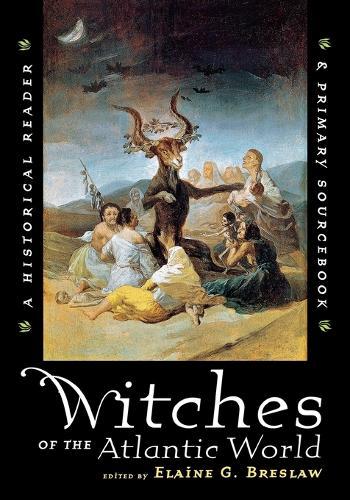
An anthology of primary documents and scholarly interpretations of witchcraft from the 15th to 18th century This unique anthology is the first to provide a multicultural perspective on witchcraft from the 15th to 18th century. Featuring primary documents as well as scholarly interpretations, Witches of the Atlantic World builds upon information regarding both Christian and non-Christian beliefs about possession and the demonic. Elaine G. Breslaw draws on Native American, African, South American, and African-American sources, as well as the European and New England heritage, to illuminate the ways in which witchcraft in early America was an attempt to understand and control evil and misfortune in the New World. Organized into sections on folklore and magic, diabolical possession, Christian perspectives, and the question of gender, the volume includes selections by Cotton Mather, Matthew Hopkins, and Samuel Willard, among others; Salem trial testimonies; and commentary by a host of distinguished scholars. Together the materials demonstrate how the Protestant and Catholic traditions shaped American concepts, and how multicultural aspects played a key role in the Salem experience. Witches of the Atlantic World sheds new light on one of the most perplexing aspects of American history and provides important background for the continued scholarly and popular interest in witches and witchcraft today.
Full Product Details
Author: Elaine G. Breslaw
Publisher: New York University Press
Imprint: New York University Press
Dimensions:
Width: 17.80cm
, Height: 2.60cm
, Length: 25.40cm
Weight: 0.975kg
ISBN: 9780814798515
ISBN 10: 0814798519
Pages: 550
Publication Date: 01 September 2000
Audience:
General/trade
,
College/higher education
,
Professional and scholarly
,
General
,
Undergraduate
Format: Paperback
Publisher's Status: Active
Availability: Manufactured on demand

We will order this item for you from a manufactured on demand supplier.
Reviews
""This is a useful collection of material on witchcraft."" Journal of World History ""This is undoubtedly one of the best reference works ever published on witchcraft. Breslaw, fresh from her well-received revisionist history Tituba: Reluctant Witch of Salem, brings together work by some of the best-known scholars of the field, including Elizabeth Reis, Carol Karlsen, John Demos, Paul Boyer, Stephen Nissenbaum and David Hall. She organizes primary sources (including the 1486 manifesto Why Women Are Chiefly Addicted to Superstitions) and insightful secondary essays around topics of European, Native American and African witchcraft. The anthology is to be applauded for its commitment to representing cultural variance--showing how, for example, indigenous American magical traditions differed greatly from tribe to tribe. Breslaw's awareness of diverse cultural contexts highlights the multiple functions that witchcraft and anti-witchcraft served in individual communities."" Publishers Weekly ""...covers a tremendous amount of spatial and temporal ground."" Maryland Historical Magazine
<p> A well-selected and admirably introduced collection of primary sources and secondary interpretations . . . By incorporating Africans and native Americans into a story that normally deals only with Europeans (at home and in the colonies), Breslaw opens new approaches to a familiar but always fascinating subject. <br>-Francis Bremer, Millersville University
<p> This is undoubtedly one of the best reference works ever published on witchcraft. Breslaw, fresh from her well-received revisionist history Tituba: Reluctant Witch of Salem , brings together work by some of the best-known scholars of the field, including Elizabeth Reis, Carol Karlsen, John Demos, Paul Boyer, Stephen Nissenbaum and David Hall. She organizes primary sources (including the 1486 manifesto Why Women Are Chiefly Addicted to Superstitions ) and insightful secondary essays around topics of European, Native American and African witchcraft. The anthology is to be applauded for its commitment to representing cultural variance--showing how, for example, indigenous American magical traditions differed greatly from tribe to tribe. Breslaw's awareness of diverse cultural contexts highlights the multiple functions that witchcraft and anti-witchcraft served in individual communities. <br>
Author Information
Elaine G. Breslaw retired as Professor of History from Morgan State University in Baltimore after 29 years and has taught on an adjunct basis at Johns Hopkins University, Goucher College, and the University of Tennessee, Knoxville. She is the author of Tituba, Reluctant Witch of Salem: Devilish Indians and Puritan Fantasies (NYU Press, 1995), Witches of the Atlantic World: An Historical Reader and Primary Sourcebook (NYU Press, 2000), and Dr. Alexander Hamilton and Provincial America: Expanding the Orbit of Scottish Culture.