Overview
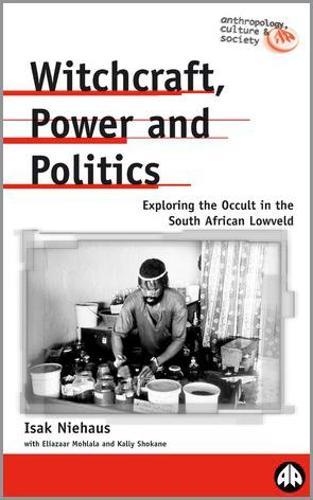
This is an extraordinary account of witchcraft and witch-hunting in the modern world. A powerful ethnographic study of witch-hunting in 1980s South Africa - a period of rapid social change - this book demonstrates the extent to which witchcraft must be seen, not as a residue of 'traditional' culture but as part of a complex social drama which is deeply embedded in contemporary political and economic processes. Isak Niehaus provides the context for this fascinating study of witchcraft practices. He shows how witchcraft was politicised against the backdrop of the apartheid state, the liberation struggle and the establishment of the first post-apartheid regime, which all affected conceptions of witchcraft. Niehaus demonstrates how the ANC and other political groups used witchcraft beliefs to further their own agenda. He explores the increasingly conservative role of the chiefs and the Christian church. In the process, he reveals the fraught nature of intergenerational and gender relations. The result is a truly insightful and theoretically engaged account of a much-studied but frequently misunderstood practice.
Full Product Details
Author: Isak Niehaus ,
Eliazaar Mohlala ,
Kally Shokaneo ,
Eliazaar Mohala
Publisher: Pluto Press
Imprint: Pluto Press
Dimensions:
Width: 13.50cm
, Height: 2.30cm
, Length: 21.50cm
Weight: 0.493kg
ISBN: 9780745315638
ISBN 10: 0745315631
Pages: 272
Publication Date: 20 May 2001
Audience:
College/higher education
,
Professional and scholarly
,
Undergraduate
,
Professional & Vocational
Format: Hardback
Publisher's Status: Out of Stock Indefinitely
Availability: Out of stock

Reviews
Witchcraft characterizes Western invention of Africa: similar phenomena are rarely called witchcraft elsewhere in the world. Niehaus (anthropology, Univ. of Natal, South Africa) critically reviews this most exotic element of African ethnography, bringing to bear current theories of human agency, avoiding romantic separation of behavior from history and politics, and demonstrating how dynamic social processes help people cope with radically changing circumstances. Witchcraft is a 'persecutorial' view of misfortune --that is, bad luck is someone's fault. In the wrenching decades of recent South Africa, fingers may be pointed in many directions, but especially at whites. The iniquities of apartheid have been matched by economic woes and stresses to black family life. Because of the superior technologies of whites and their absolute control of wealth, they are either cruel witches themselves or they must provide clandestine powers to black witches. Witchcraft accusations have increased following shifting postcolonial politics. Neihaus's richly detailed study joins recent research on the west African goddess Mami Wata and European vampires in east Africa in striving to grasp local understandings of capitalism and the seedbeds of envy it inspires, as well as related globalizing processes that exclude most Africans from their benefits. Advanced undergraduates and above. --- A. F. Roberts, University of California, Los Angeles in CHOICE
Author Information
Isak Niehaus is a Senior Lecturer in the Department of Anthropology and Archaeology, University of Pretoria, South Africa. Eliazaar Mohlala is the joint author of Witchcraft, Power and Politics (Pluto, 2001). Kally Shokaneo is the joint author of Witchcraft, Power and Politics (Pluto, 2001).