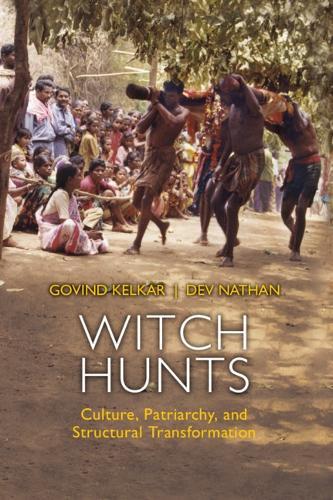
Full Product Details
Author: Govind Kelkar ,
Dev Nathan
Publisher: Cambridge University Press
Imprint: Cambridge University Press
Dimensions:
Width: 16.00cm
, Height: 2.10cm
, Length: 23.60cm
Weight: 0.510kg
ISBN: 9781108490511
ISBN 10: 1108490514
Pages: 284
Publication Date: 29 October 2020
Audience:
Professional and scholarly
,
Professional & Vocational
Format: Hardback
Publisher's Status: Active
Availability: Available To Order

We have confirmation that this item is in stock with the supplier. It will be ordered in for you and dispatched immediately.
Reviews
'It is interesting, important and well grounded in both older and newer approaches to witchcraft. The general argument about witchcraft, gender, patriarchy and structural changes in the economy is also quite persuasive, though I am sure there will be quibbles. From my point of view, the book looks both original and important.' Arjun Appadurai, New York University 'Very impressive! The authors manage to cover a lot of ground. Am really impressed by the wide scope of the book, both because of all the areas and themes covered and because of the authors' wide reading! So many literature references and ideas ... I think the focus on witch-hunts is original and productive.' Peter Geschiere, University of Amsterdam and author of Witchcraft 'Witch Hunts provides an illuminating exploration of how beliefs in witches function to explain misfortunes, virtually always in the context of significant economic and social transformations. Such processes are routinely gendered, transferring land and social power usually from women to men, and thus creating or strengthening patriarchies. Innovative is that the authors take the standpoint of the victims of witch hunts in accounting for such practices and beliefs. Decades of field work in India, and archival resources from primarily Africa and early modern Europe, provide the solid evidential basis for analyses of similarities and differences between witch hunts across geographies and histories. Clearly written and well-organized, this will make fascinating reading for courses in history, economics, anthropology and women's studies.' Sandra Harding, Emeritus Professor of Philosophy, University of California at Los Angeles 'A fascinating account, in horrifying detail, of the under-side of community and family life. We see patriarchy at its worst in this book which is an expert analysis of the socio-economic reasons for the treatment of women as witches, but with rays of hope on societal mechanisms which prevent or punish perpetrators. Highly recommended as it is both moving and knowledgeable.' Renana Jhabvala, Chairperson, SEWA Bharat (All India SEWA), Member, UN Secretary General's High Level Panel on Women's Economic Empowerment in 2016-2017; Chairperson, WIEGO (Women in Informal Employment: Globalizing and Organizing) '... excellent analysis and new insights of critical importance to policymakers in Africa on a human rights issue affecting women and the elderly in Africa.' Sheila Oparaocha, ENERGIA International 'Based on field work data on India and drawing on voluminous body of works on witchcraft and witch hunt across geography and history beyond continents and across disciplines and perspectives, Govind Kelkar and Dev Nathan lay bare general principles that produce, reinforce and weaken witch hunts in societies. This they do by brilliant engagement with three critical factors of witchcraft belief, gender struggle and socio-economic transformation by combining the lens of political economy with cultural analysis. Large in canvas, comparative in perspective and refreshing in analysis, the book will enrich anyone interested in issues of gender, witch hunts, socio-economic transformation, political economy and indigenous peoples.' Virginius Xaxa, former Professor of Sociology, Delhi School of Economics
Author Information
Govind Kelkar, a feminist scholar, has worked at Delhi University; the Asian Institute of Technology, Bangkok; Centre for Women's Development Studies, New Delhi; the Institute of Ethnology, Kunming, China; and also with UN-WOMEN. She was founding editor of the journal Gender, Technology and Development. Dev Nathan, an economist, is co-editor of the Cambridge University Press series Development Trajectories in Global Value Chains. He has held positions at Bombay University; the Nehru Memorial Museum Library; the Indian Institute of Advanced Study; the Institute of Ethnology, Kunming, China; and the Duke University GVC Center, USA.