Overview
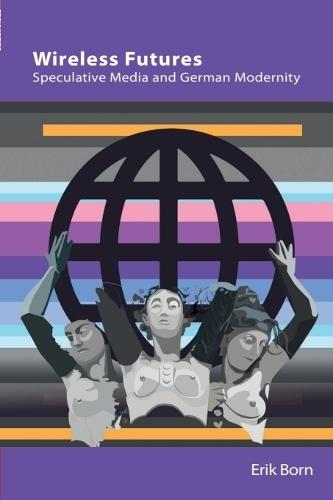
What will wireless media be like in the future? How might they change people and societies? Will the future differ significantly from the past? Wireless Futures argues that meaningful answers to these century-old questions depend equally on markets, technical limits, and sociotechnical imaginaries of media change. Before wireless came to mean 'Wi-Fi,' before 'the wireless' meant 'radio,' even before the first trials in radiotelegraphy, it was a central object of financial and theoretical speculation. Wireless Futures unpacks the speculative media question for the case of German modernity. Interrogating the materiality, temporality, and contingency of wireless, this critical project contributes to media philosophy, modernism & modernity studies, and German literary & cultural studies. Wireless Futures models an approach to speculative media based on testing out the limits of media knowledge and questioning the limits of limit-thinking. It shows how the present continuously remakes connections between the past.
Full Product Details
Author: Dr Erik Born
Publisher: Edinburgh University Press
Imprint: Edinburgh University Press
ISBN: 9781399553599
ISBN 10: 1399553593
Pages: 312
Publication Date: 30 April 2026
Audience:
College/higher education
,
Postgraduate, Research & Scholarly
Format: Hardback
Publisher's Status: Forthcoming
Availability: Not yet available

This item is yet to be released. You can pre-order this item and we will dispatch it to you upon its release.
Reviews
In Wireless Futures Professor Born has assembled a remarkable archive and combined it with incisive critical readings, reminding us just how much our present moment of ubiquitous wireless connectivity owes not just to connections made but even more to those not. Here, finally, is a study up to the challenges of meeting our wireless present directly. -- Timothy Campbell, Cornell University Wireless Futures draws signals from noise by thinking through media. No longer bound to copper wires or material conduits, these signals permeate the spaces around and within us. Born's book challenges us to reconsider the medium specificity at the heart of our historical visions of the future. -- Florian Sprenger, Ruhr-University Bochum
In Wireless Futures Professor Born has assembled a remarkable archive and combined it with incisive critical readings, reminding us just how much our present moment of ubiquitous wireless connectivity owes not just to connections made but even more to those not. Here, finally, is a study up to the challenges of meeting our wireless present directly. -- Timothy Campbell, Cornell University Wireless Futures draws signals from noise by thinking through media. No longer bound to copper wires or material conduits, these signals permeate the spaces around and within us. Born's book challenges us to reconsider the medium specificity at the heart of our historical visions of the future. -- Florian Sprenger, Ruhr-University Bochum As its title indicates, Wireless Futures is about many futures: the futures of the past that never came to pass, the present which never ever was a future, and the futures that are being predicted and projected but remain unknown. More specifically, Wireless Futures is about the wireless age in the double sense of the time before and after the wiring of our little planet earth. Elegantly written and based on close readings of a wide variety of source materials, but also daringly speculative, the study is an important contribution to the future of media studies, media theory, and media philosophy. In a world in which wired and wireless networks are and remain inextricably entangled, the book will serve as a beacon of orientation not only to scholars in the humanities, but also to a community of readers outside of academia. I venture to predict a great future for Wireless Futures. -- Wolf Kittler, University of California Santa Barbara
Author Information
Erik Born is Assistant Professor in the Department of German Studies at Cornell University where he works on transhistorical and transcultural connections across media history and theory.