Awards
- Winner of Best Book Award, Race, Ethnicity, and Politics Section of the American Political Science Association 2014
Overview
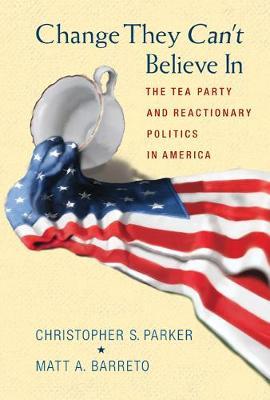
Are Tea Party supporters merely a group of conservative citizens concerned about government spending? Or are they racists who refuse to accept Barack Obama as their president because he's not white? Change They Can't Believe In offers an alternative argument--that the Tea Party is driven by the reemergence of a reactionary movement in American politics that is fueled by a fear that America has changed for the worse. Providing a range of original evidence and rich portraits of party sympathizers as well as activists, Christopher Parker and Matt Barreto show that what actually pushes Tea Party supporters is not simple ideology or racism, but fear that the country is being stolen from ""real Americans""--a belief triggered by Obama's election. From civil liberties and policy issues, to participation in the political process, the perception that America is in danger directly informs how Tea Party supporters think and act. The authors argue that this isn't the first time a segment of American society has perceived the American way of life as under siege.In fact, movements of this kind often appear when some individuals believe that ""American"" values are under threat by rapid social changes. Drawing connections between the Tea Party and right-wing reactionary movements of the past, including the Know Nothing Party, the Ku Klux Klan of the 1920s, and the John Birch Society, Parker and Barreto develop a framework that transcends the Tea Party to shed light on its current and future consequences. Linking past and present reactionary movements, Change They Can't Believe In rigorously examines the motivations and political implications associated with today's Tea Party.
Full Product Details
Author: Christopher S. Parker ,
Matthew Barreto
Publisher: Princeton University Press
Imprint: Princeton University Press
Dimensions:
Width: 15.20cm
, Height: 1.50cm
, Length: 23.50cm
Weight: 0.652kg
ISBN: 9780691151830
ISBN 10: 0691151830
Pages: 384
Publication Date: 26 May 2013
Audience:
Professional and scholarly
,
Professional & Vocational
Replaced By: 9781400852314
Format: Hardback
Publisher's Status: Active
Availability: Temporarily unavailable

The supplier advises that this item is temporarily unavailable. It will be ordered for you and placed on backorder. Once it does come back in stock, we will ship it out to you.
Language: English
Reviews
A scathing analysis of the Tea Party movement, linking it in spirit to the Ku Klux Klan and the John Birch Society. Taking today's conservative populists to be dangerous and their ideas self-incriminating, the authors speculate that Tea Party supporters may perceive of social change as subversion. Based on research and interviews, they suggest racism, desire for social dominance ... drives the Tea Party. Publishers Weekly [A] rigorous scholarly investigation of the tea party... Parker and Barreto make the case that tea party supporters are driven above all by 'anxiety incited by Obama as President.' Intuitively, this may already make sense to many readers, but the authors muster the evidence in support, dividing and subdividing different categories of political activity and belief to arrive at a firm basis for their conclusion... [S]upported by reasoned facts in place of political passions. Kirkus Reviews
A scathing analysis of the Tea Party movement, linking it in spirit to the Ku Klux Klan and the John Birch Society. Taking today's conservative populists to be dangerous and their ideas self-incriminating, the authors speculate that Tea Party supporters may perceive of social change as subversion. Based on research and interviews, they suggest racism, desire for social dominance ... drives the Tea Party. Publishers Weekly [A] rigorous scholarly investigation of the tea party... Parker and Barreto make the case that tea party supporters are driven above all by 'anxiety incited by Obama as President.' Intuitively, this may already make sense to many readers, but the authors muster the evidence in support, dividing and subdividing different categories of political activity and belief to arrive at a firm basis for their conclusion... [S]upported by reasoned facts in place of political passions. Kirkus Reviews [Parker and Barreto's] statistically informed analysis helps us understand the Tea Party's priorities, its fervor, and its contempt for compromise. -- Glenn C. Altschuler Huffington Post
A rigorous scholarly investigation of the tea party... [S]upported by reasoned facts in place of political passions. Kirkus Reviews
A scathing analysis of the Tea Party movement, linking it in spirit to the Ku Klux Klan and the John Birch Society. Taking today's conservative populists to be dangerous and their ideas self-incriminating, the authors speculate that Tea Party supporters may perceive of social change as subversion. Based on research and interviews, they suggest racism, desire for social dominance ... drives the Tea Party. --Publishers Weekly Change They Can't Believe In offers valuable empirical data on the Tea Party, and its focus on supporters' antagonism toward Obama is critical to understanding the movement. --Michael O?Donnell, New Republic [A] rigorous scholarly investigation of the tea party... Parker and Barreto make the case that tea party supporters are driven above all by 'anxiety incited by Obama as President.' Intuitively, this may already make sense to many readers, but the authors muster the evidence in support, dividing and subdividing different categories of political activity and belief to arrive at a firm basis for their conclusion... [S]upported by reasoned facts in place of political passions. --Kirkus Reviews [Parker and Barreto's] statistically informed analysis helps us understand the Tea Party's priorities, its fervor, and its contempt for compromise. --Glenn C. Altschuler, Huffington Post
Author Information
Christopher S. Parker is the Stuart A. Scheingold Professor of Social Justice and Political Science at the University of Washington, Seattle. He is the author of Fighting for Democracy (Princeton). Matt A. Barreto is associate professor of political science at the University of Washington, Seattle, and director of the Washington Institute for the Study of Ethnicity, Race and Sexuality. He is the author of Ethnic Cues.