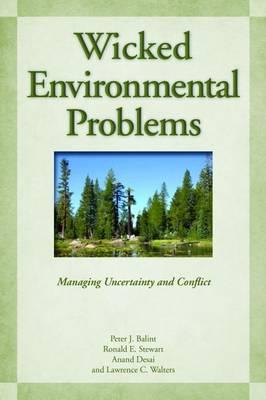
Full Product Details
Author: Peter J. Balint ,
Ronald E. Stewart ,
Anand Desai ,
Lawrence C. Walters
Publisher: Island Press
Imprint: Island Press
Dimensions:
Width: 15.30cm
, Height: 2.00cm
, Length: 22.90cm
Weight: 0.458kg
ISBN: 9781597264747
ISBN 10: 1597264741
Pages: 272
Publication Date: 19 August 2011
Audience:
College/higher education
,
Professional and scholarly
,
Undergraduate
,
Postgraduate, Research & Scholarly
Format: Hardback
Publisher's Status: Out of Stock Indefinitely
Availability: In Print

Limited stock is available. It will be ordered for you and shipped pending supplier's limited stock.
Reviews
This book has much to recommend it. The review of the wicked problems literature is very useful, especially for planning theory courses. The case studies nicely illustrate, especially when the outcomes are risky and the science is uncertain. Policy analysts and modelers will find the innovative preference analysis of special interest. --Journal of Planning Education and Research Both specialist and general reader will find much to engage them by reading Wicked Environmental Problems. --Electronic Green Journal Overall, a useful and affordable volume for scholars and practitioners in environmental management, complementing more detailed theoretical books on the market. --CHOICE Wicked Environmental Problems is a thoughtful response to the question faced by every forest manager and land planner: how do we address risk and uncertainty in the face of profound public disagreement over management options for public lands? I highly recommend this book to anyone interested in complex environmental planning. --Jack Blackwell retired Regional Forester, Pacific Southwest Region, US Forest Service Natural resource issues are becoming increasingly complex and difficult to resolve. In this book, Peter Balint and his colleagues offer fascinating insights into so-called wicked environmental problems. They suggest a commonsense approach to engage stakeholders through an adaptivemanagement framework for assessing policy options and devising solutions for the real world. --James R. Lyons Lecturer, Yale University, and Senior Director, Defenders of Wildlife This book should be required reading for government resource managers, their supervisors, and NGOs concerned with resource issues. Wicked problems, characterized by a high degree of scientific uncertainty and deep disagreement on values, will inevitably proliferate with increasing population and pressures on our lands and resources. This important book describes approaches to deal with wicked problems, and equally important, how not to approach them. --Lee M. Talbot Professor, Department of Environmental Science and Policy, George Mason University
Natural resource issues are becoming increasingly complex and difficult to resolve. In this book, Peter Balint and his colleagues offer fascinating insights into so-called wicked environmental problems. They suggest a commonsense approach to engage stakeholders through an adaptivemanagement framework for assessing policy options and devising solutions for the real world. --James R. Lyons Lecturer, Yale University, and Senior Director, Defenders of Wildlife (07/11/2011)
Author Information
Peter J. Balint is an associate professor of environmental policy in the Department of Public and International Affairs, George Mason University. Ronald E. Stewart spent thirty years with the USDADA Forest Service as Deputy Chief for Programs and Legislation and five years on the faculty of the Department of Environmental Science and Policy, George Mason University. Anand Desai is a Professor at the John Glenn School of Public Affairs at Ohio State University, in Columbus. Lawrence C. Walters is Stewart Grow Professor of Public Policy and Management in the Romney Institute, Brigham Young University, in Provo, Utah.