Full Product Details
Author: Victor Davis Hanson
Publisher: Faber & Faber
Imprint: Faber & Faber
Edition: Main
Dimensions:
Width: 13.50cm
, Height: 4.20cm
, Length: 21.50cm
Weight: 0.570kg
ISBN: 9780571216406
ISBN 10: 0571216404
Pages: 512
Publication Date: 04 November 2002
Audience:
General/trade
,
College/higher education
,
Professional and scholarly
,
General
,
Undergraduate
Format: Paperback
Publisher's Status: Active
Availability: To order

Stock availability from the supplier is unknown. We will order it for you and ship this item to you once it is received by us.
Reviews
'Western countries have tended to defeat their enemies in warfare over the last 2500 years as a result of a sustained cultural heritage that has made them ruthlessly efficient on the battlefield. That is the thesis of this robust and stimulating history, and it is especially relevant after the terrible events of September 11.' Richard Lambert, Financial Times; 'At the heart of this big, combative and gutsy book, there is an argument which is powerful and convincing. Wars are not technical exercises in a vacuum; they are products of human societies, and some of the key values and strengths of those societies will be expressed in their conduct of war.' Noel Malcolm, Sunday Telegraph
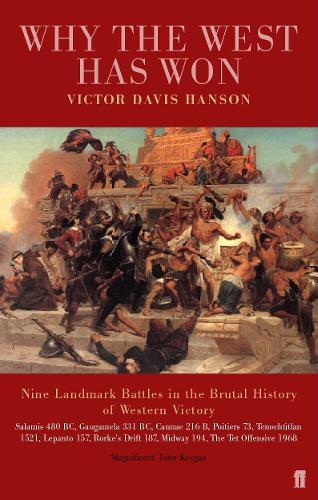
A Californian scholar surveys warfare over two and a half millenia, from the battle of Salamis to the Tet offensive in Vietnam. He concludes that victory in war is most likely to lie with the side that most prizes individuals. Free societies, he thinks, contain a cultural ingredient which makes them superior to despotisms. Besides Salamis and Tet, he discusses seven other battles: Gaugamela, Cannae, Poitiers (Charles Martel's victory, not the Black Prince's), Tenochtitlan, Lepanto, Rorke's Drift and Midway. Dozens of asides make clear that his knowledge of military history is much wider. For each battle, he summarizes its strategic weight as well as going into a gruesome mass of tactical detail; assesses the impact of ground and weather; and sums up the results. He has many telling phrases, such as this : 'the garrison at Rorke's Drift proved to be the most dangerous hundred men in the world.' He lays stress on just those features of battle that get left out by most strategic analysts: he discusses in detail the impact of weapons on flesh, and leaves his readers in no doubt about what a shocking business war has to be. Shock, in fact, is what the 'Western' fighting man is most eager to impose on his enemy. He begins each chapter with an extract from a classical Greek author, and maintains that the Greeks and Romans in turn developed the concept of the citizen soldier, who has a say in how and why he is to endanger himself for his community. He insists, as Aristotle did, that war is a normal way of life for mankind, gloomy though the prospects of modern war with modern weaponry have become. He is sounder on tactics and on armament than he is on political theory. This is a most thought-provoking book, of lasting interest and value. (Kirkus UK)
Author Information
Victor Davis Hanson was born in 1953 and received his PhD from Stanford University. He is currently Professor of Classics at California State University, Fresno. His popular books on classical warfare include The Western Way of War: Infantry Battle in Classical Greece, The Soul of Battle: From Ancient Times to the Present Day, How Three Great Liberators Vanquished Tyranny, The Other Greeks: The Family Farm and the Agrarian Roots of Western Civilization and Fields Without Dreams: Defending Agrarian Idea. He lives in Selma, California.