Overview
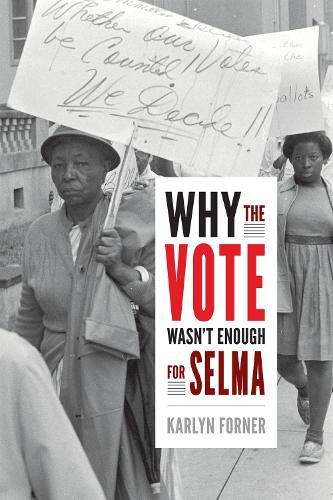
In Why the Vote Wasn't Enough for Selma Karlyn Forner rewrites the heralded story of Selma to explain why gaining the right to vote did not bring about economic justice for African Americans in the Alabama Black Belt. Drawing on a rich array of sources, Forner illustrates how voting rights failed to offset decades of systematic disfranchisement and unequal investment in African American communities. Forner contextualizes Selma as a place, not a moment within the civil rights movement -a place where black citizens' fight for full citizenship unfolded alongside an agricultural shift from cotton farming to cattle raising, the implementation of federal divestment policies, and economic globalization. At the end of the twentieth century, Selma's celebrated political legacy looked worlds apart from the dismal economic realities of the region. Forner demonstrates that voting rights are only part of the story in the black freedom struggle and that economic justice is central to achieving full citizenship.
Full Product Details
Author: Karlyn Forner
Publisher: Duke University Press
Imprint: Duke University Press
Weight: 0.522kg
ISBN: 9780822370055
ISBN 10: 0822370050
Pages: 376
Publication Date: 17 October 2017
Audience:
General/trade
,
Professional and scholarly
,
General
,
Professional & Vocational
Format: Paperback
Publisher's Status: Active
Availability: In Print

This item will be ordered in for you from one of our suppliers. Upon receipt, we will promptly dispatch it out to you. For in store availability, please contact us.
Reviews
-Karlyn Forner's valuable and informative Why the Vote Wasn't Enough for Selma provides with great depth much-needed context for a struggle that is too often reduced to a 1965 protest march, and raises with great relevance for today the often-avoided issue of the undone work necessary to secure meaningful change. This is much more than a book about Alabama civil rights struggle. Read it and learn.---Charles E. Cobb Jr., author of -This Nonviolent Stuff'll Get You Killed: How Guns Made the Civil Rights Movement Possible -
Although scholars have explored questions of voting rights and economic justice for black residents of Selma, Karlyn Forner's study provides new details and fresh insights into the evolution, impact, and legacy of the fight for voting rights. Sure to appeal to a wide audience, Why the Vote Wasn't Enough for Selma is truly exceptional in terms of its breadth, depth, vision, and scope. -- Hasan Kwame Jeffries, author of * Bloody Lowndes, Civil Rights and Black Power in Alabama's Black Belt * Karlyn Forner's valuable and informative Why the Vote Wasn't Enough for Selma provides with great depth much-needed context for a struggle that is too often reduced to a 1965 protest march, and raises with great relevance for today the often-avoided issue of the undone work necessary to secure meaningful change. This is much more than a book about Alabama civil rights struggle. Read it and learn. -- Charles E. Cobb Jr., author of * This Nonviolent Stuff'll Get You Killed: How Guns Made the Civil Rights Movement Possible *
With sheer ambition and narrative deftness, Karlyn Forner sets a new standard for deeper explorations of U.S. history. By plumbing Selma's past-not over the customary two months in 1965, but over more than a century-Forner gives us a 'civil rights movement' that is longer and broader than we ever knew. Deeply researched, brilliantly framed, and fearlessly candid, this is that rare history that also speaks loudly in the present tense. -- Timothy B. Tyson, author of * The Blood of Emmett Till * Forner argues convincingly that, for many black residents, 'Selma did more for civil rights than civil rights did for Selma.' This lucid, detailed book is often dispiriting to read, but it's an important reminder of the still-unfulfilled promise of the black freedom movement. * Publishers Weekly, Starred Review * Though the general contours of this story are well known, Forner presents an exhaustive social, political, and economic history of Selma set within local and national context. A near page-turner that will appeal to both general and scholarly readers interested in the civil rights movement. -- William D. Pederson * Library Journal * Although scholars have explored questions of voting rights and economic justice for black residents of Selma, Karlyn Forner's study provides new details and fresh insights into the evolution, impact, and legacy of the fight for voting rights. Sure to appeal to a wide audience, Why the Vote Wasn't Enough for Selma is truly exceptional in terms of its breadth, depth, vision, and scope. -- Hasan Kwame Jeffries, author of * Bloody Lowndes: Civil Rights and Black Power in Alabama's Black Belt * Karlyn Forner's valuable and informative Why the Vote Wasn't Enough for Selma provides with great depth much-needed context for a struggle that is too often reduced to a 1965 protest march, and raises with great relevance for today the often-avoided issue of the undone work necessary to secure meaningful change. This is much more than a book about Alabama's civil rights struggle. Read it and learn. -- Charles E. Cobb Jr., author of * This Nonviolent Stuff'll Get You Killed: How Guns Made the Civil Rights Movement Possible *
Author Information
Karlyn Forner is Project Manager of the SNCC Digital Gateway at Duke University Libraries.