Overview
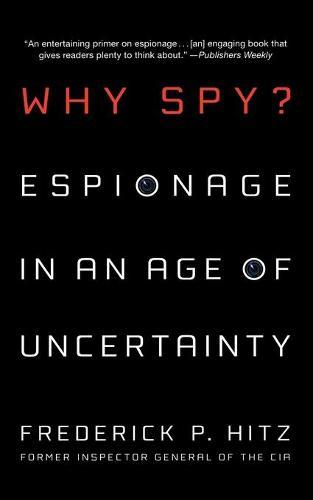
What motivates someone to risk his or her life in the shadowy, often dangerous business of espionage? What are the needs and opportunities for spying amid the 'War on Terrorism'? And how can the United States recruit spies in its struggle against Islamic fundamentalists' acts of anti-Western jihad? Drawing on more than twenty-five years of experience, Hitz, one of the nation's leading experts on intelligence, answers these questions and more, as he gives readers a fascinating, behind-the-scenes glimpse into the intriguing world of international espionage. This is a must read for fans of Tom Clancy and John le Carre.
Full Product Details
Author: Frederick P. Hitz
Publisher: Griffin Publishing
Imprint: Saint Martin's Griffin,U.S.
Dimensions:
Width: 12.70cm
, Height: 1.80cm
, Length: 18.10cm
Weight: 0.249kg
ISBN: 9780312561734
ISBN 10: 0312561733
Pages: 224
Publication Date: 09 June 2009
Audience:
General/trade
,
General
Format: Paperback
Publisher's Status: Active
Availability: Available To Order

We have confirmation that this item is in stock with the supplier. It will be ordered in for you and dispatched immediately.
Reviews
<p> A useful primer on the new (and greater) challenges to intelligence collection and analysis so different from those of the Cold War. Hitz outlines why the classic motives for recruitment of spies have weakened---even as we become more dependent on good intelligence in coping with the threat of terrorism. As a onetime inspector general at the CIA, he presents his own view regarding the restraints he feels should be imposed on intelligence operations. <br>--James R. Schlesinger, former Director of Central Intelligence and Secretary of Defense and of Energy <br> Nice Americans do not like human espionage. In this book Frederick P. Hitz has done a great job of rationally explaining the not nice, morally ambiguous, 'dirty' business of espionage. This is a service to the country at a time when there has never been a greater need for secret, human-source intelligence--which can only be obtained with the full understanding and support of the American people. <br>--Paul J. Redmond, for
A useful primer on the new (and greater) challenges to intelligence collection and analysis so different from those of the Cold War. Hitz outlines why the classic motives for recruitment of spies have weakened---even as we become more dependent on good intelligence in coping with the threat of terrorism. As a onetime inspector general at the CIA, he presents his own view regarding the restraints he feels should be imposed on intelligence operations. James R. Schlesinger, former Director of Central Intelligence and Secretary of Defense and of Energy Nice Americans do not like human espionage. In this book Frederick P. Hitz has done a great job of rationally explaining the not nice, morally ambiguous, dirty business of espionage. This is a service to the country at a time when there has never been a greater need for secret, human-source intelligence--which can only be obtained with the full understanding and support of the American people. Paul J. Redmond, former head of CIA Counterintelligence
A useful primer on the new (and greater) challenges to intelligence collection and analysis so different from those of the Cold War. Hitz outlines why the classic motives for recruitment of spies have weakened---even as we become more dependent on good intelligence in coping with the threat of terrorism. As a onetime inspector general at the CIA, he presents his own view regarding the restraints he feels should be imposed on intelligence operations. <br>--James R. Schlesinger, former Director of Central Intelligence and Secretary of Defense and of Energy <br> Nice Americans do not like human espionage. In this book Frederick P. Hitz has done a great job of rationally explaining the not nice, morally ambiguous, 'dirty' business of espionage. This is a service to the country at a time when there has never been a greater need for secret, human-source intelligence--which can only be obtained with the full understanding and support of the American people. <br>--Paul J. Redmond, former head of CIA Counterintelligence
Author Information
Frederick P. Hitz, author of The Great Game: The Myths and Reality of Espionage, was inspector general of the CIA from 1990 to 1998. He also has been a lecturer at Princeton University. He currently teaches at the University of Virginia's School of Law and Department of Politics.