Overview
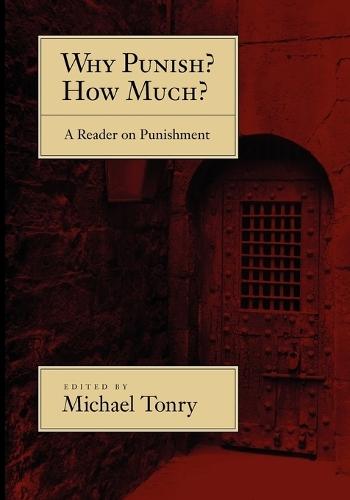
Punishment, like all complex human institutions, tends to change as ways of thinking go in and out of fashion. Normative, political, social, psychological, and legal ideas concerning punishment have changed drastically over time, and especially in recent decades. Why Punish? How Much? collects essays from classical philosophers and contemporary theorists to examine these shifts. Michael Tonry has gathered a comprehensive set of readings ranging from Kant, Hegel, and Bentham to recent writings on developments in the behavioral and medical sciences. Together they cover foundations of punishment theory such as consequentialism, retributivism, and functionalism, new approaches like restorative, communitarian, and therapeutic justice, and mixed approaches that attempt to link theory and policy. This volume includes an accessible introduction that chronicles the development of punishment systems and theorizing over the course of the last two centuries. Why Punish? How Much? provides a fresh and comprehensive approach to thinking about punishment and sentencing for a broad range of law, sociology, philosophy, and criminology courses.
Full Product Details
Author: Michael Tonry (Professor of Law and Public Policy, Professor of Law and Public Policy, University of Minnesota Law School)
Publisher: Oxford University Press Inc
Imprint: Oxford University Press Inc
Dimensions:
Width: 17.80cm
, Height: 3.10cm
, Length: 24.90cm
Weight: 0.794kg
ISBN: 9780195328868
ISBN 10: 0195328868
Pages: 456
Publication Date: 13 January 2011
Audience:
College/higher education
,
Postgraduate, Research & Scholarly
Format: Paperback
Publisher's Status: Active
Availability: Manufactured on demand 
We will order this item for you from a manufactured on demand supplier.
Table of Contents
Introduction: Thinking about Punishment, Michael Tonry Part One: Classical Theories Introduction to Part One 1. The Penal Law and the Law of Pardon, Immanuel Kant 2. Wrong [Das Unrecht], G.W.F. Hegel 3. The Utilitarian Theory of Punishment, Jeremy Bentham 4. Principles of a Rational Penal Code, Sheldon Glueck 5. The Humanitarian Theory of Punishment, C.S. Lewis 6. Legal Values and the Rehabilitative Ideal, Francis Allen Part Two: Retributive Theories Introduction to Part Two 7. The Expressive Function of Punishment, Joel Feinberg 8. Marxism and Retribution, Jeffrey Murphy 9. A Paternalist Theory of Punishment, Herbert Morris 10. Punishment and the Rule of Law, T.M. Scanlon 11. Penance, Punishment, and the Limits of Community, R.A. Duff Part Three: Mixed Theories Introduction to Part Three 12. Prolegomenon to the Principles of Punishment, H.L.A. Hart 13. Proportionate Sentences: A Desert Perspective, Andrew von Hirsch 14. Proportionality, Parsimony, and Interchangeability of Punishments, Michael Tonry 15. Sentencing and Punishment in Finland: The Decline of the Repressive Ideal, Tapio Lappi-Seppälä 16. Limiting Retributivism, Richard Frase 17. Limiting Excessive Prison Sentencing, Richard Frase Part Four: Emotion, Intuition, Determinism, and Punishment Introduction to Part Four 18. Morality and the Retributive Emotions, J.L. Mackie 19. The Role of Moral Philosophers in the Competition between Deontological and Empirical Desert, Paul H. Robinson 20. For the Law, Neuroscience Changes Nothing and Everything, Joshua Greene and Jonathan Cohen Part Five: Restorative Theories Introduction to Part Five 21. Restoration in Youth Justice, Lode Walgrave 22. In Search of Restorative Jurisprudence, John Braithwaite 23. The Virtues of Restorative Processes, the Vices of 'Restorative Justice', Paul H. Robinson 24. Restorative Punishment and Punitive Restoration, R.A. Duff Part Six: Functionalist Theories Introduction to Part Six 25. From Slavery to Mass Incarceration: Rethinking the 'Race Question' in the US, Loïc Wacquant 26. Labor Market and Penal Sanction: Thoughts on the Sociology of Criminal Justice, Georg Rusche 27. Rules for the Distinction of the Normal from the Pathological, Emile Durkheim 28. The Carceral, Michel Foucault
Reviews
<br> Law students, especially, will value this historically informed, multi-disciplinary, and yet cutting-edge anthology on two of the perennial though most problematic questions of criminal law. --John Kleinig, Director of the Institute for Criminal Justice Ethics and Professor of Philosophy, John Jay College of Criminal Justice<p><br> Why Punish? How Much? is a brilliantly organized and highly focused collection on punishment purposes, compiled at a time when the discussion of purposes at all levels is sometimes incoherent and often incomplete. I recommend this volume to lawyers, judges and students of criminal law and criminology alike. --Marc L. Miller, Professor of Law, University of Arizona College of Law<p><br> This is a wonderful selection of historical and contemporary readings that together address all the main themes of punishment theory. The editor's clear and insightful introductions situate the texts and allow readers to make sense of the debates. It will make an ideal textbook for any course on punishment theory --Matt Matravers, Director of the School of Politics, Economics, & Philosophy, University of York<p><br>
<br> Law students, especially, will value this historically informed, multi-disciplinary, and yet cutting-edge anthology on two of the perennial though most problematic questions of criminal law. --John Kleinig, Director of the Institute for Criminal Justice Ethics and Professor of Philosophy, John Jay College of Criminal Justice<p><br> Why Punish? How Much? is a brilliantly organized and highly focused collection on punishment purposes, compiled at a time when the discussion of purposes at all levels is sometimes incoherent and often incomplete. I recommend this volume to lawyers, judges and students of criminal law and criminology alike. --Marc L. Miller, Professor of Law, University of Arizona College of Law<p><br> This is a wonderful selection of historical and contemporary readings that together address all the main themes of punishment theory. The editor's clear and insightful introductions situate the texts and allow readers to make sense of the debates. It will make an ideal te
"""Law students, especially, will value this historically informed, multi-disciplinary, and yet cutting-edge anthology on two of the perennial though most problematic questions of criminal law.""--John Kleinig, Director of the Institute for Criminal Justice Ethics and Professor of Philosophy, John Jay College of Criminal Justice ""Why Punish? How Much? is a brilliantly organized and highly focused collection on punishment purposes, compiled at a time when the discussion of purposes at all levels is sometimes incoherent and often incomplete. I recommend this volume to lawyers, judges and students of criminal law and criminology alike.""--Marc L. Miller, Professor of Law, University of Arizona College of Law ""This is a wonderful selection of historical and contemporary readings that together address all the main themes of punishment theory. The editor's clear and insightful introductions situate the texts and allow readers to make sense of the debates. It will make an ideal textbook for any course on punishment theory""--Matt Matravers, Director of the School of Politics, Economics, & Philosophy, University of York"
<br> Law students, especially, will value this historically informed, multi-disciplinary, and yet cutting-edge anthology on two of the perennial though most problematic questions of criminal law. --John Kleinig, Director of the Institute for Criminal Justice Ethics and Professor of Philosophy, John Jay College of Criminal Justice<br> Why Punish? How Much? is a brilliantly organized and highly focused collection on punishment purposes, compiled at a time when the discussion of purposes at all levels is sometimes incoherent and often incomplete. I recommend this volume to lawyers, judges and students of criminal law and criminology alike. --Marc L. Miller, Professor of Law, University of Arizona College of Law<br> This is a wonderful selection of historical and contemporary readings that together address all the main themes of punishment theory. The editor's clear and insightful introductions situate the texts and allow readers to make sense of the debates. It will make an ideal textbook
""Law students, especially, will value this historically informed, multi-disciplinary, and yet cutting-edge anthology on two of the perennial though most problematic questions of criminal law.""--John Kleinig, Director of the Institute for Criminal Justice Ethics and Professor of Philosophy, John Jay College of Criminal Justice ""Why Punish? How Much? is a brilliantly organized and highly focused collection on punishment purposes, compiled at a time when the discussion of purposes at all levels is sometimes incoherent and often incomplete. I recommend this volume to lawyers, judges and students of criminal law and criminology alike.""--Marc L. Miller, Professor of Law, University of Arizona College of Law ""This is a wonderful selection of historical and contemporary readings that together address all the main themes of punishment theory. The editor's clear and insightful introductions situate the texts and allow readers to make sense of the debates. It will make an ideal textbook for any course on punishment theory""--Matt Matravers, Director of the School of Politics, Economics, & Philosophy, University of York
Author Information
Michael Tonry is Professor of Law and Public Policy at the University of Minnesota Law School, and Senior Fellow at the Netherlands Institute for the Study of Crime and Law Enforcement, Free University Amsterdam.
Tab Content 6
Author Website:
Countries Available
All regions
|