Overview
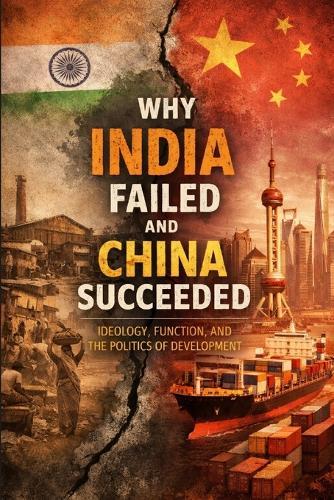
Why does China's authoritarian system deliver decades of rapid transformation while democratic India struggles to achieve the same structural shift? This book challenges the conventional answers. It rejects the easy claim that political regime alone determines economic success and instead looks at the deeper mechanics of development: the movement of labor out of subsistence agriculture, the creation of investable surplus, and the discipline that governs how that surplus is allocated. In China, the Maoist attempt to force industrialization through state extraction produced famine, stagnation, and systemic inefficiency. Yet reform-era growth did not come from the perfection of that model - it came from its partial retreat. When agricultural households regained control over output, when profit signals were allowed to operate in special economic zones, and when labor was freed to move, productivity surged and hundreds of millions escaped poverty. India followed the opposite path. Anti-colonial nationalism, shaped by the experience of being reduced to a supplier of raw materials and a market for foreign manufactures, produced a political economy of protection. Land, small-scale production, and traditional industry were shielded in the name of self-reliance. The result was not transformation but the preservation of subsistence - a democratic system that protected livelihoods without generating structural change. Through a comparative study of pre-colonial civilizational foundations, colonial state formation, post-independence policy choices, and the political economy of reform, this book advances a clear and provocative thesis: Development is not a function of ideology, regime type, or state intention. It depends on whether a society allows productive labor to leave subsistence, permits capital to be formed, and subjects investment to real economic discipline. China succeeded where incentives were restored and markets were allowed to function. India stagnated where protection froze the very transformations that industrialization requires. Blending political economy, economic history, and institutional analysis, Why India Failed and China Succeeded offers a new framework for understanding modernization - and a powerful argument about the conditions under which nations rise, stall, or fall behind.
Full Product Details
Author: Mattias Gessesse
Publisher: Independently Published
Imprint: Independently Published
Dimensions:
Width: 15.20cm
, Height: 0.40cm
, Length: 22.90cm
Weight: 0.100kg
ISBN: 9798249035846
Pages: 66
Publication Date: 19 February 2026
Audience:
General/trade
,
General
Format: Paperback
Publisher's Status: Active
Availability: Available To Order

We have confirmation that this item is in stock with the supplier. It will be ordered in for you and dispatched immediately.