Overview
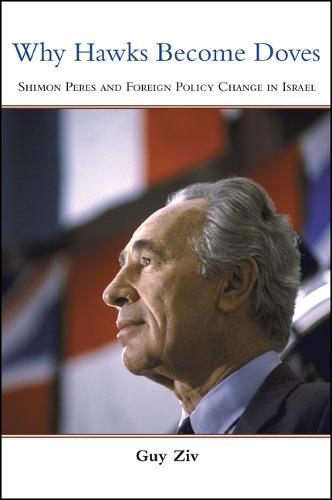
Investigates how leaders' personalities shape important foreign policy shifts.
Full Product Details
Author: Guy Ziv
Publisher: State University of New York Press
Imprint: State University of New York Press
Dimensions:
Width: 15.20cm
, Height: 2.50cm
, Length: 22.90cm
Weight: 0.272kg
ISBN: 9781438453965
ISBN 10: 1438453965
Pages: 194
Publication Date: 02 July 2015
Audience:
College/higher education
,
Undergraduate
,
Postgraduate, Research & Scholarly
Format: Paperback
Publisher's Status: Active
Availability: In Print

This item will be ordered in for you from one of our suppliers. Upon receipt, we will promptly dispatch it out to you. For in store availability, please contact us.
Reviews
Guy Ziv has written a masterful and intriguing study that breaks new ground in demonstrating the importance of the individual leader in framing foreign policy. The comparisons of Peres, Rabin, Begin, and Shamir are extraordinary, and effectively demonstrate the advantages of a leader who has a talent for adapting to altered conditions and listening to differing perspectives. It's both an absorbing page-turner and a stimulating eye-opener. -Steven L. Spiegel, coauthor of The Peace Puzzle: America's Quest for Arab-Israeli Peace, 1989-2011 Ziv has written a fascinating account of how some leaders (Peres, Rabin, Sharon) are able to shift their goals and strategies to a less conflictual mode, and how others (Shamir, Begin, Netanyahu) are simply incapable of doing so. Ziv makes a strong case for the proposition that the cognitive structure of leaders matters. A turn towards peace requires national leaders who are personally capable of making that turn. Ziv's tome is a substantial contribution to the literatures of foreign policy analysis and political psychology, and is an important read for all who seek a more peaceful world. - Valerie M. Hudson, author of Foreign Policy Analysis: Classic and Contemporary Theory
While several books have been written about Shimon Peres, this is the first academic book-length study, and as such it is very welcome ... this is a well-written book, accessible to all informed and educated readers, not only academic experts, though all will no doubt benefit from it. - Israel Journal of Foreign Affairs ...Ziv's lucid writing style makes his book accessible to students and a general readership, a feat that should not be taken for granted. This book keeps the reader engaged and ultimately makes an important contribution to the discipline of international relations, as well as providing a fresh outlook on the transformation undergone by one of Israel's most prominent statesmen, Shimon Peres. - Israel Studies Review ...a very welcome addition to the discipline. - Israel Studies Guy Ziv has written a masterful and intriguing study that breaks new ground in demonstrating the importance of the individual leader in framing foreign policy. The comparisons of Peres, Rabin, Begin, and Shamir are extraordinary, and effectively demonstrate the advantages of a leader who has a talent for adapting to altered conditions and listening to differing perspectives. It's both an absorbing page-turner and a stimulating eye-opener. -Steven L. Spiegel, coauthor of The Peace Puzzle: America's Quest for Arab-Israeli Peace, 1989-2011 Ziv has written a fascinating account of how some leaders (Peres, Rabin, Sharon) are able to shift their goals and strategies to a less conflictual mode, and how others (Shamir, Begin, Netanyahu) are simply incapable of doing so. Ziv makes a strong case for the proposition that the cognitive structure of leaders matters. A turn towards peace requires national leaders who are personally capable of making that turn. Ziv's tome is a substantial contribution to the literatures of foreign policy analysis and political psychology, and is an important read for all who seek a more peaceful world. - Valerie M. Hudson, author of Foreign Policy Analysis: Classic and Contemporary Theory
Author Information
Guy Ziv is Assistant Professor of International Relations at American University's School of International Service and the author of Readings in U.S. Foreign Policy: Revised First Edition.