Overview
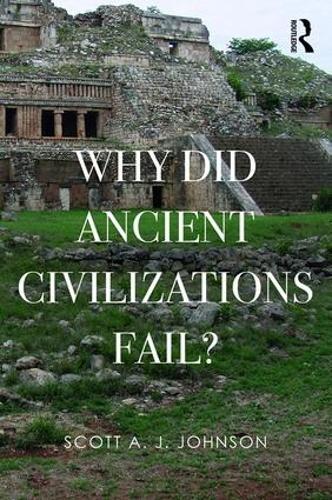
Ideas abound as to why certain complex societies collapsed in the past, including environmental change, subsistence failure, fluctuating social structure and lack of adaptability. Why Did Ancient Civilizations Fail? evaluates the current theories in this important topic and discusses why they offer only partial explanations of the failure of past civilizations. This engaging book offers a new theory of collapse, that of social hubris. Through an examination of Mesopotamian, Egyptian, Roman, Maya, Inca, and Aztec societies, Johnson persuasively argues that hubris blinded many ancient peoples to evidence that would have allowed them to adapt, and he further considers how this has implications for contemporary societies. Comprehensive and well-written, this volume serves as an ideal text for undergraduate courses on ancient complex societies, as well as appealing to the scholar interested in societal collapse.
Full Product Details
Author: Scott A J Johnson (Washington University in Saint Louis, USA)
Publisher: Left Coast Press Inc
Imprint: Left Coast Press Inc
Dimensions:
Width: 15.20cm
, Height: 2.00cm
, Length: 22.90cm
Weight: 0.570kg
ISBN: 9781629582832
ISBN 10: 1629582832
Pages: 294
Publication Date: 13 October 2016
Audience:
College/higher education
,
Undergraduate
,
Postgraduate, Research & Scholarly
Format: Paperback
Publisher's Status: Active
Availability: In Print

This item will be ordered in for you from one of our suppliers. Upon receipt, we will promptly dispatch it out to you. For in store availability, please contact us.
Reviews
Across the first 12 chapters of his book, Why did ancient civilizations fail?, Scott Johnson focuses squarely on societies of the past: the Maya, Mesopotamia, Rome, Egypt, the Aztecs and Incas. His final chapter, however, turns to 'Where we are today'-or perhaps more accurately, what we should be doing today if we wish to avoid the same fate as earlier civilisations. - Robert Witcher, Antiquity
Across the first 12 chapters of his book, Why did ancient civilizations fail?, Scott Johnson focuses squarely on societies of the past: the Maya, Mesopotamia, Rome, Egypt, the Aztecs and Incas. His final chapter, however, turns to `Where we are today'-or perhaps more accurately, what we should be doing today if we wish to avoid the same fate as earlier civilisations. - Robert Witcher, Antiquity
""Across the first 12 chapters of his book, Why did ancient civilizations fail?, Scott Johnson focuses squarely on societies of the past: the Maya, Mesopotamia, Rome, Egypt, the Aztecs and Incas. His final chapter, however, turns to ‘Where we are today’—or perhaps more accurately, what we should be doing today if we wish to avoid the same fate as earlier civilisations.""— Robert Witcher, Antiquity
Across the first 12 chapters of his book, Why did ancient civilizations fail?, Scott Johnson focuses squarely on societies of the past: the Maya, Mesopotamia, Rome, Egypt, the Aztecs and Incas. His final chapter, however, turns to 'Where we are today'--or perhaps more accurately, what we should be doing today if we wish to avoid the same fate as earlier civilisations. -- Robert Witcher, Antiquity
Author Information
Scott A. J. Johnson is a Maya archaeologist who also studies ancient writing and subsistence. Since receiving his Ph.D. in anthropology from Tulane University in 2012, he has taught at various colleges and universities in the United States and Canada. Johnson writes extensively on archaeological methods and the Maya, authoring Translating Maya Hieroglyphs. He is currently the director of the Emal Archaeological Project in Yucatan and a Research Associate at Washington University in Saint Louis.