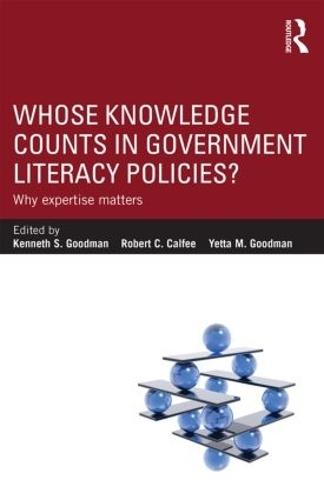
Full Product Details
Author: Kenneth S. Goodman (University of Arizona, USA) ,
Robert C. Calfee (Stanford University, USA) ,
Yetta M. Goodman (University of Arizona, USA)
Publisher: Taylor & Francis Ltd
Imprint: Routledge
Dimensions:
Width: 15.20cm
, Height: 1.50cm
, Length: 22.90cm
Weight: 0.340kg
ISBN: 9780415858014
ISBN 10: 0415858011
Pages: 217
Publication Date: 01 October 2013
Audience:
College/higher education
,
General/trade
,
Tertiary & Higher Education
,
General
Format: Paperback
Publisher's Status: Active
Availability: In Print

This item will be ordered in for you from one of our suppliers. Upon receipt, we will promptly dispatch it out to you. For in store availability, please contact us.
Reviews
Finally! A book that offers smart thinking about federal literacy education policies by the professionals who know literacy best... This book connects the dots between current literacy policies, who is writing those policies, and what ultimately happens when the policies are implemented in school classrooms. These international scholars provide glimpses of parallel events happening around the world, beg us to question why knowledge about literacy research is being ignored, and challenge us to consider who really gains when science is valued over knowledge. Renita Schmidt, The University of Iowa, USA
Curriculum and policy are informed by assumptions about what counts as knowledge, grounded in notions of human nature, and affected by determinations about whose knowledge counts in the construction and delivery of knowledge in formal educational settings. The diversity of ideas offered within the book affords the reader a rich opportunity to consider foundational issues of policy and practice. Summing up: Recommended, All readership levels - J.A. Helfer, Illinois State Board of Education in CHOICE, August 2014 Part II explores many important aspects of literacy teaching, including the curriculum, text complexity, the role of children's literature, diversity in children's literature and the roles of writing teachers. - Margaret Clark, Newman University - Birmingham, Education Journal Finally! A book that offers smart thinking about federal literacy education policies by the professionals who know literacy best... This book connects the dots between current literacy policies, who is writing those policies, and what ultimately happens when the policies are implemented in school classrooms. These international scholars provide glimpses of parallel events happening around the world, beg us to question why knowledge about literacy research is being ignored, and challenge us to consider who really gains when science is valued over knowledge. - Renita Schmidt, The University of Iowa, USA
Curriculum and policy are informed by assumptions about what counts as knowledge, grounded in notions of human nature, and affected by determinations about whose knowledge counts in the construction and delivery of knowledge in formal educational settings. The diversity of ideas offered within the book affords the reader a rich opportunity to consider foundational issues of policy and practice. Summing up: Recommended, All readership levels - JA. Helfer, Illinois State Board of Education in CHOICE, August 2014 Part II explores many important aspects of literacy teaching, including the curriculum, text complexity, the role of children's literature, diversity in children's literature and the roles of writing teachers. - Margaret Clark, Newman University - Birmingham, Education Journal Finally! A book that offers smart thinking about federal literacy education policies by the professionals who know literacy best... This book connects the dots between current literacy policies, who is writing those policies, and what ultimately happens when the policies are implemented in school classrooms. These international scholars provide glimpses of parallel events happening around the world, beg us to question why knowledge about literacy research is being ignored, and challenge us to consider who really gains when science is valued over knowledge. - Renita Schmidt, The University of Iowa, USA
Author Information
Kenneth S. Goodman is Professor Emeritus, Language, Reading and Culture, University of Arizona, USA. Robert C. Calfee is Professor Emeritus, Stanford University School of Education, USA. Yetta M. Goodman is Regents Professor Emerita, Language, Reading and Culture, University of Arizona, USA.