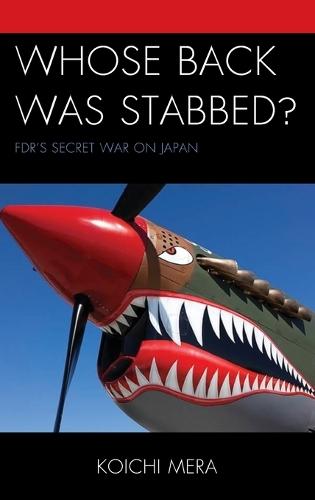
Overview
This is a book that will change the American perception of the Pacific War. One important question is: Who actually started the Pacific War? By examining recently discovered facts revealed through the declassification of official documents, the decoding of secret communications between the Soviet Union and its operatives, and findings from American and Japanese writers in recent decades, the author clarifies the role played by President Franklin D. Roosevelt and members of his cabinet in pushing Japan to the brink of war. Another notable analysis concerns the U.S. occupation of Japan immediately after the war. The author finds it as a spectacular success in politically castrating Japan. The impact is still clearly observable. Many Japanese have lost the sense of nationhood as a result. The author examines the historical background of U.S.-Japan relations from the visit of Commodore Matthew Perry in 1853 to the present day. Utilized a wealth of Japanese as well as American materials, he presents a view of the history of the two countries. He finds that Japan was not very skillful in utilizing code-breaking or information-warfare, but tried to liberate colonies in Asia and Africa, and indeed her effort was successful and ultimately resulted in the loss of Western Colonies including India, Indonesia, Burma, and Malaysia. After reviewing nearly two hundred years of history, the author urges contemporary Japanese to be free from the self-incriminating view of history and to be confident that the nation is on a right track.
Full Product Details
Author: Koichi Mera
Publisher: University Press of America
Imprint: Hamilton Books
Dimensions:
Width: 15.80cm
, Height: 1.90cm
, Length: 24.10cm
Weight: 0.458kg
ISBN: 9780761868958
ISBN 10: 076186895
Pages: 220
Publication Date: 05 April 2017
Audience:
Professional and scholarly
,
Professional & Vocational
Format: Hardback
Publisher's Status: Active
Availability: Manufactured on demand

We will order this item for you from a manufactured on demand supplier.
Reviews
Whose Back Was Stabbed? is a startling but important Japanese view of what led up to the attack on Pearl Harbor and the Pacific War, and what happened to the Japanese nation and people after the air raids. Professor Koichi Mera's personal account of a narrow escape from Korea leads into a look at what the American occupation of Japan-supposedly America's and MacArthur's finest hour-meant to people who had no chance to respond to a propaganda assault on recent Japanese history. The U.S. authorities and their 'court historians' fostered a myth of mindless Japanese aggression that persists to this very day under the guise of patriotism. There are two sides to every quarrel. Professor Mera fearlessly tells the other side. -- John Koster, Author of Operation Snow Dr. Koichi Mera has collected a vast amount of authentic documents and produced this book which represents historically accurate understanding of the events related to the U.S.-Japan relations covering the years around WWII. The FDR conspiracy theory cannot be rejected any longer. -- Hideaki Kase, Commentator on Diplomacy and International Affairs
Whose Back Was Stabbed? is a startling but important Japanese view of what led up to the attack on Pearl Harbor and the Pacific War, and what happened to the Japanese nation and people after the air raids. Professor Koichi Mera's personal account of a narrow escape from Korea leads into a look at what the American occupation of Japan-supposedly America's and MacArthur's finest hour-meant to people who had no chance to respond to a propaganda assault on recent Japanese history. The U.S. authorities and their 'court historians' fostered a myth of mindless Japanese aggression that persists to this very day under the guise of patriotism. There are two sides to every quarrel. Professor Mera fearlessly tells the other side. -- John Koster, Author of Operation Snow Dr. Koichi Mera has collected a vast amount of authentic documents and produced this book which represents historically accurate understanding of the events related to the U.S.-Japan relations covering the years around WWII. The FDR conspiracy theory cannot be rejected any longer. -- Hideaki Kase, Commentator on Diplomacy and International Affairs
Author Information
Koichi Mera, with a Ph. D. from Harvard, has been city planner, economist, public administration specialist, and business professor with Harvard, Tsukuba, Tokyo International Universities, and USC. He has started a history study group on Japan in Los Angeles since 2006.