|
|
|||
|
||||
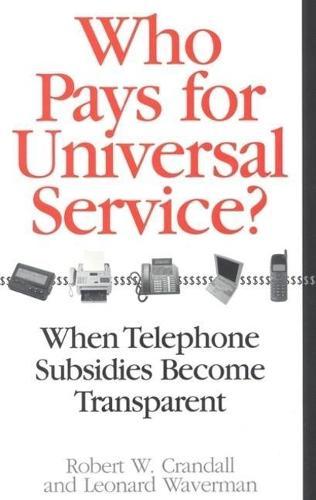
OverviewThis text aims to show that subsidised residential telephone access has little effect on telephone subscriptions in America while it has harmful consequences on the overall value of services. The authors argue that the universal sevice subsidy will have to change as a result of the 1996 Telecommunications Act: subsidies should be paid from intrastate taxes on telecom services and paid directly to carriers or subscribers. Full Product DetailsAuthor: Robert W. Crandall , Leonard WavermanPublisher: Bloomsbury Publishing Plc Imprint: Brookings Institution Dimensions: Width: 15.20cm , Height: 2.10cm , Length: 22.90cm Weight: 0.027kg ISBN: 9780815716129ISBN 10: 0815716125 Pages: 199 Publication Date: 01 June 2000 Audience: Professional and scholarly , Professional and scholarly , Professional & Vocational , Postgraduate, Research & Scholarly Format: Hardback Publisher's Status: Out of Print Availability: Out of stock Table of ContentsReviewsAuthor InformationRobert W. Crandall is a senior fellow in the Economic Studies program at the Brookings Institution, where his research has focused on telecommunications and cable television regulation, industrial organization and policy, and the changing regional structure of the U.S. economy. His previous books include Broadband: Should We Regulate Internet Access? (Brookings, 2002), Telecommunications Liberalization on Two Sides of the Atlantic (Brookings, 2001) and Who Pays for Universal Service? (Brookings, 2000). Leonard Waverman is professor of economics and director of the Centre for International Studies at the University of Toronto. Tab Content 6Author Website:Countries AvailableAll regions |
||||