Overview
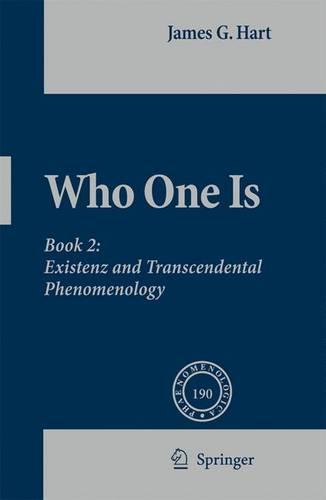
If I am asked in the framework of Book 1, “Who are you?” I, in answering, might say “I don’t know who in the world I am.” Nevertheless there is a sense in which I always know what “I” refers to and can never not know, even if I have become, e.g., amnesiac. Yet in Book 2, “Who are you?” has other senses of oneself in mind than the non-sortal “myself”. For example, it might be the pragmatic context, as in a bureaucratic setting; but “Who are you?” or “Who am I?” might be more anguished and be rendered by “What sort of person are you?” or “What sort am I?” Such a question often surfaces in the face of a “limit-situation”, such as one’s death or in the wake of a shameful deed where we are compelled to find our “centers”, what we also will call “Existenz”. “Existenz” here refers to the center of the person. In the face of the limit-situation one is called upon to act unconditionally in the determination of oneself and one’s being in the world. In this Book 2 we discuss chiefly one’s normative personal-moral identity which stands in contrast to the transcendental I where one’s non-sortal unique identity is given from the start. This moral identity requires a unique self-determination and normative self-constitution which may be thought of with the help of the metaphor of “vocation”. We will see that it has especial ties to one’s Existenz as well as to love. This Book 2 claims that the moral-personal ideal sense of who one is is linked to the transcendental who through a notion of entelechy. The person strives to embody the I-ness that one both ineluctably is and which, however, points to who one is not yet and who one ought to be. The final two chapters tell a philosophical-theological likely story of a basic theme of Plotinus: We must learn to honor ourselves because of our honorable kinship and lineage “Yonder”.
Full Product Details
Author: J.G. Hart
Publisher: Springer-Verlag New York Inc.
Imprint: Springer-Verlag New York Inc.
Edition: 2009 ed.
Volume: 190
Dimensions:
Width: 15.50cm
, Height: 3.80cm
, Length: 23.50cm
Weight: 1.160kg
ISBN: 9781402091773
ISBN 10: 140209177
Pages: 649
Publication Date: 08 May 2009
Audience:
College/higher education
,
Postgraduate, Research & Scholarly
Format: Hardback
Publisher's Status: Active
Availability: In Print

This item will be ordered in for you from one of our suppliers. Upon receipt, we will promptly dispatch it out to you. For in store availability, please contact us.
Reviews
From the reviews: James G. Hart's ! presents the results of several decades of research on self- and personhood, combining transcendental phenomenology and existential philosophy. ! focuses on the core of the personal 'I.' Hart calls this core Existenz. ! Hart has undoubtedly given us a thought-provoking study that enriches many ongoing debates and deserves increasing scholarly attention.Its two volumes belong to the most impressive, comprehensive, and innovative works in this field. I appreciate the breadth and insight of this work and heartily recommend it to anyone who wishes to learn more about who one is ! . (Claudia Welz, Philosophy Today, 2010) In this large two-volume book, James Hart offers the reader an insightful and comprehensive treatment of the perplexing manner in which we, each of us, are aware of our own selves. The book is comprehensive in two senses: in regard to the topics treated, and in regard to the authorities invoked. (...) His book could serve as a reference work for someone who wished to explore this topic and wanted to know how it has been treated in philosophical and theological traditions other than his own. (Robert Sokolowski, School of Philosophy, Catholic University of America)
From the reviews: ""James G. Hart's ! presents the results of several decades of research on self- and personhood, combining transcendental phenomenology and existential philosophy. ! focuses on the core of the personal 'I.' Hart calls this core Existenz. ! Hart has undoubtedly given us a thought-provoking study that enriches many ongoing debates and deserves increasing scholarly attention.Its two volumes belong to the most impressive, comprehensive, and innovative works in this field. I appreciate the breadth and insight of this work and heartily recommend it to anyone who wishes to learn more about who one is ! ."" (Claudia Welz, Philosophy Today, 2010) "" In this large two-volume book, James Hart offers the reader an insightful and comprehensive treatment of the perplexing manner in which we, each of us, are aware of our own selves. The book is comprehensive in two senses: in regard to the topics treated, and in regard to the authorities invoked. (...) His book could serve as a reference work for someone who wished to explore this topic and wanted to know how it has been treated in philosophical and theological traditions other than his own."" (Robert Sokolowski, School of Philosophy, Catholic University of America)
Author Information
James G. Hart (b. 1936) did a Ph.D. at the University of Chicago after research in Munich on Hedwig Conrad Martius. He taught at Indiana University, Bloomington (USA) from 1971-2001 in the Department of Religious Studies. His writings have been primarily in the area of phenomenology; his teaching was primarily in the philosophy of religion and peace studies. Since retirement he has spent his energy on philosophy and on reform of the criminal justice system.