Overview
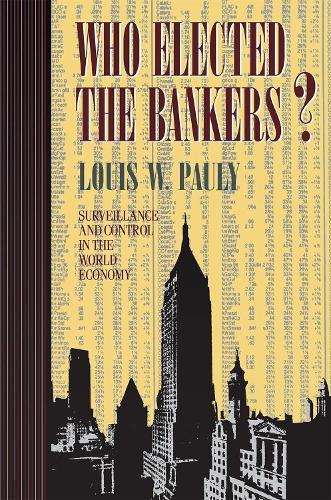
A former banker and staff member of the International Monetary Fund, Louis W. Pauly explains why people are deeply concerned about the emergence of a global economy and the increasingly integrated capital markets at its heart. In nations as diverse as France, Canada, Russia, and Mexico, the lives of citizens are disrupted when national policy falls out of line with the expectations of international financiers. Such dilemmas, ever more conspicuous around the world, arise from the disjuncture between a rapidly changing international economic system and a political order still constituted by sovereign states. The evolution of global capital markets inspires an understandable fear among people that the governing authorities accountable to them are losing the power to make substantive decisions affecting their own material prospects and those of their children. Pauly points out that today's capital markets resulted from decisions taken over many years by sovereign states, and particularly by the leading industrial democracies, who simultaneously crafted the instrument of multilateral economic surveillance. The effort to build adequate political foundations for global capital markets spans the twentieth century and links the histories of such institutions as the League of Nations, the International Monetary Fund, the European Union, and the Group of Seven.
Full Product Details
Author: Louis W. Pauly
Publisher: Cornell University Press
Imprint: Cornell University Press
Edition: New edition
Dimensions:
Width: 15.20cm
, Height: 1.60cm
, Length: 22.90cm
Weight: 0.454kg
ISBN: 9780801483752
ISBN 10: 0801483751
Pages: 200
Publication Date: 02 September 1998
Audience:
College/higher education
,
Professional and scholarly
,
Undergraduate
,
Postgraduate, Research & Scholarly
Format: Paperback
Publisher's Status: Active
Availability: Awaiting stock

The supplier is currently out of stock of this item. It will be ordered for you and placed on backorder. Once it does come back in stock, we will ship it out for you.
Reviews
Louis Pauly obviously was intent upon startling people when he set out to write the story of the International Monetary Fund, a group that he believes is credited with wielding far more power than it really has. In a careful discussion of the failings of the League of Nations, Pauly details how industrialized nations moved to create the IMF in the midst of World War II in the belief that an organization that balances international monetary policy would help prevent future conflagrations... He shows how the IMF has become intertwined with the political foundations of today's global economy. -Chicago Tribune A welcome book... Pauly organizes his claims and evidence in an innovative and effective manner... A provocative introduction and masterly consideration of the main issues... An excellent book... This is a well-written book, expertly edited, and a delight to read... This is an excellent contribution to the literature on international capital mobility and multilateral economic surveillance... Sensitive in analysis, dynamic in its identification of crucial contradictions, thoughtful in interpretation, this book will be a benchmark for future contributions to international political economy. -Timothy J. Sinclair, International Relations Louis Pauly's very interesting and readable book examines the relationship between global finance, democracy, and international institutions in the context of OECD countries. Its arguments are important and innovative not just for those studying the political economy of global finance, a field in which Pauly has been a leading figure over the last decade. They are also highly significant to anyone interested in broader debates about globalization and the future of democracy in advanced industrial states... Who Elected the Bankers' will be seen by all as a very welcome and major contribution to debates on the political economy of global finance, the history of international financial policy making and analyses of the relationship between politics and globalization. It deserves a wide audience. -Eric Helleiner, Canadian Journal of Political Science As a former staff member of the IMF, Pauly is in a unique position to give a fresh perspective. He traces the development of the IMF from its roots in the League of Nations and gives an excellent account of how it redefined its role after the demise of fixed exchange rates in the 1970s. -Ingrid Bryan, International Journal A clear, concise, and well-argued historical analysis... Who Elected the Bankers' can provide the foundation of historical knowledge that interested citizens need in order to engage in the public discussion over international integration that the leaders of powerful states now avoid. I recommend it highly. -Craig N. Murphy, Journal of Interdisciplinary History The reader interested in the evolution of the international monetary system in the postwar period will find in Pauly's book a very readable description, and an often insightful interpretation, of events, supported by detailed notes and references. -Finance and Development This is a first-rate book. Eminently readable, it provides important historical material and makes a number of salient analytical points. -Benjamin J. Cohen, University of California, Santa Barbara This book provides an insightful analysis of the development of an international institutional structure to guide country cross-border financial and economic relationships. As such, it is clearly necessary reading for all those interested in keeping abreast of the opportunities opened, and the constraints set, by a progressively integrated world financial environment. -Manuel Guitian, Director, Monetary and Exchange Affairs Department, International Monetary Fund Pauly has written a fascinating book, rich in analysis and with great historical depth, which explains the logic underlying the idea of surveillance of the international monetary system through international organizations. -Harold James, Princeton University Louis Pauly brings an insider's knowledge and an economic historian's perspective to bear on an issue of growing concern to democratic nation-states. His highly readable analysis of developments in the sometimes arcane field of international finance challenges the conventional wisdom and concludes with a prediction of when and why 'the retreat from global markets will begin.' -Ian D. Clark, Partner, KPMG Centre for Government, Toronto Surveillance is once more in fashion as we confront the risks of an integrated global financial system. Louis Pauly has written an essential introduction to the history and practice of multilateral surveillance in this century. -Miles Kahler, University of California, San Diego Louis Pauly provides us with a lively history of the problems and dilemmas created in a world of growing economic and financial interdependence among politically independent nations. His plea for collaboration and coordination, via multilateral surveillance by the IMF, is well based and deserves wide support. -Robert Solomon, The Brookings Institution
'[Pauly] skillfully describes the evolution of international monetary cooperation from the League of Nations in the early 1920s to the International Monetary Fund in the 1990s, stressing the continuities and changes over the past seventy-five years.' Foreign Affairs '[Pauly has] with remarkable clarity, described the evolution of the international markets over the past fifty years. Who Elected the Bankers? is, in my view, one of the first attempts to show how the global markets of today have been shaped by central banks, the IMF, the G-7, and the policymakers of the world.' Jacques de Larosiere, President, European Bank for Reconstruction and Development 'An insightful analysis of the development of an international institutional structure to guide...cross-border financial and economic relationships. As such, it is clearly necessary reading for all those interested in keeping abreast of the opportunities opened, and the constraints set, by a progressively integrated world financial environment.' Manuel Guitian, Director, Monetary and Exchange Affairs Department, International Monetary Fund
Author Information
Louis W. Pauly is Professor of Political Science and Director of the Centre for International Studies at the University of Toronto. He is the coeditor of Governing the World's Money and the author of Opening Financial Markets: Banking Politics on the Pacific Rim, both from Cornell, and coauthor or coeditor of several other books, including Complex Sovereignty.