Overview
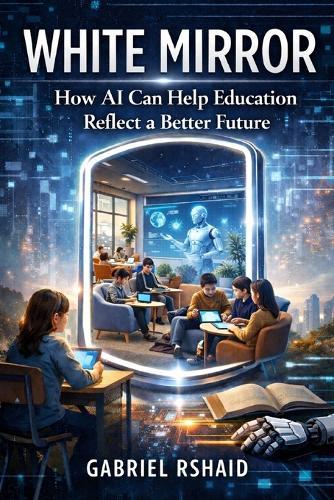
White Mirror: How AI can Help Education Reflect a Better Future opens with a deliberately absurd image: an Uber driver is gifted a pristine, top-of-the-line self-driving car-maintenance-free, indefinitely-and still chooses to keep driving passengers in an old, battered vehicle. Not because it's better, but because it's familiar. Because changing the vehicle would require changing the story. That metaphor becomes the book's lens on education's response to generative AI. The technology arrives as a once-in-a-lifetime gift-capable of supporting feedback, revision, differentiation, language support, and practice at scale. And yet the first reflex, in many places, is not possibility but fear: bans, restrictions, policy memos, ""AI detection"" tools, and a surveillance mindset that quietly institutionalizes distrust. The system enters an arms race with its own students, as if the purpose of schooling were to outwit the people it claims to serve. White Mirror argues that AI did not create education's crisis. It exposed it. A mirror doesn't invent flaws; it reflects them. When routines are built around compliance, coverage, and performance, AI makes the hollowness harder to ignore-because outputs can be replicated instantly. The question then changes. It is no longer ""How do we stop students from using AI?"" but ""What kinds of learning remain meaningful when output is cheap?"" This is not a book of hacks or prompts. It is a calm, human-centered reflection that refuses both extremes-neither dystopian panic nor techno-salvation. It treats AI as a white mirror, a deliberate inversion of the familiar ""black mirror"" metaphor: instead of an omen, a reflection of what becomes possible when the response is guided by purpose and courage rather than denial. A key distinction runs throughout: AI can function as cognitive extension-helping learners think better, go further, revise more deeply-or it can become a cognitive prosthetic, quietly outsourcing the thinking education is meant to develop. Cheating is an ethical problem; cognitive atrophy is an existential one. The deeper cultural risk is ""good enough"" instant, plausible outputs that can replace the productive struggle that builds judgment and depth. From there, White Mirror moves toward action without losing its philosophical spine: a staged roadmap for adoption, the redesign of assessment, and the ""human imperative""-the capacities that become more valuable precisely because machines can generate content. At its core is an invitation to stop covering the mirror and to redesign what the mirror reveals: learning built around meaning, discernment, and human relationship. Inside the book The ""gift of a lifetime"" problem: why transformative tools trigger institutional denial From opportunity to surveillance: bans, detection, and the hidden cost of distrust The white mirror metaphor: what AI reveals about schooling's incentives Cognitive extension vs cognitive prosthetic: thinking better vs thinking less The ""good enough"" effect and why it changes school culture and work Redesigning assessment in an AI world: authenticity without authoritarian theatre Truth, bias, and discernment: education's new literacy challenge A staged roadmap for adoption and the ""human imperative"" in an automated world
Full Product Details
Author: Gabriel Rshaid
Publisher: Independently Published
Imprint: Independently Published
Dimensions:
Width: 15.20cm
, Height: 0.90cm
, Length: 22.90cm
Weight: 0.222kg
ISBN: 9798246775981
Pages: 160
Publication Date: 03 February 2026
Audience:
General/trade
,
General
Format: Paperback
Publisher's Status: Active
Availability: Available To Order

We have confirmation that this item is in stock with the supplier. It will be ordered in for you and dispatched immediately.