Overview
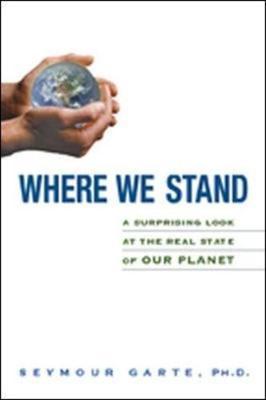
Global warming, new epidemics, and the destruction of natural resources have all made the future of the planet seem increasingly dire. But the real truth, according to respected scientist Dr. Seymour Garte, is that the environment is actually in better shape than we have been led to believe. Where We Stand will serve as a reality check for a debate surrounded by controversy. Garte presents irrefutable evidence that the state of the environment and human welfare has been improving steadily for the past two decades and that our efforts to ""save the planet"" are working. Contrary to popular opinion, the air and water are getting cleaner, cancer rates are decreasing, and forestation is improving. Meant to motivate -- not to lull -- Where We Stand will energize future efforts with the knowledge that we can make a difference. In giving us the good news, Garte does not neglect the bad; those issues that urgently need to be dealt with. There is still work to be done, but with a clearer picture of where we stand today, we will have a better chance for tomorrow. Hopeful, balanced, and convincing, this is a book that will change the way readers view the planet and the future.
Full Product Details
Author: Seymour Garte
Publisher: Amacom
Imprint: Amacom
Dimensions:
Width: 16.30cm
, Height: 2.70cm
, Length: 23.60cm
Weight: 0.628kg
ISBN: 9780814409107
ISBN 10: 0814409105
Pages: 304
Publication Date: 16 October 2007
Audience:
General/trade
,
General
Format: Hardback
Publisher's Status: Active
Availability: In Print

This item will be ordered in for you from one of our suppliers. Upon receipt, we will promptly dispatch it out to you. For in store availability, please contact us.
Reviews
<p> Where We Stand, is an antidote for an overly pessimistic view of the future of the environment...He presents an authoritative and compelling argument for the role of technology and scientific discovery -- an unusual stance in the ecological worldview. ---HealthNet Media
Where We Stand, is an antidote for an overly pessimistic view of the future of the environment...He presents an authoritative and compelling argument for the role of technology and scientific discovery -- an unusual stance in the ecological worldview. ---HealthNet Media Dr. Garte does a very good job of spelling out where we're doing well, how we've failed, and what we can continue to do to improve. This book is a testament to the academics and good attitude of Dr. Garte, a professor of environmental and occupational health at the University of Pittsburgh School of Public Health. Hopefully, by reading it, everyone can learn something, whatever your personal or political views on the subject. I highly recommend this book! --MilitantLibertarian.org For people who are put off by all the talk of global warming these days, a new book, 'Where We Stand: A Surprising Look at the Real State of Our Planet' by Seymour Garte, Ph.D., gives a balanced and in many ways positive view of the state of the planet. Garte, a professor of Environmental and Occupational Health Sciences at the University of Pittsburgh, goes over both the critical issues still facing man, as well as the often-forgotten progress and positive developments. Perusing the book, I find the author's messages to be more insightful than I would have expected with a level of optimism that's refreshing. -- Green World Blog, BostonHerald.com For people who are put off by all the talk of global warming these days, a new book, 'Where We Stand: A Surprising Look at the Real State of Our Planet' by Seymour Garte, Ph.D., gives a balanced and in many ways positive view of the state of the planet. Garte, a professor of Environmental and Occupational Health Sciences at the University of Pittsburgh, goes over both the critical issues still facing man, as well as the often-forgotten progress and positive developments. Perusing the book, I find the author's messages to be more insightful than I would have expected with a level of optimism that's refreshing. -- Green World Blog, BostonHerald.com Garte's reasoned discussion[...]a valuable tool for increasing science literacy with regards to the important environmental issues of the day. --Publishers Weekly Dr. Garte does a very good job of spelling out where we're doing well, how we've failed, and what we can continue to do to improve. This book is a testament to the academics and good attitude of Dr. Garte, a professor of environmental and occupational health at the University of Pittsburgh School of Public Health. Hopefully, by reading it, everyone can learn something, whatever your personal or political views on the subject. I highly recommend this book! --MilitantLibertarian.org Where We Stand, is an antidote for an overly pessimistic view of the future of the environment...He presents an authoritative and compelling argument for the role of technology and scientific discovery -- an unusual stance in the ecological worldview. ---HealthNet Media Where We Stand, is an antidote for an overly pessimistic view of the future of the environment...He presents an authoritative and compelling argument for the role of technology and scientific discovery -- an unusual stance in the ecological worldview. ---HealthNet Media Dr. Garte does a very good job of spelling out where we're doing well, how we've failed, and what we can continue to do to improve. This book is a testament to the academics and good attitude of Dr. Garte, a professor of environmental and occupational health at the University of Pittsburgh School of Public Health. Hopefully, by reading it, everyone can learn something, whatever your personal or political views on the subject. I highly recommend this book! --MilitantLibertarian.org Garte's reasoned discussion[...]a valuable tool for increasing science literacy with regards to the important environmental issues of the day. -- Publishers Weekly Garte's reasoned discussion[...]a valuable tool for increasing science literacy with regards to the important environmental issues of the day. -- Publishers Weekly Dr. Garte does a very good job of spelling out where we're doing well, how we've failed, and what we can continue to do to improve. This book is a testament to the academics and good attitude of Dr. Garte, a professor of environmental and occupational health at the University of Pittsburgh School of Public Health. Hopefully, by reading it, everyone can learn something, whatever your personal or political views on the subject. I highly recommend this book! --MilitantLibertarian.org Where We Stand, is an antidote for an overly pessimistic view of the future of the environment...He presents an authoritative and compelling argument for the role of technology and scientific discovery -- an unusual stance in the ecological worldview. ---HealthNet Media For people who are put off by all the talk of global warming these days, a new book, 'Where We Stand: A Surprising Look at the Real State of Our Planet' by Seymour Garte, Ph.D., gives a balanced and in many ways positive view of the state of the planet. Garte, a professor of Environmental and Occupational Health Sciences at the University of Pittsburgh, goes over both the critical issues still facing man, as well as the often-forgotten progress and positive developments. Perusing the book, I find the author's messages to be more insightful than I would have expected with a level of optimism that's refreshing. Garte doesn't merely give credit to environmental activities, technological progress and regulatory oversight, but also notes the importance of freedom and democracy to the well-being of the planet, citing the terribly oppressive toll Communism had on the environment in the days of the Soviet Union, which certainly rivals the environmental menace that was Saddam Hussein who we recall set oil fields on fire and just about destroyed the marshlands along the Tigris and Euphrates rivers. Indeed, the author makes a strong case that the environment is in much better hands with free peoples, so his support for more regulation might seem counterintuitive, but perhaps the truth is that ongoing public debate encourages more gradual changes in law which are essential to improving the environment without having very sudden, negative impacts on society, something that a more tyrannical government is more likely to cause with sudden strict laws. The author notes that despite the government's not signing onto Kyoto, industry seems to be coming around on its own tobecoming more environmentally-responsible (even if it is often only a response to public sentiment). Nevertheless, both sides would have to agree that increasing public awareness and education causes a demand for more environmental compliance that is a preferable approach to regulation alone, if only because convincing the government may have force some superficial changes in industry but convincing industry leaders can actually make changes at the root of the problem. Of course, the author notes how some problems, such as the threat of terrorism or the destruction of the rain forest, can cause significant trouble for the world in ways that are unusually difficult to predict or prevent, but he suggests that by noting and following the same path of success that helped to eliminate or reduce other problems, that these newer threats can too be met with positive results, which hopefully means we can look forward to one day living in a more peaceful, freer and more fruitful world. ---Green World Blog, BostonHerald.com Garte's reasoned discussion[...]a valuable tool for increasing science literacy with regards to the important environmental issues of the day - Publishers Weekly
For people who are put off by all the talk of global warming these days, a new book, 'Where We Stand: A Surprising Look at the Real State of Our Planet' by Seymour Garte, Ph.D., gives a balanced and in many ways positive view of the state of the planet. Garte, a professor of Environmental and Occupational Health Sciences at the University of Pittsburgh, goes over both the critical issues still facing man, as well as the often-forgotten progress and positive developments. Perusing the book, I find the author's messages to be more insightful than I would have expected with a level of optimism that's refreshing. -- Green World Blog, BostonHerald.com </p>
For people who are put off by all the talk of global warming these days, a new book, 'Where We Stand: A Surprising Look at the Real State of Our Planet' by Seymour Garte, Ph.D., gives a balanced and in many ways positive view of the state of the planet. Garte, a professor of Environmental and Occupational Health Sciences at the University of Pittsburgh, goes over both the critical issues still facing man, as well as the often-forgotten progress and positive developments. <p> Perusing the book, I find the author's messages to be more insightful than I would have expected with a level of optimism that's refreshing. Garte doesn't merely give credit to environmental activities, technological progress and regulatory oversight, but also notes the importance of freedom and democracy to the well-being of the planet, citing the terribly oppressive toll Communism had on the environment in the days of the Soviet Union, which certainly rivals the environmental menace that was Saddam Hussein who we recall set oil fields on fire and just about destroyed the marshlands along the Tigris and Euphrates rivers. <p> Indeed, the author makes a strong case that the environment is in much better hands with free peoples, so his support for more regulation might seem counterintuitive, but perhaps the truth is that ongoing public debate encourages more gradual changes in law which are essential to improving the environment without having very sudden, negative impacts on society, something that a more tyrannical government is more likely to cause with sudden strict laws. <p> The author notes that despite the government's not signing onto Kyoto, industry seems to be coming around on its own tobecoming more environmentally-responsible (even if it is often only a response to public sentiment). Nevertheless, both sides would have to agree that increasing public awareness and education causes a demand for more environmental compliance that is a preferable approach to regulation alone, if only because convincing the government may have force some superficial changes in industry but convincing industry leaders can actually make changes at the root of the problem. <p> Of course, the author notes how some problems, such as the threat of terrorism or the destruction of the rain forest, can cause significant trouble for the world in ways that are unusually difficult to predict or prevent, but he suggests that by noting and following the same path of success that helped to eliminate or reduce other problems, that these newer threats can too be met with positive results, which hopefully means we can look forward to one day living in a more peaceful, freer and more fruitful world. <p> ---Green World Blog, BostonHerald.com
<p> "Garte’s reasoned discussion[…]a valuable tool for increasing science literacy with regards to the important environmental issues of the day." -- Publishers Weekly
Author Information
Seymour Garte, Ph.d. (Pittsburgh, PA) is a professor of environmental and occupational health at the University of Pittsburgh School of Public Health and a working scientist with over 30 years of experience in the field. His articles have appeared in Nature and countless other scientific publications. He has been funded in his research by the National Institute of Environmental Health Sciences, the National Cancer Institute, and the American Cancer Society.