Overview
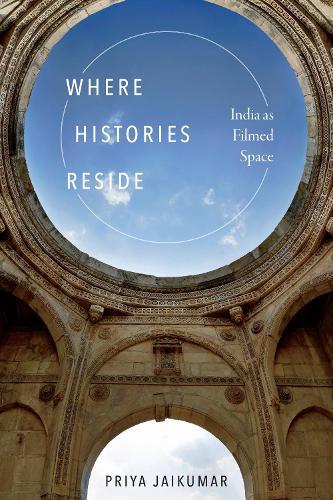
In Where Histories Reside Priya Jaikumar examines eight decades of films shot on location in India to show how attending to filmed space reveals alternative timelines and histories of cinema. In this bold ""spatial"" film historiography, Jaikumar outlines factors that shape India's filmed space, from state bureaucracies and commercial infrastructures to aesthetic styles and neoliberal policies. Whether discussing how educational shorts from Britain and India transform natural landscapes into instructional lessons or how Jean Renoir's The River (1951) presents a universal human condition through the particularities of place, Jaikumar demonstrates that the history of filming a location has always been a history of competing assumptions, experiences, practices, and representational regimes. In so doing, she reveals that addressing the persistent question of ""what is cinema?"" must account for an aesthetics and politics of space.
Full Product Details
Author: Priya Jaikumar
Publisher: Duke University Press
Imprint: Duke University Press
Weight: 0.703kg
ISBN: 9781478004127
ISBN 10: 1478004126
Pages: 416
Publication Date: 09 October 2019
Audience:
Professional and scholarly
,
Professional & Vocational
Format: Hardback
Publisher's Status: Active
Availability: In Print

This item will be ordered in for you from one of our suppliers. Upon receipt, we will promptly dispatch it out to you. For in store availability, please contact us.
Reviews
With grace and flair Priya Jaikumar shows how the preproduction practices and industry cultures of cinema--from expedition and nature films to commercial Bollywood cinema--produced and reinforced the spatial notions of territory and empire that dominated geopolitical histories. She looks forward to contemporary Indian geopolitics, as the privatization of economic resources increasingly harms vulnerable populations--even while location-based films exploit these populations and iconic precolonial architecture, now often in ruins, for a cinematic backdrop or ambience. Here is a magnificent study. --Tom Conley, Abbott Lawrence Lowell Professor, Harvard University Where Histories Reside is a superbly written book in which Priya Jaikumar uses the optics of space to recast the discourse of Indian cinema and its pasts. Landscape, territory, and architecture are brought into conversation with geography, cultural theory, cinema studies, and politics. The result is a magnificent and methodologically daring approach that displaces the desire for causality with the spatialization of historical inquiry. --Ranjani Mazumdar, Professor of Cinema Studies, School of Arts and Aesthetics, Jawaharlal Nehru University, Delhi
Written with style and verve, [Where Histories Reside] is one of those rare academic works that can justifiably claim a readership beyond conventional disciplinary provinces like film history or theory. -- Anustup Basu * Critical Quarterly * Employing a variety of methodologies, the volume is valuable both in itself and as a model for subaltern cinema history and historiography. -- K. J. Wetmore Jr. * Choice * Where Histories Reside is a superbly written book in which Priya Jaikumar uses the optics of space to recast the discourse of Indian cinema and its pasts. Landscape, territory, and architecture are brought into conversation with geography, cultural theory, cinema studies, and politics. The result is a magnificent and methodologically daring approach that displaces the desire for causality with the spatialization of historical inquiry. -- Ranjani Mazumdar, Professor of Cinema Studies, School of Arts and Aesthetics, Jawaharlal Nehru University, Delhi With grace and flair Priya Jaikumar shows how the preproduction practices and industry cultures of cinema-from expedition and nature films to commercial Bollywood cinema-produced and reinforced the spatial notions of territory and empire that dominated geopolitical histories. She looks forward to contemporary Indian geopolitics, as the privatization of economic resources increasingly harms vulnerable populations-even while location-based films exploit these populations and iconic precolonial architecture, now often in ruins, for a cinematic backdrop or ambience. Here is a magnificent study. -- Tom Conley, Abbott Lawrence Lowell Professor, Harvard University
Author Information
Priya Jaikumar is Professor of Cinema and Media Studies at the University of Southern California and author of Cinema at the End of Empire: A Politics of Transition in Britain and India, also published by Duke University Press.