|
|
|||
|
||||
Awards
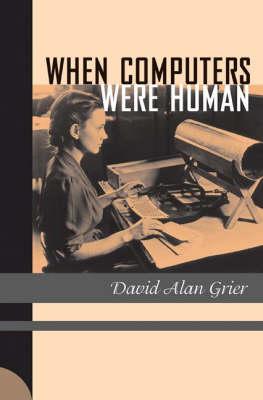
OverviewFull Product DetailsAuthor: David Alan GrierPublisher: Princeton University Press Imprint: Princeton University Press Dimensions: Width: 15.20cm , Height: 2.70cm , Length: 23.50cm Weight: 0.482kg ISBN: 9780691091570ISBN 10: 0691091579 Pages: 424 Publication Date: 14 March 2005 Audience: Professional and scholarly , College/higher education , Professional & Vocational , Tertiary & Higher Education Replaced By: 9781400849369 Format: Hardback Publisher's Status: Out of Print Availability: Out of stock Language: English Table of ContentsReviewsDavid Alan Grier's recovery of the wonderfully rich story of human computers ... ask[s] why human computers were made to disappear in the first place... It is notoriously difficult to recover details of the lives of ordinary people... But Grier triumphantly achieves his aim when discussing the twentieth-century human computer, as many are alive to tell their tales. -- Jon Agar Nature Prior to the advent of programmable data-processing electronic devices in the mid-20th century, the word computer was commonly used to describe a person hired to crank out stupefyingly tedious calculations... Human computers have ... been largely forgotten, and David Alan Grier ... is intent on restoring them to their rightful place in history. -- Ann Finkbeiner Discover When Computers Were Human is a detailed and fascinating look at a world I had not even known existed. -- James Fallows, National Correspondent Atlantic Monthly The strength of this book is its breadth of research and its human touch... [A] well written, informative and enjoyable work. -- Amy Shell-Gellasch MAA Reviews Overall, this book provides a wonderful survey of human computing from 1682 onward... I recommend this book to all historians of computing, both professional and amateur. -- Jonathan P. Bowen IEEE Annals of the History of Computing Author InformationDavid Alan Grier is Associate Professor in the Center for International Science and Technology Policy at George Washington University. His articles on the history of science have appeared in the ""American Mathematical Monthly"", ""Chance"", the ""Christian Science Monitor"", and the ""Washington Post"". He is Editor in Chief of the ""IEEE Annals of the History of Computing"". Long before he learned that his grandmother had been trained as a human computer, he absorbed the methods of programming the electronic computer from his father, who was a scientific computing specialist for the Burroughs Corporation. Tab Content 6Author Website:Countries AvailableAll regions |
||||