Overview
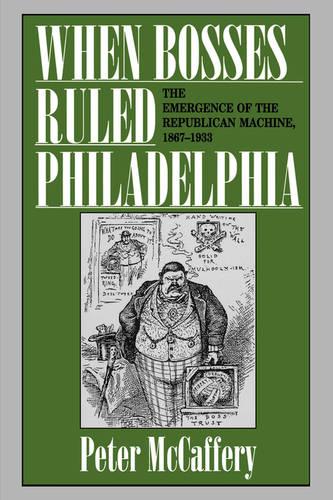
This is the most thoughtful and intensive analysis of the emergence of a political machine of any written in recent years. McCaffery has mastered the theory and historiography of the political machine in general and applied this to a wealth of sources in Philadelphia. His questions are rigorously formulated, exhaustively researched, and convincingly stated.-Terrence J. McDonald, University of Michigan In 1903, Muckraker Lincoln Steffens brought the city of Philadelphia lasting notoriety as ""the most corrupt and the most contented"" urban center in the nation. Famous for its colorful ""feudal barons,"" from ""King James"" McManes and his ""Gas Ring"" to ""Iz"" Durham and ""Sunny Jim"" McNichol, Philadelphia offers the historian a classic case of the duel between bosses and reformers for control of the American city. But, strangely enough, Philadelphia's Republican machine has not been subject to critical examination until now. When Bosses Ruled Philadelphia challenges conventional wisdom on the political machine, which has it that party bosses controlled Philadelphia as early as the 1850s and maintained that control, with little change, until the Great Depression.According to Peter McCaffery, however, all bosses were not alike, and political power came only gradually over time. McManes's ""Gas Ring"" in the 1870s was not as powerful as the well-oiled machine ushered in by Matt Quay in the late 1880s. Through a careful analysis of city records, McCaffery identifies the beneficiaries of the emerging Republican Organization, which sections of the local electorate supported it, and why. He concludes that genuine boss rule did not emerge as the dominant institution in Philadelphia politics until just before the turn of the century. McCaffery considers the function that the machine filled in the life of the city. Did it ultimately serve its supporters and the community as a whole, as Steffens and recent commentators have suggested? No, says McCaffery. The romantic image of the boss as ""good guy"" of the urban drama is wholly undeserved.
Full Product Details
Author: Peter McCaffery
Publisher: Pennsylvania State University Press
Imprint: Pennsylvania State University Press
Dimensions:
Width: 15.20cm
, Height: 2.10cm
, Length: 22.90cm
Weight: 0.454kg
ISBN: 9780271034300
ISBN 10: 0271034300
Pages: 286
Publication Date: 15 September 1993
Audience:
General/trade
,
General
Format: Paperback
Publisher's Status: Active
Availability: Manufactured on demand

We will order this item for you from a manufactured on demand supplier.
Reviews
This is the most thoughtful and intensive analysis of the emergence of a political machine of any written in recent years. McCaffery has mastered the theory and historiography of the political machine in general and applied this to a wealth of sources in Philadelphia. His questions are rigorously formulated, exhaustively researched, and convincingly stated. --Terrence J. McDonald, University of Michigan
This is the most thoughtful and intensive analysis of the emergence of a political machine of any written in recent years. McCaffery has mastered the theory and historiography of the political machine in general and applied this to a wealth of sources in Philadelphia. His questions are rigorously formulated, exhaustively researched, and convincingly stated. </p> Terrence J. McDonald, University of Michigan</p>
This is the most thoughtful and intensive analysis of the emergence of a political machine of any written in recent years. McCaffery has mastered the theory and historiography of the political machine in general and applied this to a wealth of sources in Philadelphia. His questions are rigorously formulated, exhaustively researched, and convincingly stated. Terrence J. McDonald, University of Michigan
This is the most thoughtful and intensive analysis of the emergence of a political machine of any written in recent years. McCaffery has mastered the theory and historiography of the political machine in general and applied this to a wealth of sources in Philadelphia. His questions are rigorously formulated, exhaustively researched, and convincingly stated. </p>--Terrence J. McDonald, University of Michigan</p>
This is the most thoughtful and intensive analysis of the emergence of a political machine of any written in recent years. McCaffery has mastered the theory and historiography of the political machine in general and applied this to a wealth of sources in Philadelphia. His questions are rigorously formulated, exhaustively researched, and convincingly stated. --Terrence J. McDonald, University of Michigan This is the most thoughtful and intensive analysis of the emergence of a political machine of any written in recent years. McCaffery has mastered the theory and historiography of the political machine in general and applied this to a wealth of sources in Philadelphia. His questions are rigorously formulated, exhaustively researched, and convincingly stated. Terrence J. McDonald, University of Michigan This is the most thoughtful and intensive analysis of the emergence of a political machine of any written in recent years. McCaffery has mastered the theory and historiography of the political machine in general and applied this to a wealth of sources in Philadelphia. His questions are rigorously formulated, exhaustively researched, and convincingly stated. --Terrence J. McDonald, University of Michigan This is the most thoughtful and intensive analysis of the emergence of a political machine of any written in recent years. McCaffery has mastered the theory and historiography of the political machine in general and applied this to a wealth of sources in Philadelphia. His questions are rigorously formulated, exhaustively researched, and convincingly stated. Terrence J. McDonald, University of Michigan This is the most thoughtful and intensive analysis of the emergence of a political machine of any written in recent years. McCaffery has mastered the theory and historiography of the political machine in general and applied this to a wealth of sources in Philadelphia. His questions are rigorously formulated, exhaustively researched, and convincingly stated. Terrence J. McDonald, University of Michigan This is the most thoughtful and intensive analysis of the emergence of a political machine of any written in recent years. McCaffery has mastered the theory and historiography of the political machine in general and applied this to a wealth of sources in Philadelphia. His questions are rigorously formulated, exhaustively researched, and convincingly stated. --Terrence J. McDonald, University of Michigan
Author Information
Peter McCaffery is Assistant Dean in the School of Creative Cultural and Social Studies at Thames Valley University in London, UK.