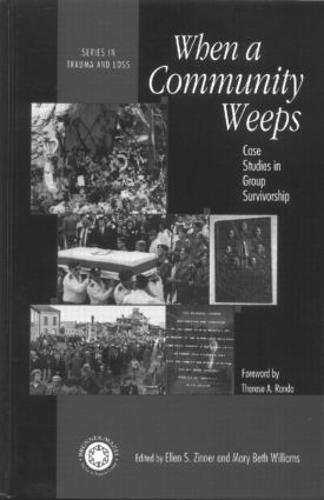
Full Product Details
Author: Ellen S. Zinner ,
Mary Beth Williams
Publisher: Taylor & Francis Ltd
Imprint: Brunner-Mazel Inc
Dimensions:
Width: 15.20cm
, Height: 2.00cm
, Length: 22.90cm
Weight: 0.700kg
ISBN: 9780876309537
ISBN 10: 0876309538
Pages: 292
Publication Date: 01 October 1998
Audience:
College/higher education
,
General/trade
,
Tertiary & Higher Education
,
General
Format: Hardback
Publisher's Status: Active
Availability: In Print

This item will be ordered in for you from one of our suppliers. Upon receipt, we will promptly dispatch it out to you. For in store availability, please contact us.
Reviews
""This modest and respectful book makes a valuable contribution to our understanding of the consequences of disasters and other traumas and how we can more effectively combine our knowledge of community and understanding of collective, group processes with our trauma, grief and recovery work."" -- Joshua Miller, Smith College School for Social Work, Northampton, MA ""This book addresses the important question of how whole communities react to major loss, looking at ten recent case studies. The editors emphasise that different socio-cultural traditions have to be acknowledged, and that communities should try to anticipate high risk situations and plan ahead to deal with the unthinkable as far as possible. Each makes interesting, at times compelling reading-we can all learn something from how other communities react to major events."" -- William Yule, Professor of Applied Child Psychology ""This is a significant book, historically, in its identification of a major new awareness or trend in loss identification and care. We need to become more aware of both the connection between, and distinction from, grief and trauma. The traumatized grieve. The bereaved who are traumatized both grieve the loss and grieve the reality of their victimization due to trauma. Each is real and, while they may be intertwined, oftentimes the impact of trauma is minimized as we rush in to soothe the wounds of the griever and those become more complicated."" -- Resources Hotline, Vol. 6, No.5
This modest and respectful book makes a valuable contribution to our understanding of the consequences of disasters and other traumas and how we can more effectively combine our knowledge of community and understanding of collective, group processes with our trauma, grief and recovery work. -Joshua Miller, Smith College School for Social Work, Northampton, MA This book addresses the important question of how whole communities react to major loss, looking at ten recent case studies. The editors emphasise that different socio-cultural traditions have to be acknowledged, and that communities should try to anticipate high risk situations and plan ahead to deal with the unthinkable as far as possible. Each makes interesting, at times compelling reading-we can all learn something from how other communities react to major events. -William Yule, Professor of Applied Child Psychology This is a significant book, historically, in its identification of a major new awareness or trend in loss identification and care. We need to become more aware of both the connection between, and distinction from, grief and trauma. The traumatized grieve. The bereaved who are traumatized both grieve the loss and grieve the reality of their victimization due to trauma. Each is real and, while they may be intertwined, oftentimes the impact of trauma is minimized as we rush in to soothe the wounds of the griever and those become more complicated.. -Resources Hotline, Vol. 6, No.5
This modest and respectful book makes a valuable contribution to our understanding of the consequences of disasters and other traumas and how we can more effectively combine our knowledge of community and understanding of collective, group processes with our trauma, grief and recovery work. <br>-Joshua Miller, Smith College School for Social Work, Northampton, MA <br> This book addresses the important question of how whole communities react to major loss, looking at ten recent case studies. The editors emphasise that different socio-cultural traditions have to be acknowledged, and that communities should try to anticipate high risk situations and plan ahead to deal with the unthinkable as far as possible. Each makes interesting, at times compelling reading-we can all learn something from how other communities react to major events. <br>-William Yule, Professor of Applied Child Psychology <br> This is a significant book, historically, in its identification of a major new awareness or trend in loss identification and care. We need to become more aware of both the connection between, and distinction from, grief and trauma. The traumatized grieve. The bereaved who are traumatized both grieve the loss and grieve the reality of their victimization due to trauma. Each is real and, while they may be intertwined, oftentimes the impact of trauma is minimized as we rush in to soothe the wounds of the griever and those become more complicated.. <br>-Resources Hotline, Vol. 6, No.5 <br>
Author Information
Ellen S. Zinner, Mary Beth Williams