Awards
- Short-listed for Canadian Aboriginal History Book Prize, Canadian Historical Association 2017 (Canada)
- Winner of Jeanne Clarke Award for Local History, Prince George Library and History Association 2018 (Canada)
- Winner of Jeanne Clarke Award for Local History, Prince George Library and History Association 2019 (Canada)
- Winner of Publication Award, Canadian Association of Foundations of Education 2017 (Canada)
Overview
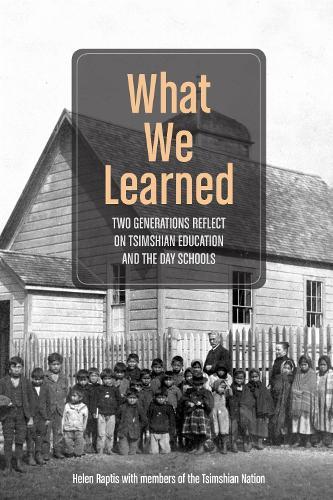
Stories of Indigenous children forced to attend residential schools have haunted Canadians in recent years. Yet most Indigenous children in Canada attended ""Indian day schools,"" and later public schools, near their home communities. Although church and government officials often kept detailed administrative records, we know little about the actual experiences of the students themselves. In What We Learned, two generations of Tsimshian students – a group of elders born in the 1930s and 1940s and a group of middle-aged adults born in the 1950s and 1960s – reflect on their traditional Tsimshian education and the formal schooling they received in northwestern British Columbia. Their stories offer a starting point for understanding the legacy of day schools on Indigenous lives and communities. Their recollections also invite readers to consider a broader notion of education – one that includes traditional Indigenous views that conceive of learning as a lifelong experience that takes place across multiple contexts.
Full Product Details
Author: Helen Raptis ,
members of the Tsimshian Nation
Publisher: University of British Columbia Press
Imprint: University of British Columbia Press
Dimensions:
Width: 15.20cm
, Height: 1.00cm
, Length: 22.90cm
Weight: 0.340kg
ISBN: 9780774830201
ISBN 10: 0774830204
Pages: 224
Publication Date: 15 August 2016
Audience:
Professional and scholarly
,
Professional & Vocational
Format: Paperback
Publisher's Status: Active
Availability: Temporarily unavailable

The supplier advises that this item is temporarily unavailable. It will be ordered for you and placed on backorder. Once it does come back in stock, we will ship it out to you.
Reviews
Helen Raptis has written an important book about Tsimshian educational history. It is also a book about building research relationships with Indigenous communities. It is a work that recognizes, implicitly, that Indigenous history does not run in a straight line but is more liquid and circular. The journey to understand the Indigenous past requires deft canoe navigation through riptides and crosscurrents, past colonization's half-submerged debris. Landing on the beach, one discovers no conventional separation between past, present, and future. There are only the stories-the stories and the sacred landscape. -- Michael Marker, University of British Columbia * History of Education Quarterly, Vol. 57 No. 1, February 2017 * Too many stories are still untold; too many memories have been lost to the ages; too many biases have coloured our view of the past. That is why a book such as this one is a treasure, an overdue and culturally aware look at a forgotten aspect of the education of Indigenous children in British Columbia. -- Dave Obee, a member of the board of Canada's History Society and editor-in-chief of the Times Colonist in Victoria * Canada's History, Vol. 97 No. 1, February 2017 * One of the few serious studies of the subject, [What We Learned] provides an unusually detailed account of the transition from on-reserve to integrated schooling through the eyes of those who were there ... With its contextual richness, innovative methodology, sharp analysis, and poignant personal narratives, What We Learned is a book that deserves a wide audience. -- Brian Titley, The University of Lethbridge * BC Studies *
Helen Raptis has written an important book about Tsimshian educational history. It is also a book about building research relationships with Indigenous communities. It is a work that recognizes, implicitly, that Indigenous history does not run in a straight line but is more liquid and circular. The journey to understand the Indigenous past requires deft canoe navigation through riptides and crosscurrents, past colonization's half-submerged debris. Landing on the beach, one discovers no conventional separation between past, present, and future. There are only the stories-the stories and the sacred landscape. -- Michael Marker, University of British Columbia History of Education Quarterly, Vol. 57 No. 1, February 2017 Too many stories are still untold; too many memories have been lost to the ages; too many biases have coloured our view of the past. That is why a book such as this one is a treasure, an overdue and culturally aware look at a forgotten aspect of the education of Indigenous children in British Columbia. -- Dave Obee, a member of the board of Canada's History Society and editor-in-chief of the Times Colonist in Victoria Canada's History, Vol. 97 No. 1, February 2017
Author Information
Helen Raptis is an associate professor in the Faculty of Education at the University of Victoria. The members of the Tsimshian Nation are Mildred Roberts, Wally Miller, Sam Lockerby, Verna Inkster, Clifford Bolton, Harvey Wing, Charlotte Guno, Don Roberts Junior, Steve Roberts, Richard Roberts, Carol Sam, and Jim Roberts