Overview
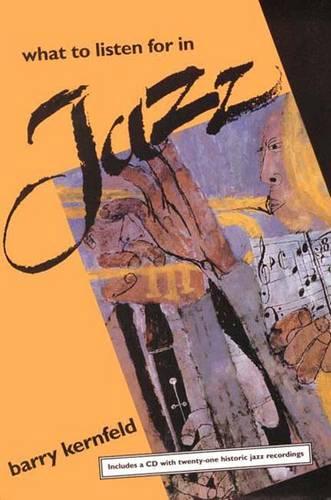
Exhilarating and exciting, subtle and profound-jazz requires knowledge and understanding to be truly appreciated. Barry Kernfeld here provides a thorough, learned, and accessible introduction to jazz, discussing its musical concepts, procedures, and styles and providing the background necessary to fully enjoy this musical art. The book is organized around twenty-one historical jazz recordings-from the New Orleans Rhythm Kings' Tin Roof Blues (1923) to Ornette Coleman's Honeymooners (1987)-that are analyzed in the text and included in a compact disc that accompanies the book. Barry Kernfeld draws from these musical works to illustrate jazz rhythm, forms, arrangement, composition, improvisation, style, and sound (recording fidelity, tuning systems, instrumentation, and timbre). Included in the book are eighty-five notated music examples keyed to the compact disc and a biographical dictionary of musicians who figure prominently on the disc. By laying out musical ideas that unify the genre, rather than by splintering it along stylistic lines, this authoritative book offers a new method for enhancing enjoyment and understanding of jazz. It will be a valued resource for students and general listeners who wish to know more about this unique musical form.
Full Product Details
Author: Barry Kernfeld
Publisher: Yale University Press
Imprint: Yale University Press
Edition: New edition
Dimensions:
Width: 15.60cm
, Height: 0.20cm
, Length: 23.50cm
Weight: 0.431kg
ISBN: 9780300072594
ISBN 10: 0300072597
Pages: 294
Publication Date: 20 October 1997
Audience:
College/higher education
,
Professional and scholarly
,
Undergraduate
,
Postgraduate, Research & Scholarly
Format: Paperback
Publisher's Status: Out of Print
Availability: Awaiting stock

Reviews
A book-and-CD set introducing jazz to the uninitiated. Kernfeld (editor, The New Grove Dictionary of Jazz, not reviewed) takes an analytical, listening-oriented approach to the music, focusing on seven areas: rhythm, form, arrangement, composition, improvisation, sound, and style. He draws from 21 well-known recorded selections, using them as springboards for his often insightful analyses. Key artists such as Louis Armstrong, Count Basic, Duke Ellington, Charlie Parker, Miles Davis, Sun Ra, and Ornette Coleman are used to demonstrate the variety of individual expression in jazz, as well as the overall continuity that links their diverse styles. This book will appeal most strongly to students and teachers of jazz, because it offers musical analysis with enough of an enthusiast's edge to give a balance to what would otherwise be a purely scholarly discussion. In fact, it is in the asides that Kernfeld's true personality shines (for instance, in his description of Coleman's Honeymooners as delightfully twisted...funky dance music or noting how the out-of-tune tonality of New Orleans revivalist Kid Thomas Valentine's band contributes to the essential sludge in the sound ). Kernfeld also makes some telling observations, showing, for example, that the modal jazz style of the '50s is based more on slow-moving chord harmonies than on medieval modes. The plethora of notated examples makes for some heavy sledding, and there are a few mysterious choices made in the accompanying CD (not included for review, but according to a list of its contents, for example, Kernfeld will compare two takes of a particular recording in the text, but only one of the two will be offered on the CD - often the better-known and more easily accessible version - which is certain to frustrate the reader). Deserves to find a home in academic halls, although less essential for the home bookshelf. (Kirkus Reviews)
Author Information
Barry Kernfeld is editor of The New Grove Dictionary of Jazz and The Blackwell Guide to Recorded Jazz.