|
|
|||
|
||||
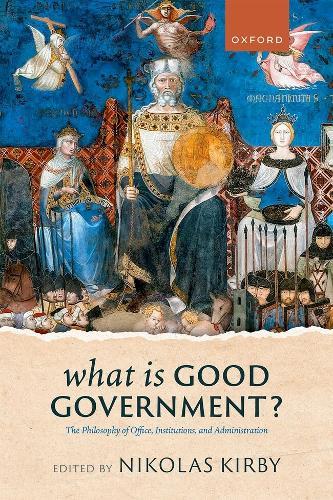
OverviewWhat is good government? The concept of 'good government' aims to set an ideal for how governments - and their constituent agents - should act, be structured, and held accountable. It promises a fundamental norm to guide the design of its offices and institutions and the administrative state. It is a concept central to contemporary development practice, public administration, and political science, but has largely been neglected in contemporary political philosophy. This, therefore, is the first edited volume specifically dedicated to the philosophy of good government. Bringing together some of today's foremost political philosophers, it explores the complex relationship between good government and other concepts fundamental to politics: justice, legitimacy, and the common good. Placing in conversation classical, modern, and contemporary perspectives, this volume explores themes such as the role of virtue, education, and ritual in governance; political realism and the role of accountability institutions; the virtues and vices of the administrative state; official discretion and public control of state institutions; public trust and the fiduciary conception of public office; and the importance of explanation, reasonableness, and representation in administrative decision-making. Full Product DetailsAuthor: Nikolas Kirby (Reader in Politics and International Relations, Reader in Politics and International Relations, School of Social and Political Sciences, University of Glasgow)Publisher: Oxford University Press Imprint: Oxford University Press Dimensions: Width: 15.60cm , Height: 23.40cm , Length: 2.10cm Weight: 0.645kg ISBN: 9780198910466ISBN 10: 0198910460 Pages: 360 Publication Date: 07 May 2026 Audience: College/higher education , Tertiary & Higher Education Format: Hardback Publisher's Status: Active Availability: To order Stock availability from the supplier is unknown. We will order it for you and ship this item to you once it is received by us. Table of ContentsPart I. Public Service: Merit and Virtue 1: Melissa Lane: Guarding the Guardians: Plato and Constitutionalism for the Good of the Ruled 2: Joseph Chan: Confucian Perspectives on Good Governance and Regime Type: Historical Choices and Their Contemporary Legacy Part II. Public Institutions: Power and Accountability 3: Mark Philp: Democracy and the Operational Integrity of Government 4: Emanuela Ceva and Maria Paola Ferretti: Office Accountability: The Open Texture of Public Institutional Normativity Part III. Public Will: Compliance and Discretion 5: Chiara Cordelli: The Case for Administrative Co-Determination 6: Daniel Engster: Relational Discretion and Good Governance Part IV. Public Control: Non-Domination and Responsiveness 7: Philip Pettit: State, Republic, and Good Government 8: Leah Downey: Good Self-Governance Part V. Public Goods: Individual and Collective 9: Cass R. Sunstein: The Administrative State, Inside Out 10: Blake Emerson: Collective Rights and the Obligations of Good Government Part VI. Public Trust: Loyalty and Purpose 11: Nikolas Kirby: Fiduciary Governance: Power Without Despotism 12: Paul B. Miller: Political Trust, Public Justification, and Judicial Office Part VII. Experience: Explanation, Reasonableness, and Representation 13: Zeynep Pamuk: Explanation and Power: Governing Well with Algorithms 14: Joseph Heath: Reasonableness as a Quality of Good Government 15: Jane Mansbridge: Making Government Work: The Recursivity ResponseReviewsAuthor InformationNikolas Kirby is Reader in Politics and International Relations at the University of Glasgow. He was previously Democracy Visiting Fellow at the Ash Center for Democratic Governance and Innovation at the Harvard Kennedy School, and before that Leverhulme Early Career Fellow and Director of the Building Integrity Programme at the Blavatnik School of Government, University of Oxford. His work has been published in journals including Philosophy and Public Affairs, Journal of Politics, and British Journal of Political Science, and is the co-editor, with Giacomo Floris, of How Can We Be Equals? (OUP, 2024). Tab Content 6Author Website:Countries AvailableAll regions |
||||