Overview
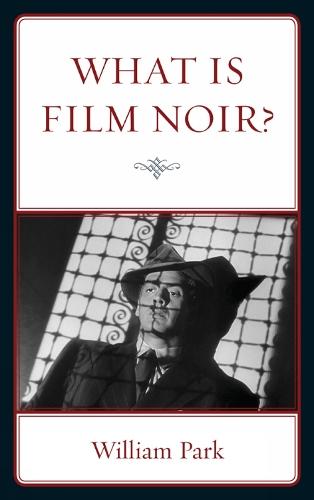
Everyone seems to know what film noir is, but scholars and critics cannot agree on any definition. Some go so far as to insist that there is no such thing. What is Film Noir? claims that this confusion arises from the fact that film noir is both a genre and a period style, and as such is unique in the history of Hollywood. The genre, now known as “neo-noir,” continues into the present, while the period, which began in the early 1940s, had expired by 1960. William Park surveys the various theories of film noir, defines the genre, and explains how film noir relates to the style and the period in which it was created. The book corrects several common misconceptions: that film noir was an afterthought, that Hollywood was not conscious of what it was creating, and that film noir is too amorphous to be a genre. Park also provides a very useful theory of genre and how it relates to film study.
Full Product Details
Author: William Park
Publisher: Associated University Presses
Imprint: Bucknell University Press,U.S.
Dimensions:
Width: 16.10cm
, Height: 2.10cm
, Length: 23.80cm
Weight: 0.508kg
ISBN: 9781611485219
ISBN 10: 1611485215
Pages: 213
Publication Date: 15 June 2013
Audience:
College/higher education
,
Professional and scholarly
,
Undergraduate
,
Postgraduate, Research & Scholarly
Format: Paperback
Publisher's Status: Active
Availability: In Print

This item will be ordered in for you from one of our suppliers. Upon receipt, we will promptly dispatch it out to you. For in store availability, please contact us.
Reviews
[Park] has opened the door to a new type of inquiry for [noir film]. Others who follow can walk through it to anchor a more historically coherent unified field theory of noir that will serve to place it in a truly comprehensive lens. Noir City What Is Film Noir is a highly recommended reading for fans of the genre who want to elucidate their doubts about the categories and context their favorite noir films belong to. Princeton Alumni Weekly Park (formerly, Sarah Lawrence College) begins his well-researched study of film noir by asking, Is it a genre, a style, or a period? He gives a learned, clearly written chapter to each of these alternatives, and he answers yes to all three: film noir is a genre and a style and a period (1940-60). Chapter 6 is dedicated to the films of Alfred Hitchcock, whose Vertigo Park considers the ultimate noir film. Some cinephiles may quarrel with that assessment. Throughout his lively, wide-ranging analyses, Park engages with important predecessors in noir criticism, notably, James Naremore's authoritative More than Night (CH, Apr'99, 36-4393; rev. ed., 2008). Park's book makes an interesting intervention in the noir debate...Five appendixes list important films in various noir subcategories. Summing Up: Recommended. All readers. CHOICE Park's book is not simply an introduction to noir. In many ways it is the definitive encyclopedia of the genre. Park clearly views film noir as an art and perhaps one of those easiest to identify, classify, and enjoy, because it deals with human frailty and normally-although not always-with redemption and some type of justice. CatholiCity
[Park] has opened the door to a new type of inquiry for [noir film]. Others who follow can walk through it to anchor a more historically coherent unified field theory of noir that will serve to place it in a truly comprehensive lens. Noir City What Is Film Noir is a highly recommended reading for fans of the genre who want to elucidate their doubts about the categories and context their favorite noir films belong to. Princeton Alumni Weekly Park (formerly, Sarah Lawrence College) begins his well-researched study of film noir by asking, Is it a genre, a style, or a period? He gives a learned, clearly written chapter to each of these alternatives, and he answers yes to all three: film noir is a genre and a style and a period (1940-60). Chapter 6 is dedicated to the films of Alfred Hitchcock, whose Vertigo Park considers the ultimate noir film. Some cinephiles may quarrel with that assessment. Throughout his lively, wide-ranging analyses, Park engages with important predecessors in noir criticism, notably, James Naremore's authoritative More than Night (CH, Apr'99, 36-4393; rev. ed., 2008). Park's book makes an interesting intervention in the noir debate...Five appendixes list important films in various noir subcategories. Summing Up: Recommended. All readers. CHOICE Park's book is not simply an introduction to noir. In many ways it is the definitive encyclopedia of the genre. Park clearly views film noir as an art and perhaps one of those easiest to identify, classify, and enjoy, because it deals with human frailty and normally-although not always-with redemption and some type of justice. Catholicity
[Park] has opened the door to a new type of inquiry for [noir film]. Others who follow can walk through it to anchor a more historically coherent unified field theory of noir that will serve to place it in a truly comprehensive lens. * Noir City * What Is Film Noir is a highly recommended reading for fans of the genre who want to elucidate their doubts about the categories and context their favorite noir films belong to. * Princeton Alumni Weekly * Park (formerly, Sarah Lawrence College) begins his well-researched study of film noir by asking, Is it a genre, a style, or a period? He gives a learned, clearly written chapter to each of these alternatives, and he answers yes to all three: film noir is a genre and a style and a period (1940-60). Chapter 6 is dedicated to the films of Alfred Hitchcock, whose Vertigo Park considers the ultimate noir film. Some cinephiles may quarrel with that assessment. Throughout his lively, wide-ranging analyses, Park engages with important predecessors in noir criticism, notably, James Naremore's authoritative More than Night (CH, Apr'99, 36-4393; rev. ed., 2008). Park's book makes an interesting intervention in the noir debate....Five appendixes list important films in various noir subcategories. Summing Up: Recommended. All readers. * CHOICE * Park's book is not simply an introduction to noir. In many ways it is the definitive encyclopedia of the genre. Park clearly views film noir as an art and perhaps one of those easiest to identify, classify, and enjoy, because it deals with human frailty and normally-although not always-with redemption and some type of justice. * CatholiCity *
Author Information
William Park has taught at Hamilton College, Columbia, and Sarah Lawrence, where he co-founded the film program. He is the coeditor of The College Anthology of English and American Poetry, the author of The Idea of Rococo, Hollywood: An Epic Production, and numerous articles on film.