Full Product Details
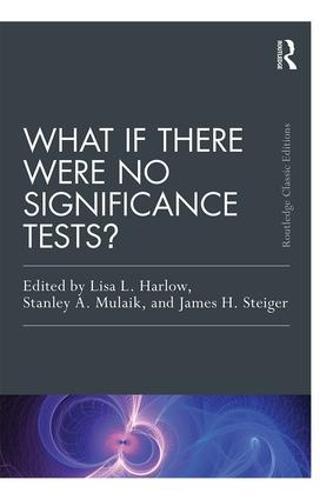
Author: Lisa L. Harlow (University of Rhode Island, USA) ,
Stanley A. Mulaik (Georgia Institute of Technology, USA) ,
James H. Steiger (Vanderbilt University, USA)
Publisher: Taylor & Francis Ltd
Imprint: Routledge
Edition: Classic ed
Dimensions:
Width: 15.20cm
, Height: 2.30cm
, Length: 22.90cm
Weight: 0.612kg
ISBN: 9781138892477
ISBN 10: 1138892475
Pages: 396
Publication Date: 14 March 2016
Audience:
College/higher education
,
Professional and scholarly
,
Undergraduate
,
Postgraduate, Research & Scholarly
Format: Paperback
Publisher's Status: Active
Availability: In Print

This item will be ordered in for you from one of our suppliers. Upon receipt, we will promptly dispatch it out to you. For in store availability, please contact us.
Reviews
"""What If There Were No Significance Tests was a book ahead of its time. ... It inspired me to start teaching statistics differently. … It continues to have an impact on me. I return to it every time debates erupt about significance testing, confidence intervals, or statistical inference generally. Nearly two decades after its publication, many of its ideas still are not only timely, but in some cases, unsurpassed. If there is any book in psychology’s methodological canon that deserves a classic republication, this is it."" – Michael Smithson, the Australian National University, Australia ""The contributors are a ""Who’s Who"" of specialists in a variety of statistical areas. The book provides a balanced account of one of the most controversial and important issues of data analysis in recent decades, and it has inspired countless important researches and articles on such topics as significance testing, estimation of effect sizes, and construction of confidence intervals. Instruction in statistics has, or should be, greatly influenced by this book."" – Robert Grissom, San Francisco State University, USA ""The book remains the sourcebook for issues related to Null Hypothesis Significance Testing and its alternatives. … This is the go-to book for information on significance testing and its ramifications. ... Strengths and limitations of significance testing are entertainingly described by leaders in methodology. The comments in the book are as relevant today as ever."" – David P. Mackinnon, Arizona State University, USA"
What If There Were No Significance Tests was a book ahead of its time. ... It inspired me to start teaching statistics differently. ... It continues to have an impact on me. I return to it every time debates erupt about significance testing, confidence intervals, or statistical inference generally. Nearly two decades after its publication, many of its ideas still are not only timely, but in some cases, unsurpassed. If there is any book in psychology's methodological canon that deserves a classic republication, this is it. - Michael Smithson, the Australian National University, Australia The contributors are a Who's Who of specialists in a variety of statistical areas. The book provides a balanced account of one of the most controversial and important issues of data analysis in recent decades, and it has inspired countless important researches and articles on such topics as significance testing, estimation of effect sizes, and construction of confidence intervals. Instruction in statistics has, or should be, greatly influenced by this book. - Robert Grissom, San Francisco State University, USA The book remains the sourcebook for issues related to Null Hypothesis Significance Testing and its alternatives. ... This is the go-to book for information on significance testing and its ramifications. ... Strengths and limitations of significance testing are entertainingly described by leaders in methodology. The comments in the book are as relevant today as ever. - David P. Mackinnon, Arizona State University, USA
What If There Were No Significance Tests was a book ahead of its time. ... It inspired me to start teaching statistics differently. It continues to have an impact on me. I return to it every time debates erupt about significance testing, confidence intervals, or statistical inference generally. Nearly two decades after its publication, many of its ideas still are not only timely, but in some cases, unsurpassed. If there is any book in psychology s methodological canon that deserves a classic republication, this is it. Michael Smithson, the Australian National University, Australia The contributors are a Who s Who of specialists in a variety of statistical areas. The book provides a balanced account of one of the most controversial and important issues of data analysis in recent decades, and it has inspired countless important researches and articles on such topics as significance testing, estimation of effect sizes, and construction of confidence intervals. Instruction in statistics has, or should be, greatly influenced by this book. Robert Grissom, San Francisco State University, USA The book remains the sourcebook for issues related to Null Hypothesis Significance Testing and its alternatives. This is the go-to book for information on significance testing and its ramifications. ... Strengths and limitations of significance testing are entertainingly described by leaders in methodology. The comments in the book are as relevant today as ever. David P. Mackinnon, Arizona State University, USA
Author Information
Lisa L. Harlow is Professor of Psychology at the University of Rhode Island. She is the Editor of Psychological Methods and a past president of the American Psychological Association‘s Division 5. Stanley A. Mulaik is Professor Emeritus of Psychology at Georgia Institute of Technology. His research interests include philosophy of statistics and causality and objectivity. James H. Steiger is Professor of Psychology and Human Development at Vanderbilt University. His research interests include the use of confidence intervals to evaluate the fit of statistical models.