Awards
- Commended for Axiom Business Book Awards (Corporate History) 2014
Overview
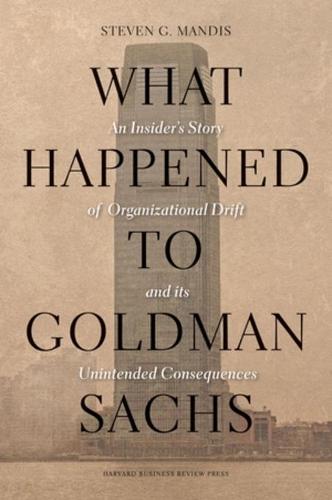
A banker, investor, and Columbia Business School professor offers an insider's take on what happened to Goldman Sachs-informed by his own experience, interviews with others who worked at or with the firm, and previously unreleased research. Readers and business leaders will also learn about what Steven G. Mandiscalls ""organizational drift""-and how to avoid it in their own firms.
Full Product Details
Author: Steven G. Mandis
Publisher: Harvard Business Review Press
Imprint: Harvard Business Review Press
Dimensions:
Width: 15.50cm
, Height: 3.60cm
, Length: 23.40cm
Weight: 0.637kg
ISBN: 9781422194195
ISBN 10: 1422194191
Pages: 400
Publication Date: 01 October 2013
Audience:
General/trade
,
General
Format: Hardback
Publisher's Status: Active
Availability: Temporarily unavailable

The supplier advises that this item is temporarily unavailable. It will be ordered for you and placed on backorder. Once it does come back in stock, we will ship it out to you.
Reviews
Forget Greg Smith and those muppets. What Happened to Goldman Sachs by Steven Mandis is the book to read. -- [as tweeted by] Andrew Palmer, Finance Editor at The Economist an accessible, clearly written book. Those interested in all things Goldman will find it useful for its appendixes, which include a timeline of the bank's history and biographical sketches of its top leaders -- The New York Times .. .a remarkable new book... -- The Economist In this riveting debut, Columbia Business School professor and former Goldman Sachs executive Mandis examines the factors that tarnished the firm's reputation in recent years. .. .a must-read for anyone interested in the world of business and finance, history, or organizational dynamics. -- Publisher's Weekly .. . entertaining and informative... a welcome addition to the literature on the rise and fall of corporations. -- Seeking Alpha (seekingalpha.com) .. . a profound tale. -- The Financial Times Several authors have tackled the question of how Goldman's culture changed post-1999 but none so deftly as Steven G. Mandis... -- The Wall Street Journal Mandis's book describes changes at the bank and across the industry that have contributed to the unflattering portrait of Wall Street that has taken hold since the financial crisis. -- Politico (politico.com) .. . a more somber, studied look at the bank's culture.... His book, [ What Happened to Goldman Sachs ] has the added gravitas of being the basis for Mandis's PhD dissertation on his former employer at Columbia University. -- Bloomberg Businessweek .. . 'organizational drift' can erode the core values that make any company successful. Steven G. Mandis, a former Goldman Sachs investment banker, explains how that happened to the Wall Street firm and offers prescriptions for combating the problem in this insightful volume. -- Fort-Worth Star Telegram If you've lost patience (or in
ADVANCE PRAISE for What Happened to Goldman Sachs <br>Bethany McLean, coauthor, The Smartest Guys in the Room: The Amazing Rise and Scandalous Fall of Enron and All the Devils Are Here: The Hidden History of the Financial Crisis ; contributing editor, Vanity Fair --<br> Steven Mandis's exploration of how the culture at Goldman Sachs changed should be required reading for anyone who is interested in how organizations evolve and in the culture of Wall Street more generally. Mandis resists judging the firm, but rather explains, thoughtfully and clearly. <br>Donald MacKenzie, professor of sociology, University of Edinburgh; author, An Engine, Not a Camera: How Financial Models Shape Markets --<br> The financial crisis has shown us how little we understand about banks as organizations and about their internal cultures. Mandis's pioneering study is thus essential reading for anyone concerned about the future of the financial system. <br>Gerald Davis, Wilbur K. Pierpont Collegiate Professor of Management, Ross School of Business, University of Michigan--<br> What Happened to Goldman Sachs explains the organizational processes that led Goldman to drift from its vaunted 'clients come first' culture as it grew from a modest-sized partnership to a vast public corporation. Steven Mandis combines an insider's experience with the tools of sociology to show how pressures for growth resulted in the Goldman Sachs that we know today. <br>Anat Admati, George G.C. Parker Professor of Finance and Economics, Stanford Graduate School of Business; coauthor, The Bankers' New Clothes: What's Wrong with Banking and What to Do about It --<br> Steven Mandis, in his thought-provoking book, shows how even a disciplined partnership aiming to put its clients' needs first can, bit by bit, become a large, complex corporation mired in conflicts big and small. Mandis's nuanced and convincing analysis reveals the key forces that we all need to worry about when it comes to banki
Author Information
Steven G. Mandis worked at Goldman Sachs from 1992 to 2004 in its investment banking, private equity, and proprietary trading areas. He assisted Hank Paulson and other senior executives on special projects and eventually became a portfolio manager in one of the largest and most successful proprietary trading areas at Goldman Sachs. Post-Goldman, he cofounded a multibillion-dollar global alternative asset management firm that was a trading and investment banking client of Goldman Sachs. During the financial crisis, Mandis was a senior adviser to McKinsey & Company before accepting a senior executive position at Citigroup. Currently, he is an adjunct professor at Columbia Business School and a PhD candidate in the sociology department at Columbia University. He holds an AB from the University of Chicago and an MA and MPhil from Columbia University.